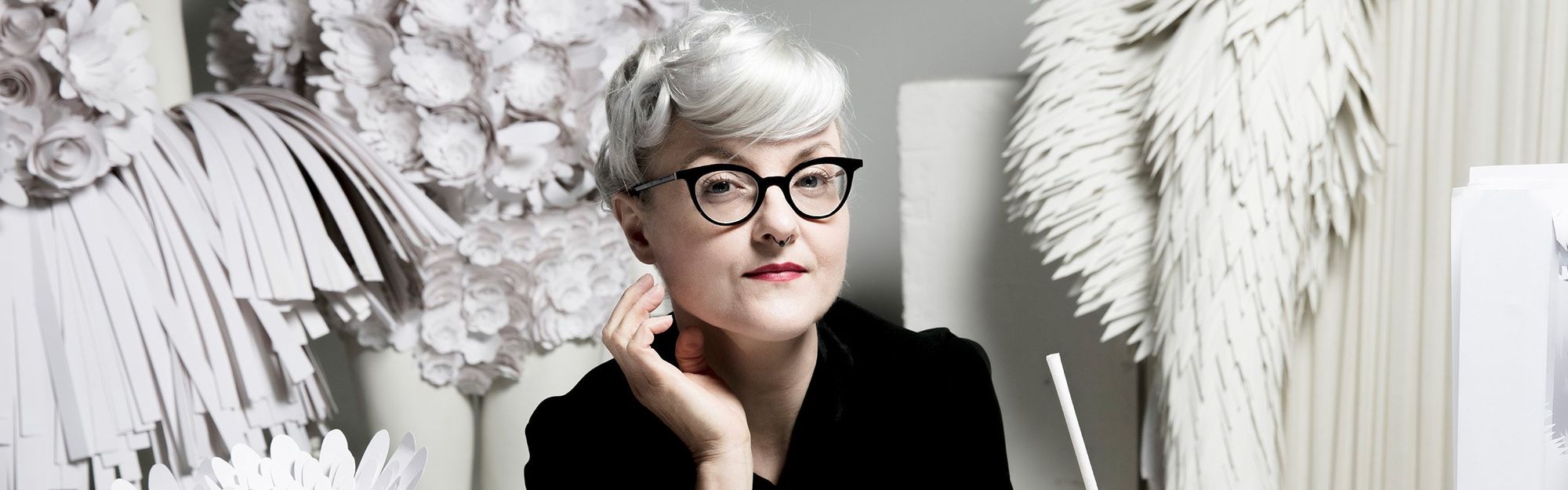
Art, paper, scissors
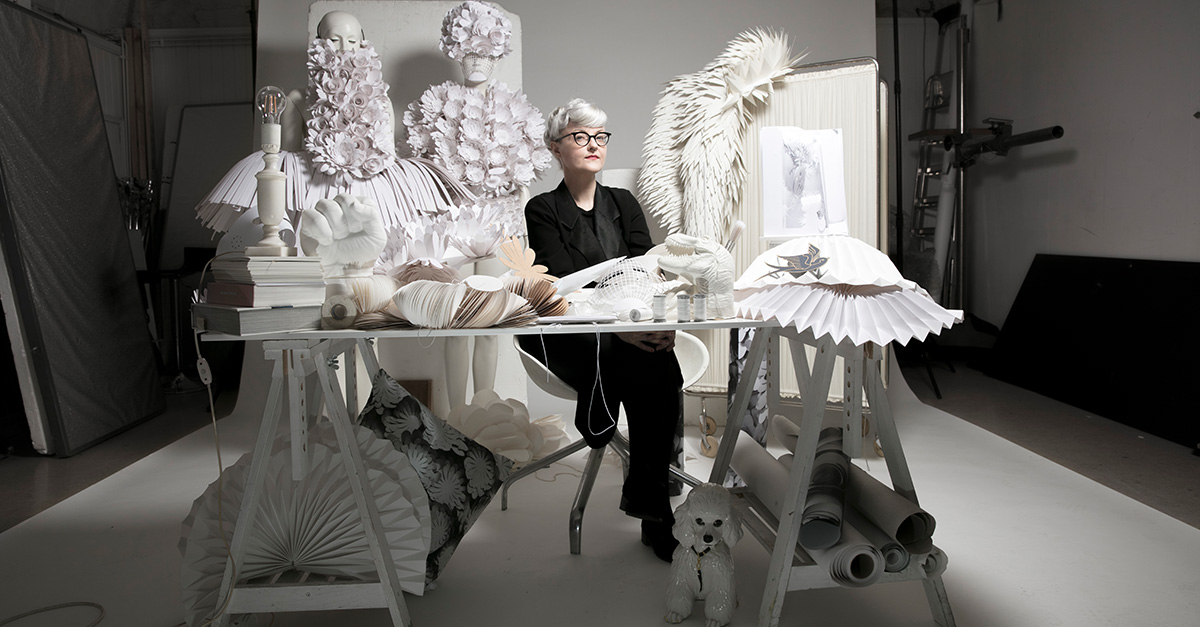
Bea Szenfeld, has always felt an urge to express herself through different types of mediums and materials. She is a trained potter, cutter and fashion designer and has done her trainee at Stella McCartney’s. But she felt out of place working with fashion, and experienced that she came too far away from what she actually loved.
– After my training and education in fashion and design, I started my own brand of clothes, says Bea Szenfeld. But I noticed after some time that the majority of my time was spent on dealing and trading with textiles, or with marketing – and that was not my forte. I love design, and I love the human body. So I started doing some small projects on the side, where I had a more artistic approach to the human form and figure. That is when I began to do clothes in other material than fabric. And I noticed that when I did a dress out of salad or pasta, the focus shifted from “can I get this in another size?” to “oh, this is design – a new way of dressing the body and contouring silhouettes!”.
During this period, Szenfeld describes, she did many trials and errors with different materials, but quite soon discovered the simplicity with paper.
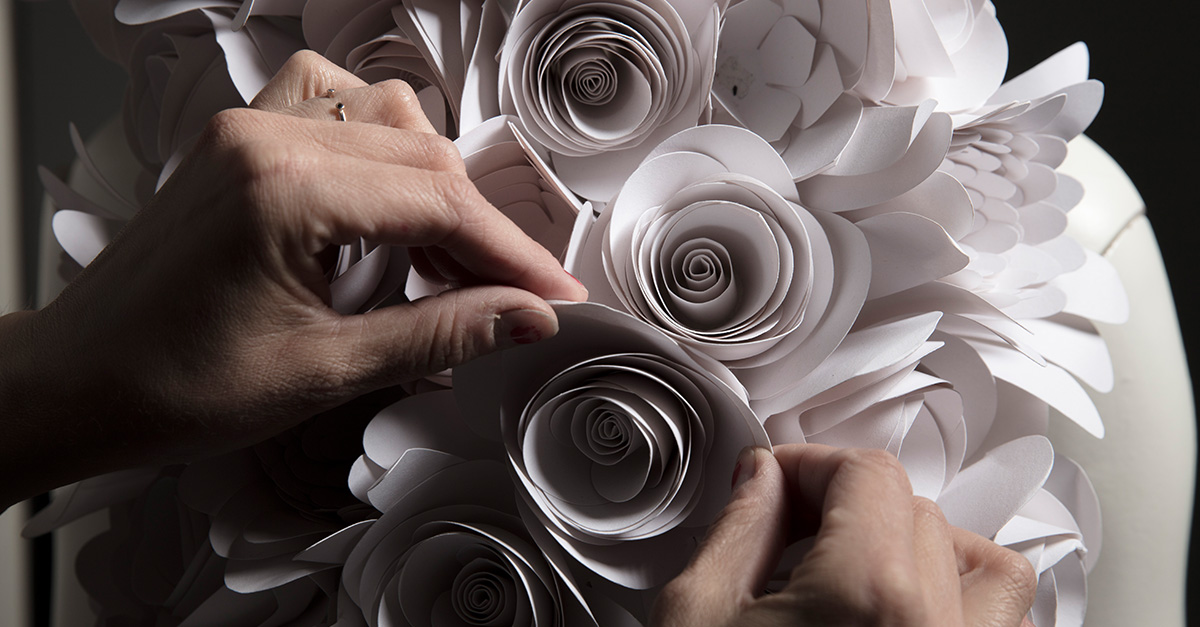
– I did some tests in paper, and thought “this is too good to be true!”, Bea Szenfeld laughs. It was incredibly simple, and paper is such a beautiful material. It's such an easy job, once you play in its league. Once you have learned paper, it is truly so gratifying!


Heavy light-weight
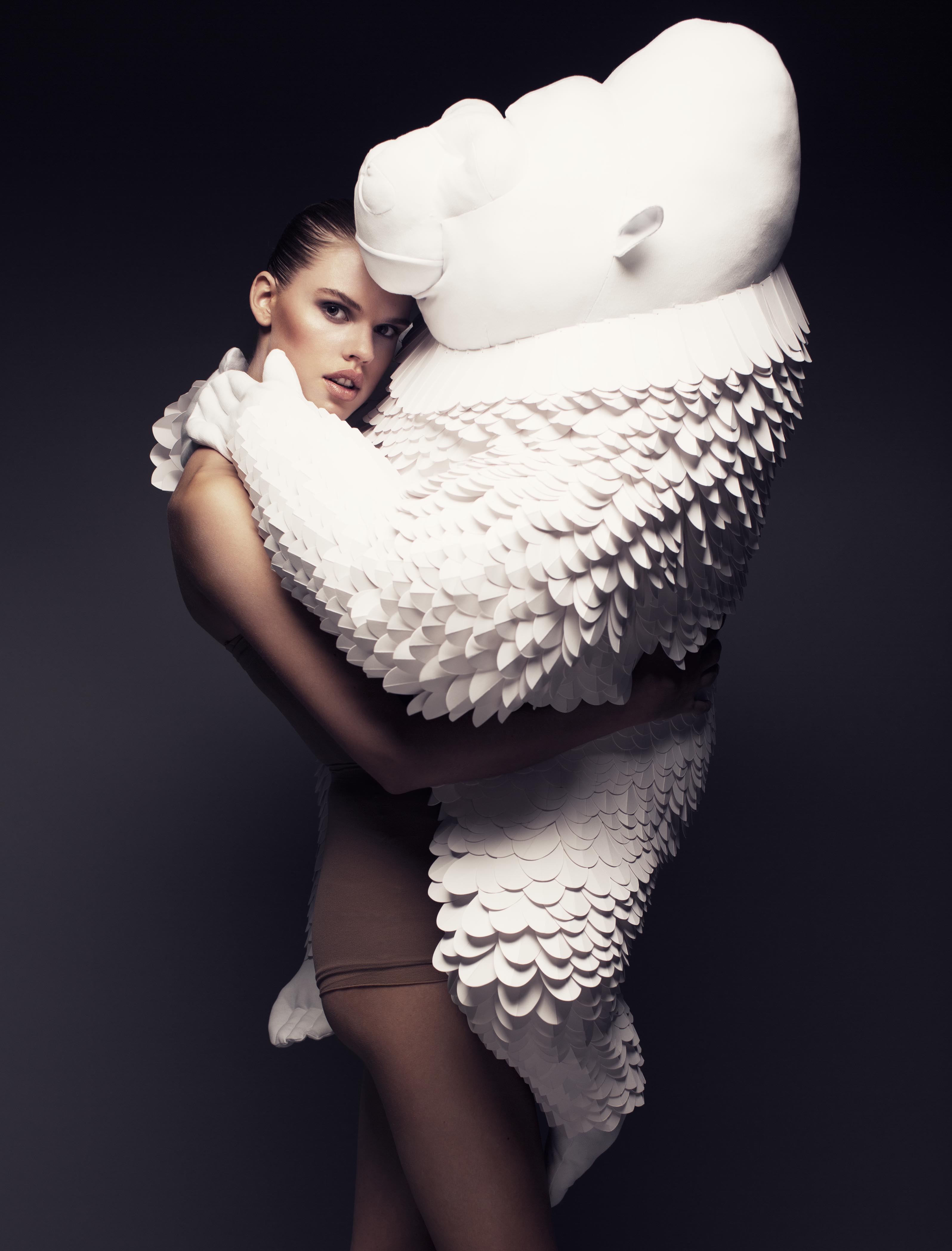
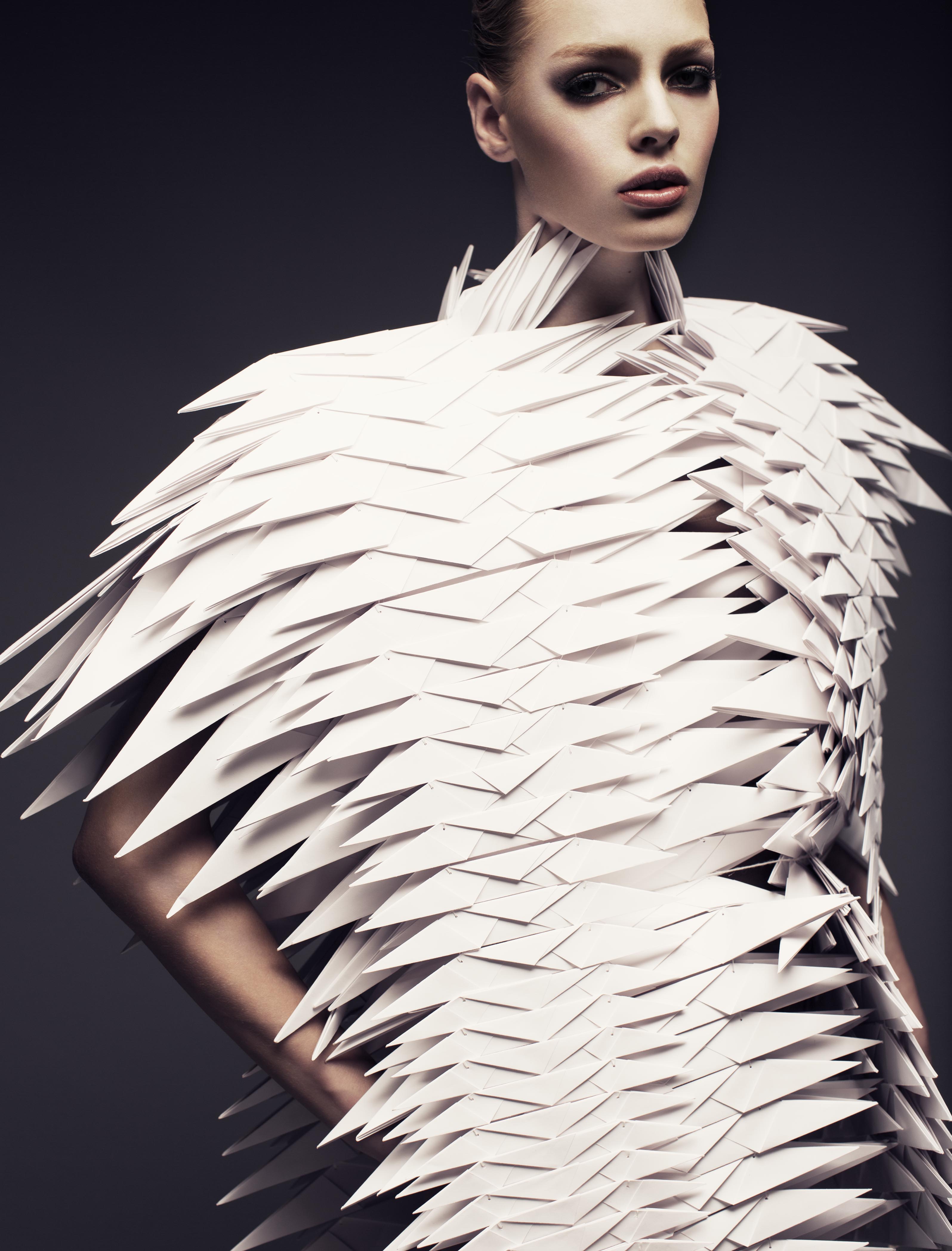
Even though Szenfeld has found her core material, it is still an explorational journey for her creations. Most often, it is the practical conditions that limits the creative possibilities in her work. Despite the light weight material, Szenfeld’s creation are surprisingly heavy, and sometimes hard to transport. Therefore, the garment is shipped in disassembled pieces – and then reassembled on a model when in use.
– The garments I make can often break in shipping or handling, and many of my pieces weigh over 20 kg, Szenfeld explains. So I have found a way to store and transport these creations in small pieces, where I instead dress on every single garment. I build these sculptures and assemble them one by one. Paper can withstand quite a lot, but not too much. Therefore, you need to trick the eye, and also the paper, a little. If I cut a little cardboard and a little tissue paper in between, I can trick the eye into thinking "this feels fragile", but still it is a support in the form of the solid cardboard.
Szenfeld has, with her experimental creations and unusual concepts, proven that sometimes you don’t need to label what you do. You just need to do. Her pieces really leaves no one unimpressed, and that is the intention. A common denominator in her work is emotions – and humor.
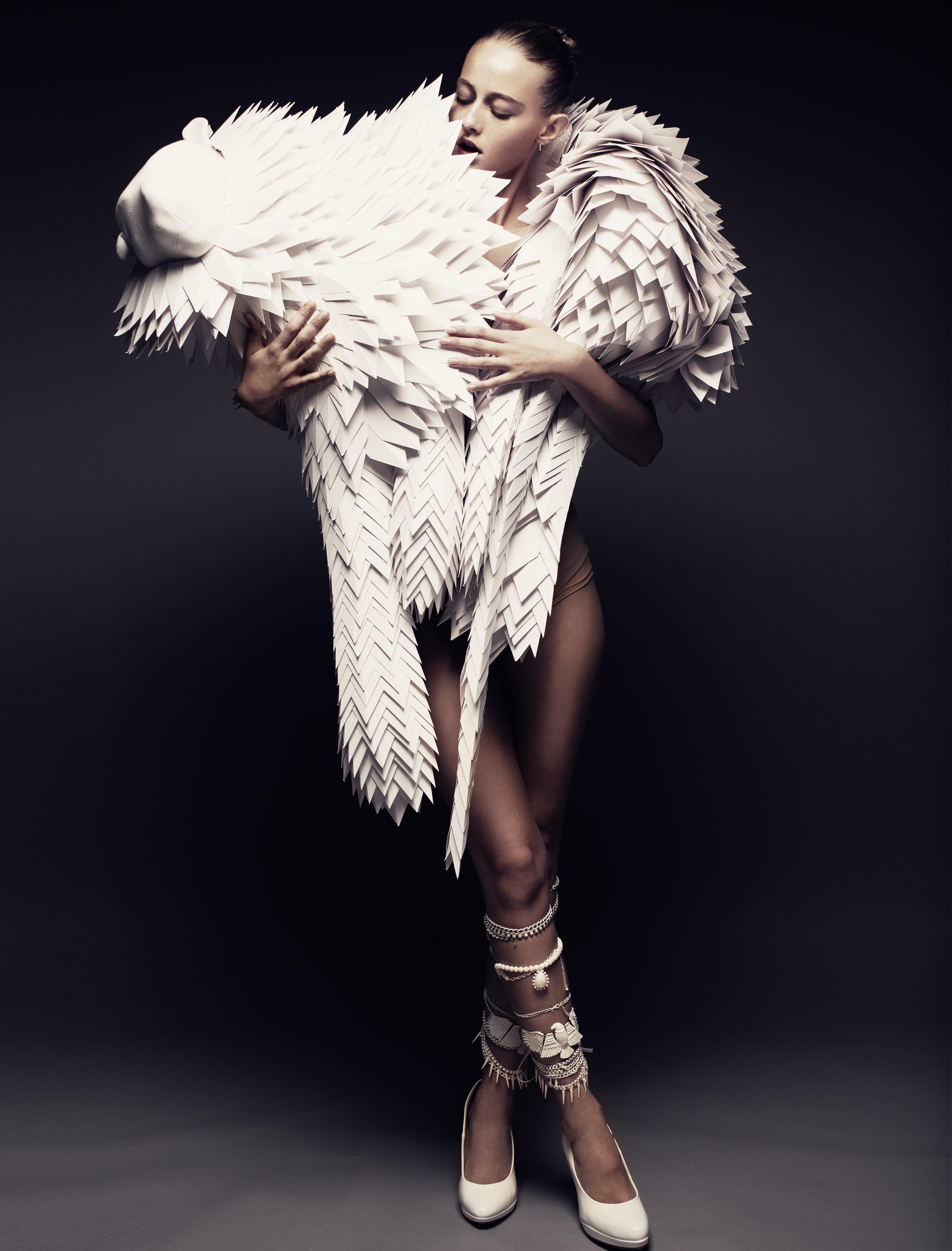
– Yes, humor is very important! Szenfeld laughs. I really try to be serious, but despite that, when I had my fashion show in 2015, people laughed when my models came out. Because "here comes the model carrying a 200-kilo gorilla like a handbag". I believe that fashion needs to be paused a bit, because it gets ridiculous when it gets too cool.
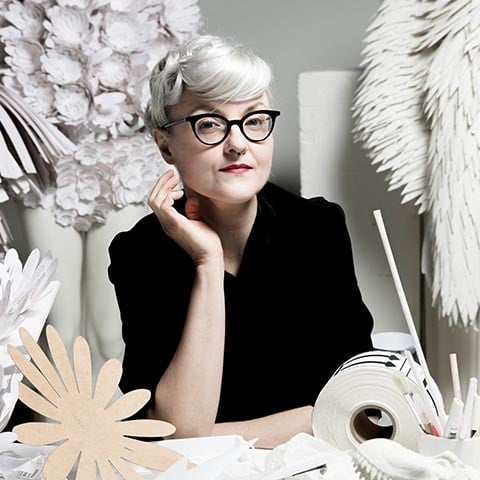 "I believe my strength has been that I have never been still. I am constantly testing my way forward." Bea Szenfeld, artist & designer
Sustainable fashion
As recent times have shown, we need to rethink and challenge given frameworks to find a more durable way forward. Even though the art pieces requires a lot of material, the resources used are environmentally friendly, and most definitely circular.
– I work with plain paper, no special treatments on it or anything, Szenfeld explains. Plain paper, directly from the paper mill here in Sweden. The great thing about paper is that we have been producing and recycling paper for so, so many years. It is one of the oldest materials we reuse, which means that it is not rocket science - we know this, we know how to manage this resource.
All surplus and waste pieces from the art objects can be put straight in the paper recycling. Since no materials are mixed, everything can be pulled apart and recycled or reused. When the lifespan of a garment is finished, the threads are removed and the glass/plastic beads are reused. The paper is just put in the recycling bin. It really is circular art. And for the garments that still lives on, depending on the storage and treatment it can really be long lasting.
– My paper sculptures can be stored and kept for as long as you like, it all depends on how you handle them, Szenfeld explains. They cannot be exhibited in direct sunlight or in a humid room, but if they are handled by me or museum staff, they last for decades.
Different target groups
Apart from exhibiting her art at museums and in fashion magazines, Szenfeld is also a recurrent feature in one of Swedish Televisions most watched TV-magazines, Go’kväll (Good Evening). There she has a standing mission on a reoccurring basis, a DIY-project that is either recycled or upcycled.
– I love those projects, Szenfeld smiles. I have about 7 minutes to show a DIY-craft that people can do themselves at home. In those projects, I find that lamps and luminaires are among the best things to use. You can do simple things and it is always needed at home. And especially now with LED lighting, when the light source does not get hot, the possibilities are so much more and vivid! It really enables you to work with more recycled materials than previously.
Yet another aspect regarding the material is that people from so many different target groups can relate to it. Everyone from pre-schoolers, craftsmen, designers or engineers – they all enjoy the magic and illusions created with regular paper.
– That is truly one of the things I love about my paper clothes, that I can float out without a straight horizon, Bea Szenfeld says. If you like art, you may like my stuff. If you like fashion, you can like my stuff. When I exhibit in cities with paper or forest industry, there are usually visitors who work with paper - who have never seen it used like this. They might work with cardboard and large sheets, and so all of a sudden they see how their material can become something completely different. And those who love crafts, the same thing. You can do so much with paper, scissors, a ruler and some time - it's completely crazy! It's really lovely to find entrances to so many different audiences.
Tabula rasa
So, how does the future looks like for art in general, and more sustainable art in particular? Is there a visible trend for designers and artists to work more circular?
– Yes absolutely! Szenfeld states. I am part of the jury in Ung Svensk Form (Young Swedish Form) and at least half of all projects that contribute are about recycling and reusing. Either they reuse materials or create designs that are easy to reuse.
Not only is sustainability a high awareness among the upcoming artists and designers, so is also the love for crafts and handmade work.
– I love that, but we craftsmen must never relax and think that “this is good, now crafts are in", Szenfeld says with emphasis. We must always fight for recognition, and the time we spend. What we do is not a quick fix, a craft takes time to learn. That's something we need to explain to the new generation, that you have to take time with things. Now we have a world that spins so incredibly fast. From one day as unknown, to another day as world-famous on TikTok. That was not the case before, then you had the chance to grow up a little cautiously. Crafts are really slow techniques, and that is the way it must be.

Fact on Bea Szenfeld:
- She is trained potter and cutter, as well as graduated from Beckmans School of Design.
- After participating in Project Runway, she earned her internship at Stella McCartney.
- Has dressed celebrities such as Lady Gaga, Björk and Loreen.
- Designed the Swedish minister of Culture Alice Bah-Kunkhe’s dress for the Noble Dinner.
- Has explored other materials as well, and made a dress out of pasta for Barilla and clothes entirely of PVC.
Gerelateerd nieuws

Als materiaal ertoe doet – Wrapped komt met een nieuwe kijk op duurzame verlichting
In een wereld waar elke gram materiaal en elke gram koolstofdioxide telt, duikt Wrapped op niet als een gewoon armatuur – maar als een statement. Het is Fagerhult's meest duurzame pendelarmatuur tot nu toe, en dat is niet per ongeluk zo gekomen. Elk detail, elke beslissing, elk materiaal werd gekozen met een duidelijk plan. Duurzaamheid begint vaak met een eenvoudige vraag: Waar is het van gemaakt? Voor Wrapped is het antwoord een trio materialen die elk hun eigen milieuverhaal met zich meedragen. Massief karton: een vertrouwde vriend Bij Fagerhult vond het eerste gebruik van massief karton in 2021 plaats met Multilume Re:Think. Maar voor Wrapped zijn we nog een stapje verder gegaan. Het materiaal bestaat uit een drielaagse constructie met een 100% gerecyclede kern, een hernieuwbare FSC-gecertificeerde toplaag en een dunne beschermende plastic folie. Een materiaal dat dus al voor 65% gerecycled is – en een 89% lagere CO₂-uitstoot heeft dan nieuw geëxtrudeerd aluminium. Fotogalerij: Massief karton Wrapped is gemaakt van biologisch massief karton, gerecycled aluminium en post-consumer gerecycled plastic. Plastic opnieuw vormgeven Plastic wordt vaak genoemd in gesprekken over duurzaamheid. Maar niet alle plastic wordt op dezelfde manier gemaakt. Wrapped gebruikt gerecycled consumentenplastic: het soort plastic dat al eerder een leven heeft geleid, misschien als shampoofles of voedselcontainer. Pre-consumer plastic daarentegen is anders, omdat het nooit eerder in de schappen heeft gestaan. Citaat: Josefin Carlsson Aluminium met een verleden Aan de binnenkant van Wrapped zitten twee structurele onderdelen die zijn gemaakt van 100% post-consumer gerecycled aluminium. Ook dit materiaal maakt deel uit van een circulaire infrastructuur – en heeft misschien ooit wel deel uitgemaakt van een Notor armatuur. In vergelijking met nieuw aluminium vermindert deze keuze de uitstoot met 83%. Ontworpen met minder - gemaakt om lang mee te gaan Duurzaamheid gaat echter niet alleen over wat je gebruikt - maar ook over hoeveel. Met slechts 900 mm is Wrapped korter dan een conventioneel pendelarmatuur van 1200 mm. Alleen al die vermindering van de afmetingen verlaagt de impact op het klimaat met 25%, zonder afbreuk te doen aan de verlichtingsprestaties van het armatuur. Josefin Carlsson vergelijkt de klimaatimpact van producten in het Fagerhult Experience Centre in Habo. Om de impact van Wrapped te begrijpen, helpt het om te kijken waar we vandaan komen. In 2021 had Notor 65, gemaakt van nieuw aluminium, een klimaatimpact van 34 kg CO₂e. In 2024, met 75% gerecycled aluminium, was dat getal teruggebracht tot 25 kg CO₂e. En Wrapped komt nu uit op slechts ongeveer 12 kg CO₂e. "Dat is een derde van de oorspronkelijke Notor 65 en de helft van de huidige uitvoering, en een stille revolutie, gemeten in kilogrammen CO₂e," zegt Josefin Carlsson. Na een lange levensduur; die wordt geschat op 100.000 uur, is Wrapped klaar voor een al even duurzame exit. Door het ontwerp is het eenvoudig te demonteren, waarbij elk materiaal recyclebaar is en klaar voor een volgend hoofdstuk in de circulaire economie.
De cirkel sluiten – en de levenscyclus van armaturen verlengen
Het concept van het opnieuw gebruiken van oude armaturen om materiaal en energie te besparen wordt steeds populairder. Om weer opnieuw te kunnen stralen heeft een verouderd armatuur soms alleen maar wat liefdevolle verzorging en technische vaardigheden nodig. We ontmoetten Emma Hallman, Mathilda Holl en Andreas Ekslätt, het team achter ReLight bij Fagerhult, om te praten over de uitdagingen die gepaard gaan bij het vinden van oplossingen om oude armaturen naar de toekomst te voeren. Bij Fagerhult beïnvloedt een diepgewortelde innovatiecultuur alle aspecten van het werk. Dit komt mogelijk voort uit de mentaliteit van oprichter Bertil Svensson om problemen op te lossen met soms kleine middelen - en nieuwsgierigheid en toewijding. In tegenstelling tot nu was duurzaamheid toen echt geen modewoord. Het bewust gebruiken van onze middelen en het streven naar een hoge kwaliteit zijn echter altijd hoekstenen geweest voor Fagerhult. Vandaag de dag heeft een nieuwe focus op circulariteit ons aangespoord om ons denken uit te dagen en ons bewust gemaakt van het vinden van duurzame oplossingen. De afdeling Bespoke Lighting Solutions (BLS) van Fagerhult ontwikkelt al vele jaren unieke armaturen en aangepaste oplossingen. Dus het opknappen en bijwerken van oude armaturen is niet onbekend voor ons. Maar de ambitie om oude armaturen opnieuw te gebruiken en te herbouwen om de klimaatimpact te verminderen is in de loop der tijd wel toegenomen. In dit proces worden het ontwerp en de technologie van gisteren bijgewerkt tot de vooruitgang van vandaag om te voldoen aan de eisen van morgen. Citaat ReLight uw oude armaturen Voor het ReLight-team van Fagerhult bestaan er geen ongebruikelijke vragen of onmogelijke oplossingen. Dagelijks behandelen ze vragen uit de markten van Fagerhult over speciaal ontwikkelde verlichtingsoplossingen voor projecten. Het is een complex proces, maar gedurende die tijd hebben ze geleerd dat sommige projecten ideaal zijn voor het hergebruik van oude armaturen in plaats van te investeren in nieuwe. “Voor ons vormen de kwaliteit van het armatuur op het gebied van verlichtingscomfort, veiligheid en esthetiek de kern van elk ReLight-project. We berekenen ook grondig of - en hoeveel - we de totale klimaatimpact van het armatuur gedurende de levenscyclus kunnen verminderen. Als aan al deze eisen is voldaan, beginnen we met het ontwikkelen en ontwerpen van een nieuwe kit”, zegt Emma Hallman. Binnen ReLight hebben we de uitgesproken wilskracht om materialen en energie te besparen en een milieu-inspanning te leveren door de armaturen te moderniseren. Niet alle oude armaturen gaan echter eeuwig mee; sommige zijn verouderd en dan is het beter om te recyclen dan te refurbishen. Img “Voor ons vormen de kwaliteiten van de armatuur op het gebied van lichtcomfort, veiligheid en esthetiek de kern van elk ReLight-project. Op verzoek berekenen we ook of – en hoeveel – we de totale klimaatimpact van de armatuur gedurende de hele levenscyclus kunnen verminderen”, zegt Emma Hallman. Bij Fagerhult zijn veiligheid en kwaliteit de rode draad die alle producten combineren. En ReLight is daarop geen uitzondering. Gedurende het proces zijn CE-markering en testen cruciale factoren. "Om de algehele kwaliteit te garanderen, wordt de vernieuwde armatuur vóór levering volledig CE-gemarkeerd. We willen ook de installatie ter plaatse zowel soepel als snel laten verlopen, en de nieuwe kit benadert een complete armatuur zo dicht mogelijk”, zegt Andreas Ekslätt.