“It’s all go now. After years of discussions, preparations and product development, LED technology is commercially ready. Customers are more informed and discerning with both the efficiency and, increasingly, the light quality they expect from their LED investment,” says Leif Norrby, Product Development Director at Fagerhult.
During the 00s, the lighting industry switched arena from being a standard manufacturing focusing on conventional light sources to part of the electronics industry. Years of standard practice was rapidly transformed, Fagerhult for instance, started producing luminaires for fluorescent tubes in the 1950’s, as the migration from T5 to LED took place in little over a decade.
“We were offered a unique opportunity to use the new, more efficient T5 fluorescent tube which was also smaller. With our innovation-driven corporate culture – Fagerhult has always been open to new technology and materials – it was a challenge not to be missed,” Leif Norrby remembers.
The transition to T5 involved a number of technical lighting considerations.
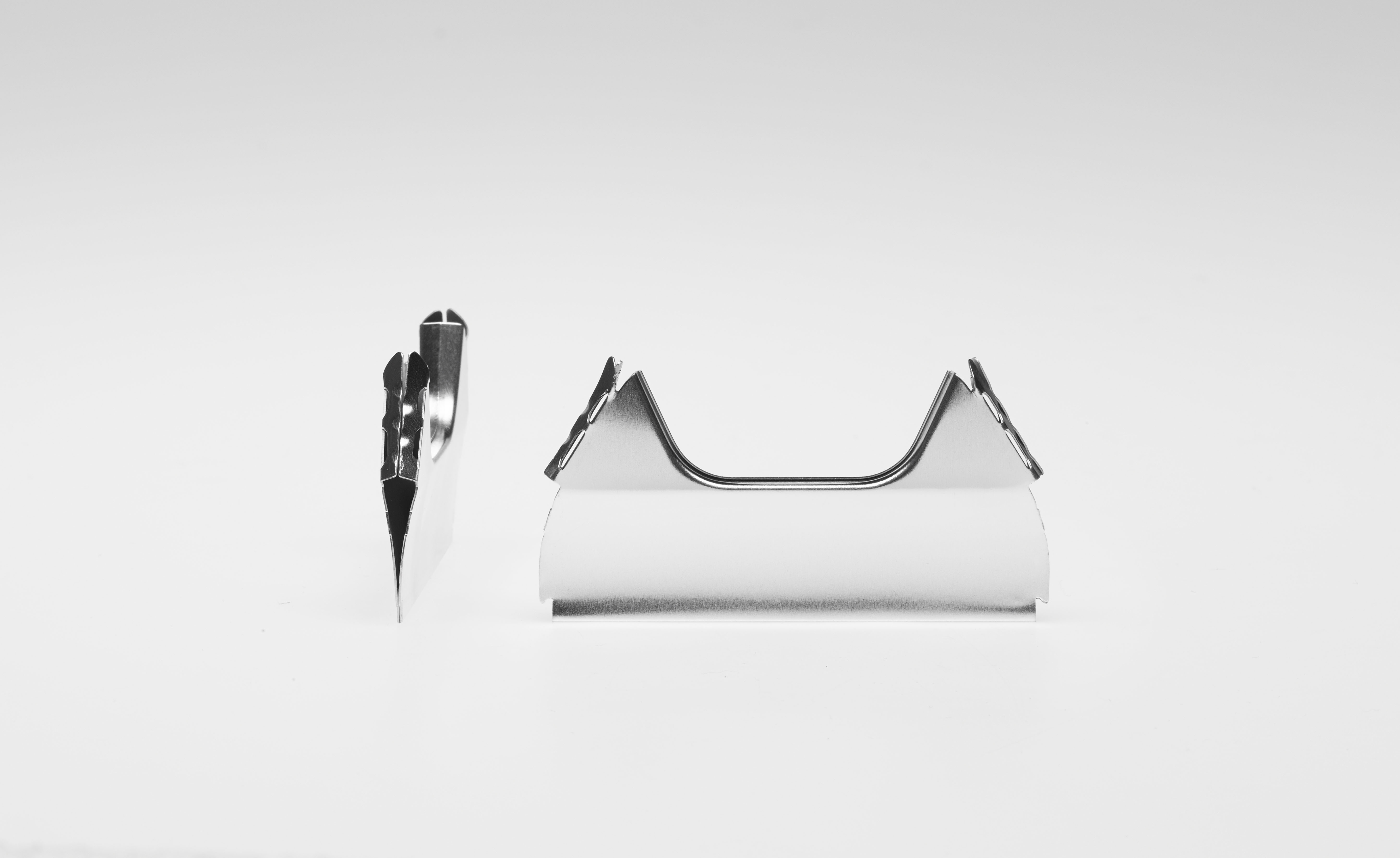
“The louvre was the main focus. The existing reflector technology, based on double-parabolic louvres made of anodised aluminium, couldn’t benefit from the increased efficiency of T5. That’s why we chose to develop a completely new louvre based on the new light source.”
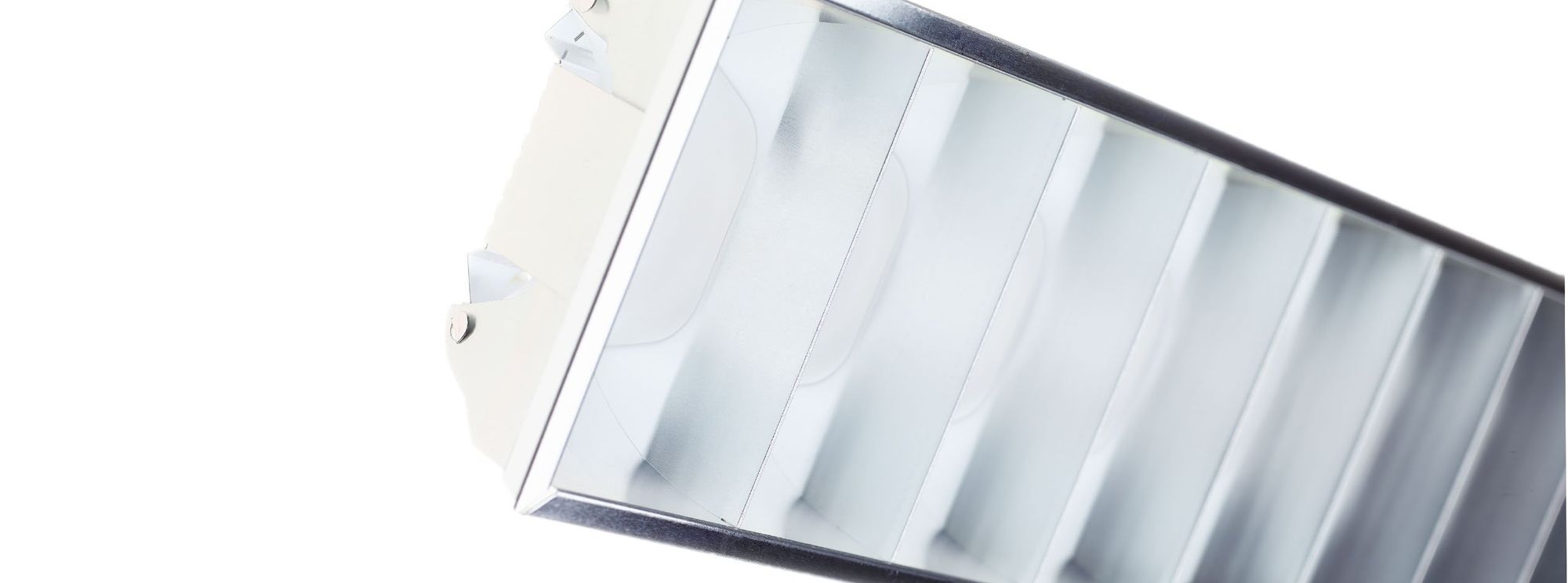
Fagerhult Beta LED lamellasThe innovative r5 louvre built on a new combination of a side and top reflector in addition to a cross reflector, the latter was the fulcrum for increased control of the light distribution. Using new manufacturing technology and a new metallised aluminium material called Miro, we succeeded in creating an efficient louvre that reinforced the all the benefits of the T5 light source. By using Miro, the reflection factor increased from 86% to 95%.
“Another crucial point was the temperature inside the luminaire. T5 performed best at 35°C, compared to T8 which performed best at 25°C. By building louvres and luminaires with inside temperatures adapted for T5, we increased the efficiency even further.
r5 was also developed to satisfy the more stringent cut-off requirements.
“We realised that a smaller, more intensive light source also involves a greater risk of glare. Visual comfort had long been part of Fagerhult’s signature and was not something on which we were willing to compromise.”
r5 was launched in 1998. The combination of T5 and electronic ballasts became a new standard in the market, but as early as in 2010 it was time for a new generation. When LED was first introduced as a light source it was primarily used in downlights. Fagerhult launched its first luminaires for general and work lighting in 2013.
“The r5 project taught us a lot. Just like T5 in its time, LED posed a real challenge. Both cases involved new, relatively unexplored light sources that were very light-intensive compared with the incumbent variety. We knew how difficult it was to take a new light source and dress it in an old suit. If existing louvres and reflectors do not have the capacity to control and manage the power of the light sources – which they didn't in either of these cases – you risk both the efficiency and, above all, the lighting comfort. The high intensity of LED brought matters to a head. This small, intensive light point risked dazzling people in a completely different way to the long, narrow fluorescent tube.”
 "Visual comfort had long been part of Fagerhult’s signature and was not something on which we were willing to compromise." Leif Norrby, Product Development Director at Fagerhult
There were a number of reasons to be wary. The early LED modules varied a lot in quality – from service life and deterioration to colour reproduction and colour temperature. The LED modules requirement for an efficient cooling mechanism also necessitated luminaires designed solely for use with LEDs. Otherwise you risk letting the fire go up the chimney with LED modules that will break in the future.
When Fagerhult rolled out the first big LED series, the focus was on luminaires developed from scratch. Just like other manufacturers, Fagerhult chose to work with microprismatic louvres to satisfy the requirements for energy efficiency and lighting comfort.
“Our aim has always been to create a double-parabolic louvre that can also improve performance and user experience. This is why we developed a new r5 generation customised for LED. Beta Opti makes use of the benefits of Medium Power LED and gives us completely new options for efficient and ergonomic control of general and work lighting.”
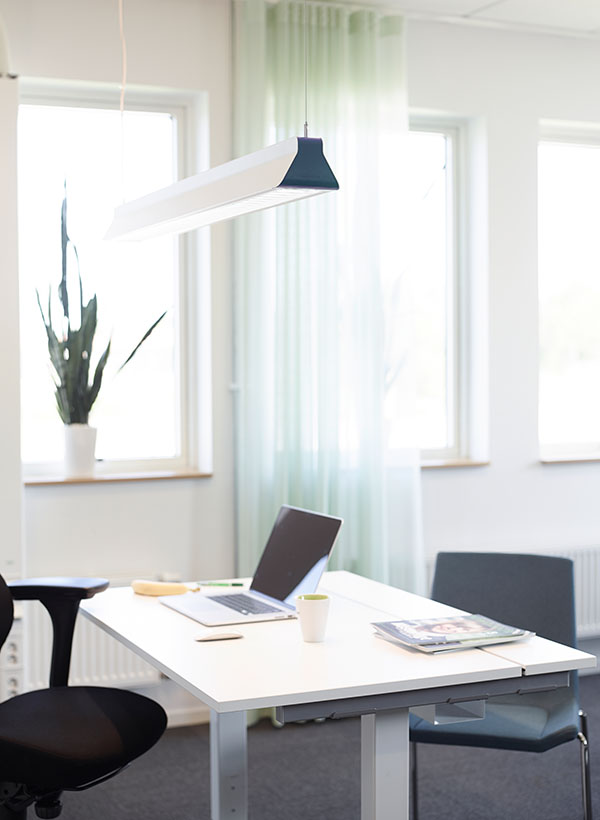
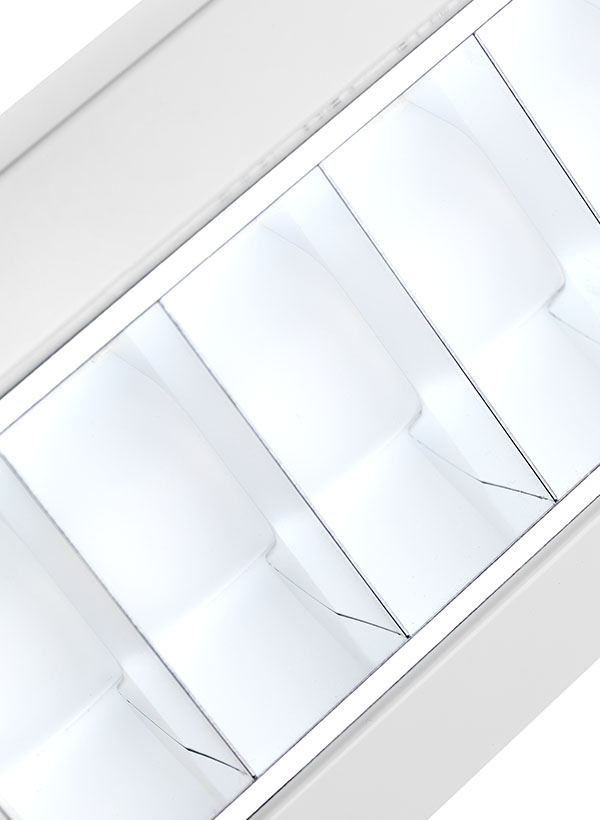
Beta Opti is based on a modified r5 cross-blade that, in combination with side reflectors and a diffusing film, provides complete control of the luminous flux. The efficiency has gone from 70 lm/W (T5) to approx. 120 lm/W and the aim is to achieve an even better value. The louvre has two different modules: one with direct light and one with an advanced combination of direct and wide-beam indirect light.
“The traditional long, narrow luminaire shape is based on fluorescent tubes. With LED the prerequisites were different and that’s why we’ve tried to create a uniform light for long surfaces as well. The luminaires with Beta Opti satisfy the cut-off requirements in EN 12464-2 and I would claim the lighting comfort is better than when using conventional light sources. Aesthetically speaking, a double-parabolic louvre is also a welcome alternative to the microprismatic and opal louvres.”
The launch of the Beta Opti reflector is Fagerhult’s signal that LED technology is ripe for full-scale implementation. However, Leif Norrby expects the development to continue at the same intensive pace, but with increased focus on quality.
“On average, a new more energy and cost-efficient LED version is launched every eight months. This is a development with which we have to keep up. Lighting will also be an important part of the new digital infrastructure where connectivity and Internet of Things are key concepts. It is a complex process that we follow with great interest. In the future I think lighting manufacturers should expect our assignments to be further displaced – we will become more valued as sub-consultants.”
“But our most important assignment in the future is to maintain visual comfort. It’s so easy to get carried away and allow yourself to be swept up by the quick development of efficiency and performance. LED is an unbelievably intensive light source and we must remember that in everything we do. We cannot let a hundred years of experience go down the drain. Technology exists to serve man.”
Gerelateerd nieuws

Innovatie in elke vouw - Wrapped blinkt uit in engineering
Omdat duurzaamheid niet langer een keuze is maar een noodzaak, moet innovatie beginnen met de vraag: Wat als we het eens anders deden? Voor het R&D-team van Fagerhult werd die vraag de vonk achter Wrapped, 's werelds eerste pendelarmatuur gemaakt van karton. Traditioneel worden pendelarmaturen gemaakt met metalen frames, wat een duurzame, vertrouwde en veilige methode is. Maar het team achter Wrapped wilde ontdekken of ze een andere pad konden betreden. Ze besloten om met elkaar uit te zoeken of ze een armatuur konden maken dat niet alleen op topniveau presteerde, maar ook een minimale impact had op het milieu. Na grondige overwegingen speelt massief karton, een hernieuwbaar en gerecycled kartonmateriaal dat voorheen alleen werd gebruikt in verborgen onderdelen, nu de hoofdrol. Wrapped is meer dan een armatuur, het is een verkenning van vooruitstrevendheid en creativiteit. Zonder kant-en-klare oplossingen om zich op te baseren, moest het ontwerpteam vanaf nul beginnen. Elk element, van de constructie tot de montage, werd onder de loep genomen en het resultaat is een armatuur dat zowel technisch solide als milieubewust is. Gallery: Wrapped details De armatuurbehuizing is gemaakt van 65% gerecycled karton en kan ineen worden gevouwen door zeer nauwkeurige uitsparingen die perfect in elkaar passen. Engineering elegantie De behuizing van Wrapped bestaat uit twee belangrijke delen: de binnen- en de buitenbehuizing, beide ontworpen om in harmonie samen te werken voor kracht en stabiliteit. De buitenkant wordt bij elkaar gehouden door een rib van 100% gerecycled post-consumer aluminium, die de vouwen op hun plaats houdt en zorgt dat de vorm behouden blijft. De eindkappen zijn gemaakt van 100% gerecycled gebruikt plastic en klikken vast in nauwkeurige uitsparingen, waardoor de structuur wordt vastgezet zonder dat er schroeven nodig zijn. De aansluitdoos wordt op zijn plaats geklikt en de driver wordt aangebracht met kleine klemmetjes, gemaakt van gerecycled post-consumer plastic. De LED-printplaat is op de lens gemonteerd en wordt beschermd door een afdekking van massief karton en de complete verlichtingsmodule wordt op zijn plaats vergrendeld met een afscherming. Het resultaat is een naadloze, schroefvrije constructie die een doordacht ontwerp belichaamt. Design met een doel Fredrik Beckius, Design Engineer bij R&D, kijkt terug op de reis:"De uitdaging was het werken met een materiaal dat we nog nooit eerder voor een pendelarmatuur hadden gebruikt. We konden de onderdelen niet op de gebruikelijke manier monteren, dus moesten we op zoek naar alternatieve oplossingen."Martin Gustafsson, ook een Design Engineer, voegt hieraan toe:"We moesten een manier vinden om de armatuur kostenefficiënt te produceren, zowel voor ons als voor onze leveranciers. Elk ontwerponderdeel moest meer dan één doel dienen." Dit tweeledige denken is duidelijk zichtbaar in het hele ontwerp van Wrapped. Het gaat niet alleen om esthetiek of duurzaamheid - het gaat om technisch vernuft en om elk onderdeel te laten tellen. Citaat: Martin Gustafsson Duurzaamheid zonder compromissen Wrapped wordt gemaakt in Fagerhult, Habo, met lokaal gewonnen gerecyclede en hernieuwbare materialen. Het is een product geboren uit Zweedse innovatie, geworteld in de erfenis van eerdere duurzame ontwerpen zoals Multilume Re:Think en Kvisten. In tegenstelling tot veel milieubewuste producten is Wrapped zelfverzekerd en eenvoudigweg duurzaam. Met uiterst precieze uitsparingen, een stabiele constructie en strenge tests tijdens het hele proces voldoet Wrapped aan alle kwaliteitsnormen zonder afbreuk te doen aan zijn milieu-ethos.
Fagerhult introduceert 's werelds eerste hoogwaardige pendelarmatuur van karton
Het nieuwe Fagerhult-armatuur Wrapped is ontworpen en gemaakt in Zweden en combineert hoogwaardige verlichting, hoge efficiëntie en een laag gewicht met het feit dat het het meest klimaatvriendelijke, hoogwaardige armatuur van het bedrijf tot nu toe is. De armatuurbehuizing van Wrapped is gemaakt van biologisch, gerecycled karton, Solid Board, dat per kilogram 89% minder impact heeft op het klimaat dan aluminium. De weinige details die wel van plastic en metaal zijn, zijn bovendien gemaakt van gerecycled post-consumer materiaal. Het resultaat is een pendelarmatuur met een minimale totale impact op het milieu, zonder afbreuk te doen aan lichtkwaliteit of design. “Door te kiezen voor massief karton, rekken we het idee op dat een pendelarmatuur van aluminium gemaakt moet zijn. We vroegen ons gewoon af: Kunnen we een ander hernieuwbaar en gerecycled materiaal gebruiken dat al deel uitmaakt van een gevestigde circulaire infrastructuur?” zegt Christer Liljegren, productmanager bij Fagerhult. Betaalbare duurzaamheid Wrapped combineert eersteklas verlichtingsprestaties met een gunstig prijspunt en maakt duurzame verlichtingsoplossingen beschikbaar voor een breder publiek. De keuze voor lichter materiaal maakte ook een totaalgewicht van 1,6 kilogram mogelijk (hangend, 900 mm). “Ik denk dat de installateurs net zo veel waardering voor Wrapped zullen hebben als wij. Hij is echt verrassend licht en makkelijk te hanteren,” zegt Christer Liljegren. De lancering omvat ook Wrapped Pendant 900 mm. De geringe hoeveelheid materiaal maakt het tot een echt duurzame keuze, omdat het in veel toepassingen net zo goed presteert als een algemeen 1200 mm armatuur. Het is verkrijgbaar met de Beta Opti afscherming, heeft een 50/50 directe en indirecte lichtverdeling en de visuele ergonomie blijft uitstekend. De productfamilie wordt in 2026 uitgebreid met extra uitvoeringen. De voortzetting van een erfenis van duurzame innovatie Wrapped bouwt voort op Fagerhults innovatieve werk met duurzame materialen, na de Multilume Re:Think (die ook is gemaakt van massief karton) en het houten armatuur Kvisten. “Wrapped belichaamt ons idee van licht voor een betere toekomst; het combineren van eersteklas verlichting met duurzaamheid op een toegankelijk niveau,” zegt Paula Backman, Product en Marketing Directeur bij Fagerhult.