
Related News

NEWS ARTICLE |
Why Home Feels Better Than the Office and What Commercial Spaces Can Learn
As millions shifted to remote work during the pandemic, productivity broadly held steady or improved, but comfort and well-being gained prominence in people’s minds. Studies now indicate that a majority of employees feel as productive - or more productive - at home, often because they experience better focus, autonomy and control over their environment. For example, a study found that 90% of remote workers report being as productive or more productive away from the office, with many surprised by their own performance. As organisations redefine the role of the office, they face a pivotal question: what can commercial spaces learn from the home - especially if the goal is to make workplaces feel better. The Evolution of the Office Workplace design has always reflected broader social, economic, and technological shifts, evolving alongside the organisation of work itself. Early offices were largely functional and hierarchical, shaped by clerical work and supervision. As industrialisation gave rise to white-collar professions, offices expanded in scale and complexity to support growing organisations. By the mid-20th century, workplaces were generally more stable and spacious. Employees typically had assigned desks, while managers worked from private offices that often incorporated elements of domestic interiors. Softer furnishings, desk lamps, layered lighting and personal artefacts introduced a sense of comfort alongside authority, reflecting an early understanding of the relationship between environment and performance. The 1960s saw the rise of the cubicle, originally intended to offer greater autonomy, visual privacy and flexibility within larger office floors. Over time, however, increasing standardisation and density reduced this human-centred ambition, shifting the focus back toward efficiency. From the 1970s onwards, open-plan layouts, standardised furniture and uniform lighting became dominant, prioritising flexibility and space optimisation over sensory richness and personal control. In more recent years, these trends accelerated through hot-desking and shared zones. While technically agile, many offices lost a sense of ownership and environmental control, resulting in spaces that feel efficient and dynamic - but often emotionally neutral. The Home Reveals What Was Missing Working from home reintroduced something the modern office had gradually lost: agency over the environment. At home, people instinctively adjust lighting, move between spaces, and adapt their surroundings to suit their mood, task, or time of day. These small acts of control shape comfort and focus. Lighting plays a central role in this experience. A single, flat overhead source rarely lights homes; instead, light is layered through a combination of daylight, task lamps and softer accent lighting. This creates visual richness and flexibility. By contrast, many offices still rely on uniform ceiling lighting that prioritises visibility over comfort, often contributing to glare, visual fatigue and a sense of detachment. Fagerhult’s research on the history of office lighting shows how, over time, many workplaces shifted away from more nuanced lighting approaches that supported human comfort and circadian alignment toward standardised solutions focused primarily on energy performance and compliance. The home, by contrast, retained many of those intuitive lighting principles. Bringing the Best of Home into the Office Redesigning workplaces to feel more comfortable - without losing their professional purpose - means creating environments that respond intelligently to human needs. One solution is tunable white lighting. By allowing colour temperature to shift over the course of the day - warmer in the morning and evening, cooler during peak focus times - spaces can better align with natural circadian rhythms. This supports alertness, reduces visual strain, and creates environments that feel more intuitive than those with static lighting. Layered lighting strategies - combining ambient, task and accent lighting - reflect the way people naturally light their homes, supporting comfort, focus and choice throughout the working day. Coupled with smart lighting controls, workplaces can become responsive rather than prescriptive. These systems adjust lighting based on time of day, occupancy or task, while still providing users with simple ways to customise their immediate surroundings. This balance restores a sense of personal agency without adding complexity. Designing for Belonging and Choice Beyond lighting technology, the way spaces are organised and understood matters. One reason a home feels comfortable is that it is personal - even if only at the level of choice and control. Commercial spaces can support that feeling by designing for legibility and behaviour. Lighting can define zones for focus, collaboration and restoration through subtle shifts in intensity or tone rather than physical partitions. These visual layers help people understand the space instinctively, reducing cognitive load and supporting fluid movement throughout the day. When environments prioritise choice and variety - from bright, alert task zones to softer, calmer areas - they feel less like tools for productivity and more like places where people can be productive in ways that suit them. From Places of Attendance to Places People Choose The pandemic didn’t render offices obsolete. It did, however, reveal what people value in a working environment: autonomy, comfort and control. The challenge - and opportunity - for commercial design is to bring those qualities into offices without diluting their purpose. Adaptable lighting solutions, such as tunable white systems, smart controls, responsive sensors, and task lighting, provide a clear path forward. These technologies support human-centred design, improve energy and operational performance, and help workplaces feel more supportive and intuitive. At their best, offices should not ask people to tolerate discomfort as a prerequisite for professionalism. They should make comfort part of how work happens - and in doing so, make the office a place people don’t just attend, but choose. If you would like to know more about how Fagerhult’s lighting solutions support comfort, flexibility and well-being, get in touch.
NEWS ARTICLE |
Designing Lighting for Changing Bodies and Minds
Buildings are often designed around a fixed idea of the “average” user, but in reality, people are anything but fixed. Our vision evolves with age, and our cognitive needs shift throughout the day. Hormones, health, neurodiversity, stress, screen use and circadian rhythms all influence how we experience light. Recognising these differences can help buildings better serve the people who use them. With increasing emphasis on people-first environments, lighting is no longer viewed solely as a technical requirement but as a dynamic design tool that can respond to human needs. Designing lighting – whether for workplaces, or education settings – means recognising that bodies and minds change, and that our built environments must adapt alongside them. We Don’t Experience Light the Same Way Forever A simple reality sits at the heart of human-centred lighting design: a 20-year-old and a 60-year-old do not perceive light in the same way. As we age, our eyes typically need more light to see clearly and comfortably. A 40-year-old may require around twice as much light as a 20-year-old for comparable visual clarity, while a 60-year-old may need four times as much. Yet many lighting standards are effectively based around the visual needs of a typical 40-year-old. In reality, building occupants span a far wider age range, each with different visual requirements. Colours may appear different, contrast becomes harder to detect, and glare often feels more distracting with age. Light that feels bright and comfortable to one person may feel harsh or insufficient to another. When lighting is designed only to meet minimum standards, these differences can leave some people comfortable while others struggle to see or experience fatigue. Designing for an “average” user, therefore, risks excluding many of the people who actually occupy a space. Changing Bodies: The Biological Dimension Human physiology shapes how we experience light throughout our lives. Lighting affects not only how we see, but how we feel, think and function. Ageing eyes typically require higher light levels and better contrast for comfortable visibility, whilst careful glare control becomes increasingly important to prevent visual fatigue. Hormonal changes can also influence light sensitivity and comfort. For example, people experiencing menopause may report increased sensitivity to light, fatigue and sleep disruption – all of which can affect well-being and productivity in the workplace. Circadian rhythms add another dimension. Modern lifestyles often involve long hours indoors, extended screen exposure and reduced access to natural daylight. Lighting that supports the body’s natural rhythms can help regulate alertness, mood and sleep patterns. This is where Human Centric Lighting (HCL) plays an important role. By considering the biological effects of light – including melanopic stimulation and the changing patterns of natural daylight – designers can create lighting environments that support both visual and physiological well-being. In this context, lighting becomes more than illumination; it becomes a subtle regulator of comfort, well-being, and daily rhythm. Changing Minds: Cognitive and Psychological Needs Lighting also plays an important role in cognitive and emotional experience. In workplaces and educational environments, lighting can influence concentration, stress levels and mental fatigue. The widespread use of digital screens means people frequently shift their focus between monitors, paper and the surrounding environment – placing new demands on lighting balance and contrast. Growing awareness of neurodiversity is also changing how designers approach sensory environments. Individuals with conditions such as autism, ADHD or dyslexia may experience sensory input differently, meaning lighting that feels neutral to one person may feel overwhelming to another. Recent research found that some users prefer lower light levels, reduced glare or warmer colour temperatures to minimise sensory stress. Flicker, reflections and uneven brightness can also contribute to discomfort or distraction. This does not mean there is a single “correct” lighting condition. Instead, it highlights the importance of flexibility and user choice. Designing for Variability, Not Uniformity If people experience light differently – and if those experiences evolve – then lighting design should not focus on uniformity, but adaptability. Traditional lighting schemes often aimed for consistency: evenly distributed illuminance, fixed colour temperatures and static lighting conditions throughout the day. Today, human-centred design increasingly recognises that spaces benefit from a custom lighting system. Lighting systems can support this through: Adjustability – allowing brightness and colour temperature to change Zoning – enabling different areas to support different activities Personal control – allowing individuals to tailor lighting to their needs Temporal change – aligning lighting conditions with natural daylight rhythms Visual hierarchy – guiding movement and attention through contrast Systems such as Organic Response enable these principles in practice. By integrating sensors directly into each luminaire, Organic Response enables lighting to continuously respond to occupancy and daylight levels throughout a space, with each fitting communicating with the ones around it, enabling localised dimming, adaptive zoning, and responsive lighting scenes without the need for complex central programming. This distributed intelligence means lighting can automatically adjust to changing conditions, support daylight-led rhythms and provide the flexibility needed for different activities and user preferences. In essence, it shifts lighting from something static and uniform to something that quietly adapts to the people and spaces it serves. The Architectural Responsibility Human-centric lighting works best when integrated into the architectural concept from the earliest stages of design. Daylight strategy, interior finishes, ceiling heights, surface reflectance and spatial planning all influence how light is experienced. Successful projects therefore require collaboration between architects, lighting designers, engineers and clients – including engagement with end users – to ensure lighting supports the wider spatial vision. This approach is becoming increasingly important as societies age and awareness of diverse user needs grows. Buildings must accommodate a broader range of visual and cognitive experiences than ever before. Designing for People Ultimately, the goal of lighting design is not simply to illuminate architecture, but to support the people who inhabit it. As people age, their sensory preferences evolve, lighting that recognises these realities can help create spaces that feel comfortable, supportive and intuitive to use. By moving beyond the idea of the “average” user and embracing variability, lighting systems can play a vital role in creating environments that reflect the diversity of human experience. And in doing so, lighting becomes one of the most powerful tools available for shaping truly people-centred spaces. Want to explore how lighting can support changing human needs? Get in touch with us to learn more about how we can help create more comfortable and inclusive environments.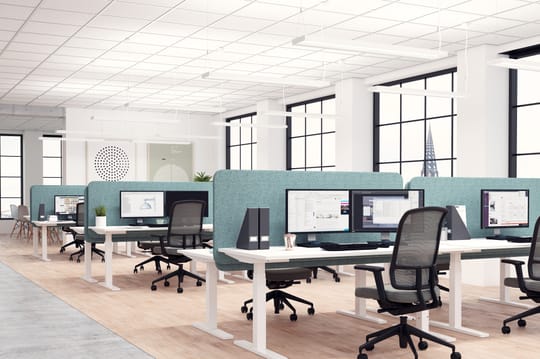
NEWS ARTICLE |
Why Uniform Lighting isn’t Enough for Modern Workplaces
Many offices still rely on static lighting: fixed light levels, fixed colour temperature and a one-size-fits-all approach applied across entire floors. While this supports compliance, it reflects an older model of office design built around consistency rather than the varied ways people work today. Modern workplaces are no longer single-purpose environments. Focused work, collaboration, video calls, and informal conversations all place different demands on the space, yet uniform lighting treats them the same way. A single lighting condition may satisfy baseline standards such as EN 12464-1, but it cannot accommodate different tasks, preferences, sensory needs or employee age. Recent workplace research found that 51.8% of employees identified flexibility as a top priority, while poor lighting was cited alongside noise and lack of personal space as a barrier to performance. This highlights a clear disconnect between traditional lighting strategies and the reality of modern work. Modern Workplaces Require Adaptive Lighting Today’s offices support multiple ways of working across the same footprint. Lighting that supports concentration at a desk may feel too clinical for a breakout space, while lighting designed for social comfort may not provide the clarity needed for focused work. This changes the role of workplace lighting. Rather than delivering a single uniform lighting setup, lighting should help define how the space is used. Subtle shifts in intensity, tone and contrast can distinguish between areas for focus, collaboration and restoration, creating clearer visual cues without relying on physical barriers. Visual Comfort Matters More Than Consistency Uniform light does not automatically mean comfortable light. A workplace may achieve consistent illuminance and still create discomfort if glare, reflections and contrast are poorly managed. In screen-heavy offices, visual comfort depends on more than just meeting an arbitrary illuminance target. Direct glare, veiling reflections and excessive contrast can all contribute to eye strain, fatigue and reduced concentration, even in technically compliant spaces. Effective workplace lighting should balance horizontal and vertical illuminance, maintain appropriate luminance ratios and reduce discomfort glare through careful luminaire placement, shielding and optical control. For modern workplaces, visual comfort is not a refinement. It is a prerequisite for sustained focus, well-being, and performance. Inclusion Requires Flexibility Uniform lighting assumes uniform needs, but workplaces are not uniform. A single lighting condition may meet technical standards yet still feel too bright, too dim, or distracting for different users. People experience light differently. Ageing can increase sensitivity to glare and reduce contrast perception, while neurodivergent users may be more sensitive to flicker, reflections, colour temperature or high illuminance. Inclusive lighting is not about finding a single ideal setting but about creating adaptable environments that support diverse needs throughout the day. Local dimming, zoned lighting, personal control and lower-stimulation areas can all help make workplaces more comfortable. Inclusion depends less on uniformity and more on flexibility. From Static Illumination to Dynamic Lighting Standard office lighting has traditionally focused on delivering a maintained average light level across a workspace. While this supports visibility, it does not fully reflect how people respond to light throughout the day. Human physiology is closely linked to daylight, which shifts in intensity and colour over time. Research suggests that changing light conditions may better support alertness, concentration and cognitive performance than constant lighting. “Static lighting assumes people need the same thing all day. In reality, effective workplace lighting has to respond to changing visual, biological and emotional needs.” — Leslie Thomas, Lighting Technology Manager, Fagerhult UK This is where Human Centric Lighting and Double Dynamic Lighting become relevant. Rather than treating light as a fixed background condition, these approaches consider its visual, biological, and emotional effects, balancing comfort, performance, mood, and well-being. A More Responsive Approach If uniform lighting no longer reflects how modern workplaces function, the alternative is not simply more light, but smarter use of it. A more responsive approach combines ambient, task and accent lighting to create greater visual hierarchy and flexibility. Subtle shifts in tone, intensity and contrast can help define spaces for focus, collaboration and restoration without physical separation. Responsiveness also depends on control. Zoned lighting, local dimming and personal adjustment allow users to shape their immediate environment, while connected systems can respond in real time through occupancy sensing, daylight integration and automated dimming. This improves comfort, supports more efficient use of space and ensures light is delivered where and when it is needed. Lighting as Part of Workplace Performance Workplace lighting should no longer be treated as a background utility designed purely to meet technical requirements. It plays a direct role in how people feel, how well they focus and how effectively they work throughout the day. Light influences more than visibility. It shapes concentration, comfort, mood and alertness, affecting both individual performance and the overall experience of a space. When designed to support comfort, adaptability and human rhythms, lighting becomes a strategic workplace tool rather than a compliance exercise. Rethink What Workplace Lighting Should Deliver If your workplace lighting strategy still prioritises uniformity above all else, it may already be limiting comfort, flexibility and performance. Speak to us to discover how our adaptive lighting solutions can create more responsive, inclusive and effective workplace environments.
Return to top