Related News
NEWS ARTICLE |
Reused printing plates in Fagerhult’s new cardboard luminaires
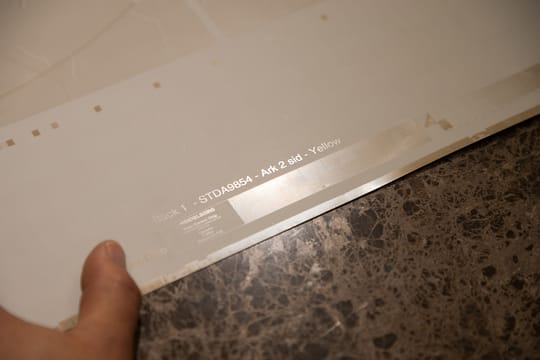
A used printing plate can be given a new lease of life as a component in a luminaire. This is exactly what happens in the Wrapped corner and ceiling luminaires, where used printing plates are reused and become an integral part of the design. Reusing printing plates perfectly encapsulates the concept of industrial symbiosis – where a residual product from one operation becomes a valuable input product in another. The idea took shape at a kitchen table in Lund, when Fagerhult’s Sustainability Manager, Niclas Thulin, was visiting his parents.“They asked how things were going at work, and I told them about Kvisten, which we were in the final stages of at the time. We were reusing reflectors from old TV sets for that product, and I mentioned that we were looking for more residual materials to reuse.” Niclas went on to explain that the company needed a steady flow and consistent quality over time – and, ideally, the same format as well. “And then my Dad, who’s worked in the printing industry his whole life, suddenly says, ‘What the heck, we’ve got loads of printing plates. They’re of the highest quality, always the same format – and they’re recycled.’ The next day, he brought home a couple of printing plates, which I then took to work and gave to my colleagues in the development department. “I could tell right away that they were similar to the materials we use in many of our luminaires. In addition, there were a large number of them, the quality was high and consistent, and they were roughly the same size. All the qualities we were looking for were there.” Quote Niclas From printing works to luminaire When the printing plates arrived at Fagerhult’s development department, they quickly attracted a lot of interest – could they be used in the new Wrapped luminaires?“I was in touch with the printing works about Wrapped and how we could use paper for the actual luminaire body. The printing plates were in the back of my mind at the time, so I raised the issue with them. They jumped at it immediately,” says Jonathan Levinsson, Design Engineer at Fagerhult.The printing works uses a great many printing plates, and some of these are now being used for Wrapped Corner and Wrapped Surface (ceiling). The sheet metal is installed on the inside, as part of the structure. Here it contributes to electrical safety, for example, by acting as an insulation and earthing layer. It also provides stability and can be used to secure cables and other components, for instance. Circular flow. Waste from one industry creates value in another. “The fact that the plates maintain the same dimensions and specifications over time ensures a stable material flow and makes it possible to plan production. This is a major advantage for us,” says Jonathan. Start with the material – not the product The work also highlights an important principle when it comes to industrial symbiosis. It is often easier to find a use for a residual product than to first decide what product you want to make and then try to find suitable recycled material.“I think you have to start with the raw material and then design the component based on that. If you design a component first and then try to find a suitable material, it can be really difficult,” says Niclas.The printing plates are a clear example. If Fagerhult had instead started by asking itself, ‘Where can we find sheet metal as a residual product?’ the search would probably have focused on the metal industry.“We might have been looking for a business that bends or punches sheet metal. We would never have thought about printing works, which are a completely different kind of business. That’s what makes industrial symbiosis so interesting.”At the same time, finding new connections is not easy.“It’s hard to know what residual products other businesses have, especially when you don’t always know exactly what you’re looking for yourself. I think we need more forums where people can gain an insight into other industries and businesses, and where we can discuss industrial symbiosis with a more open mind,” says Niclas. By sharing and developing ideas, Niclas and Jonathan enable new and innovative collaborations. Ideas that roam between departments At Fagerhult, there is already a way of working that fosters this kind of exchange of ideas. Niclas and Jonathan continually bounce ideas off each other, and a small group of people from Sustainability and R&D meet from time to time in order to brainstorm new ideas.“We share a lot of ideas with each other. It’s fun to see what grabs Jonathan’s interest and what doesn’t. At times, someone will have stumbled upon something that we can then build on,” says Niclas.In the case of the printing plates, the solution came from an unexpected source.“It was really just luck. My Dad wasn’t sitting around wondering how he could solve a problem for Fagerhult. But when I told him what we needed, he saw the opportunity right away. He’s clever and often comes up with his own solutions,” says Niclas. “I’m almost a little annoyed that I didn’t think of it myself.” A solution that links multiple workflows So far, we have not performed any calculations regarding the exact climate benefits. The principle is clear, however: when existing materials can be used rather than virgin raw materials, the potential exists to reduce the need for new resources. “We need to be open throughout the entire chain and to dare to look beyond our own industry. The right materials might be found in a place we’d never even have thought of looking,” concludes Niclas Thulin.
NEWS ARTICLE |
Fagerhult halves CO₂ emissions – 49% reduction since 2021
Material choices, product innovations, reuse initiatives, and a systematic analytical approach underpin Fagerhult’s reduced climate impact. Over five years, total CO₂ emissions have decreased by 49 per cent – far exceeding the company’s own targets. Using resources wisely has been a cornerstone throughout Fagerhult’s 80-year history, and it continues to shape the business today. Since 2021, this work has gained even sharper focus and direction, with clear carbon-emission targets, long-term plans, and a comprehensive sustainability programme based on life-cycle assessments (LCA).“A reduction of this magnitude in such a short time shows that systematic work truly makes a difference. It is the result of many large – and small – initiatives, where every improvement contributes to the whole,” says Josefin Carlsson, Sustainability Specialist at Fagerhult. Fagerhult's total CO₂ emissions have decreased by 49 per cent compared to 2021 levels. Many initiatives – one shared direction The success is underpinned by a series of strategic decisions in product development and processes. The work has been carried out across several parallel tracks, following the principle many small streams together create significant impact.“Innovation and sustainable solutions make a real difference for our customers and reduce emissions across the entire value chain – not just in our own production,” adds Josefin Carlsson. Josefin Carlsson, Sustainability Specialist at Fagerhult, Habo. The greatest impact is in the use phase, where emissions since 2021 have been steadily reduced by around 200,000 tonnes of CO₂e – a 49 per cent decrease. At the same time, emissions in Scope 1 and 2 have been reduced by 60 per cent compared with the base year. Sustainability in practice A decisive factor behind this progress is the many parallel initiatives, with material choices playing a central role.Since 2025, the majority of luminaires with housings made from extruded aluminium profiles contain up to 75 per cent recycled material. This contributes to an annual climate saving of approximately 225 tonnes of CO₂e.In 2025, Fagerhult reused more than one hundred luminaires per working day through the ReLight initiative. By upgrading existing luminaires with new technology and extending their life cycle, the climate impact from materials and production is significantly reduced. In total, more than 50,000 products have been given a new lease of life through reuse.Product development is also a key driver of the transition, and several innovations have both reduced climate impact and increased energy efficiency: Multilume Re:Think has reduced Scope 3 emissions by over 320 tonnes of CO₂e through smart design and environmentally sustainable material choices since its launch in 2021. This is equivalent to planting and growing 1,300 trees for ten years. Twin Dual Driver has reduced the climate impact of control gear by 49 per cent through more efficient electronics and improved material composition. Wrapped’s Solid Board housing has up to 89 per cent lower climate impact per kilogram compared with virgin aluminium. Gallery - products At the same time, more than one in ten luminaires sold today includes an integrated sensor, helping to reduce energy consumption during operation. A key factor behind the success is the long-term, fact-based approach.“Based on life cycle assessments, we have identified where and when climate impact occurs – and which actions have the greatest impact. We’re now carrying that knowledge forward in our continued efforts to further reduce our climate impact,” concludes Josefin Carlsson.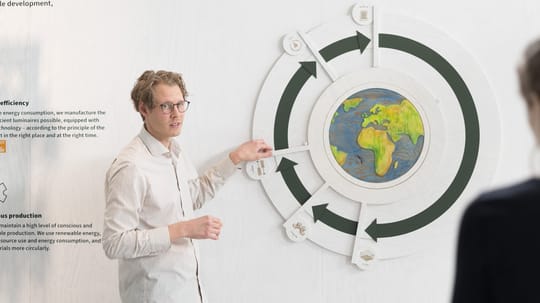
NEWS ARTICLE |
Fagerhult is switching LEDs to reduce its climate impact
Fagerhult is implementing a major change with the aim of reducing the climate impact of its luminaires. By switching to the latest LED technology, Fagerhult is able to reduce annual emissions by 2,250 tonnes CO₂e from the products it sells. “A small change in each luminaire that has a huge overall impact,” says Niclas Thulin, Sustainability Manager at Fagerhult. The decision to replace the LED technology in the luminaires is a strategic one and has been made at management level. In practice, this means that the majority of Fagerhult’s Indoor range will be equipped with new LEDs featuring the latest generation of Flip Chip technology. This change will improve efficiency and reduce energy consumption by 5–10 percent, depending on the luminaire model. A small change with a big impact “Successful sustainability efforts entail focusing on the right things. In all, 85 percent of Fagerhult’s total climate impact across the entire value chain – Scopes 1–3, in other words – comes from the energy consumption associated with the use of our products. If we can improve efficiency and reduce electricity consumption from a significant portion of our product range, this will have a major impact,” says Niclas Thulin. Extended lifetime from 50,000 to 100,000 hours, with stable, high-quality light throughout. “It’s always difficult to predict exactly how much a change will save, since there are many factors at play. But by using data from 2025 – how many luminaires we sold and to which markets – and assuming that they are used for an average of 50,000 hours without lighting control, we estimate potential savings of approximately 2,250 tonnes of CO₂e each year*.” That is basically an entire forest: “That’s roughly equivalent to the amount of carbon dioxide absorbed by 90,000 trees in a year**. As a result, this change could have a significant impact on both our own and our customers’ environmental efforts.” A small LED upgrade can reduce emissions by approximately 2,250 tonnes of CO₂e per year – equivalent to the amount of carbon dioxide absorbed annually by 90,000 trees. Doubling the operating time The change also offers other sustainability benefits. The operating time of the luminaires is doubled from 50,000 hours to 100,000 hours. In the long run, this will entail a reduction in the consumption of resources such as raw materials and other materials. It will also provide financial benefits for our customers, who can make a secure and profitable investment in energy-efficient lighting with a longer working life. With this new technology, all luminaires will also have a Constant Light Output, providing stable, high-quality light throughout the luminaire’s working life. Put simply, good lighting ergonomics at work. How it works A small change that produces big results – what exactly makes the difference from a technical standpoint?“Our approach involves replacing standard LEDs with the latest generation of Flip Chip technology. In simple terms, Flip Chip has a more advanced design in which electrodes and other contact surfaces are positioned in such a way that they do not block or affect the light output. Flip Chip LEDs are simply more energy-efficient and robust,” explains Niclas Thulin.Luminaire models that already feature this type of LED will be upgraded to the latest generation of Flip Chip, as will all models that were previously equipped with standard LEDs. A win-win for everyone The cost of the upgrade will not be passed on to customers in the form of more expensive luminaires but will be financed through the logistical benefits that the change will bring. Sustainability Manager Niclas Thulin regularly meets customers in Fagerhult’s Sustainability Hub —bringing to life how informed lighting choices can deliver both climate and cost savings. “Larger purchase volumes and fewer item numbers mean we can offer these added benefits. Improved energy efficiency, a longer working life and better light quality, lower energy consumption and, above all, a significant contribution to the climate,” says Niclas Thulin.“Here at Fagerhult, we are committed to fulfilling our social responsibility and offering solutions that can address both climate change and the challenges associated with future electricity supplies. In our opinion, our customers shouldn’t have to choose between affordability and sustainability when it’s possible to have both. It's a win-win for everyone.” * Emission factors by country, based primarily on data from the Association of Issuing Bodies (AIB).** Based on average carbon dioxide absorption according to Ecotree.
Return to top