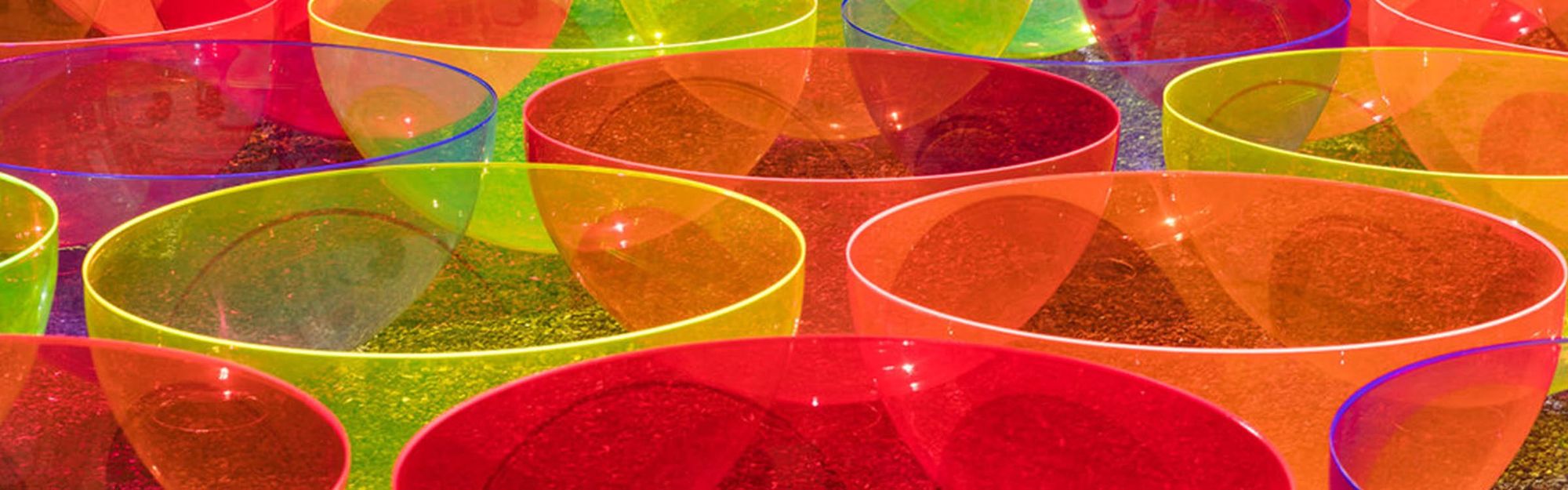
When talking to artist Liz West, a new world opens up. A world full of light, colours, structures, impressions, and feelings. Something that is present all around us every day but might not be noticed by all. But West notices and finds the inspiration for her work sometimes in the most unexpected places.
– I find my inspiration everywhere, West explains. I am super-sensory, so my head is quite a busy place. Whenever I go anywhere, I take in everything. It means that I don’t miss a thing, which can be quite overwhelming. I do not remember everything, but I remember the important things, the things that inspire me. Maybe a subtle reflection; in a piece of glass, a monumental structure, a piece of music that I hear – or the way someone dresses or do their hair. It could be anything. It is the world as a whole that inspires me.
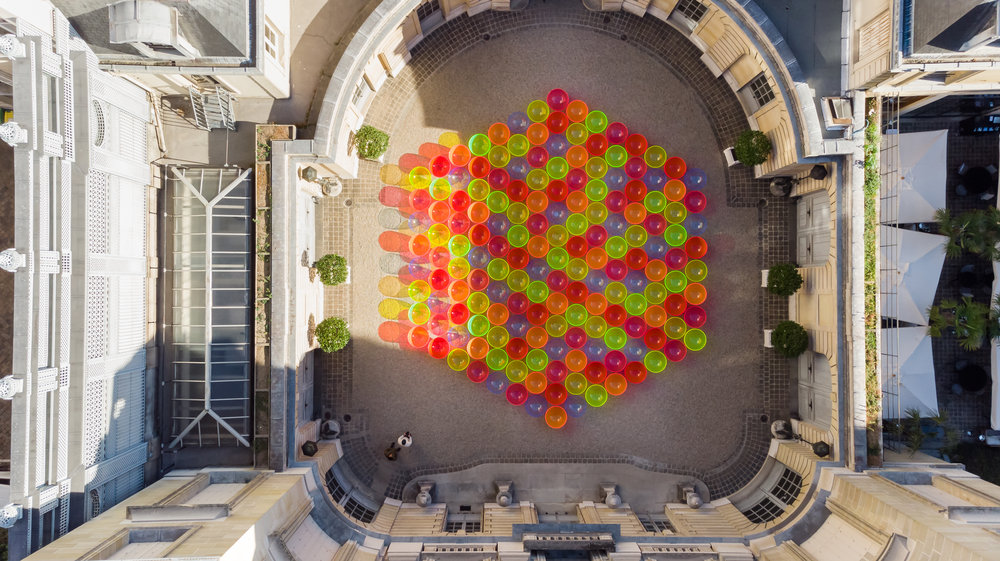
Art was always present
To work with colour and light was a natural progression for West. Even as a small child, she was interested in things that were “luminous and vivid”. Both her parents are artists, and the house was always full of creativity. More importantly, there were always materials available to play with. And that is what she did.
– My work has come from a very organic, natural place, says West. I am just intrinsically passionate about colour and light. As a student I tried to make work about all sorts of things, and I discovered quite quickly that I wanted to make work that had a brightness, vividness, and glow to it. When I made an art-series of colour projected into space I realized in a lifechanging moment that “ahaaa, it is luminous colour that I am interested in!”. A whole atmosphere is made through that coloured light. So, that was the answer to what I needed to do next.
West was born and raised, northern England. A place she describes as a bit colder, and with occasional brilliant summers. She recalls being quite affected by the seasonal changes, and the light changes during the day.
– One of my greatest inspirations is the way natural light changes during the seasons, West declares. In the UK we have different seasons, which are a very beautiful thing to observe. The light strength and direction changes throughout the day; I really wanted to utilize the sun as the light source, and then start making work with natural light - that was a big turning point for me.
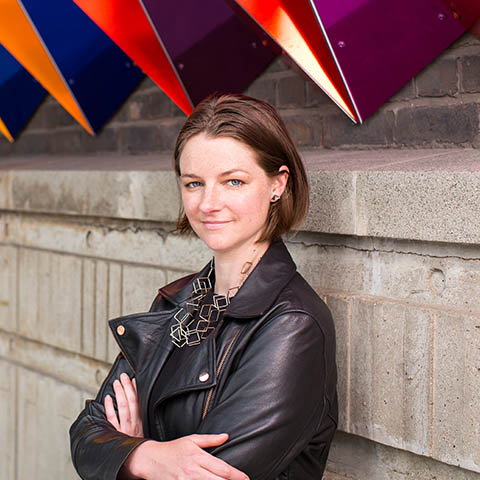 "I like illusions, and any sort of material that can create a space that can heighten someone’s sensory and perception is great." Liz West, artist
Technological advances - or obstacles?
West has worked actively as a full-time artist for more than a decade, and her pieces have always had a more analogue touch regarding material and technology. She is passionate about the craft, and the details leading up to the result of an installation. West almost exclusively works with fluorescent lights, when using artificial light in her art and almost never any sensors or programming.
– I find the LED’s a bit problematic; West explains. The technology is moving at quite a pace, and what you can do today in lighting is quite remarkable. However – as an artist – I like real things. Real material, something analogue. So, when I think of artificial light it is the fluorescent lamp for me. It is a much more tangible light, more immersive. The colours you can achieve with a fluorescent light are through filters wrapped around them and so you have a limited amount of coloured filters. Mix those filters, overlap them, and you create new colours.
West elaborates further:
– I think you see LED’s being misused, or mistreated in art. They can have a subtlety to them, but when artists use them for the first time on a project, they are not using their full capabilities. What I try to achieve in my work is an immersive space, and I want to supersaturate that space. Although there are millions of possible colours that you can get with an LED, what I am actually left with is that top row with a 100 % saturation, and that is not millions of colours. It is probably tens or hundreds. So, actually the tones and the hues that you can achieve through the physical filtering, is much more intense than LED.
Don’t conform – create
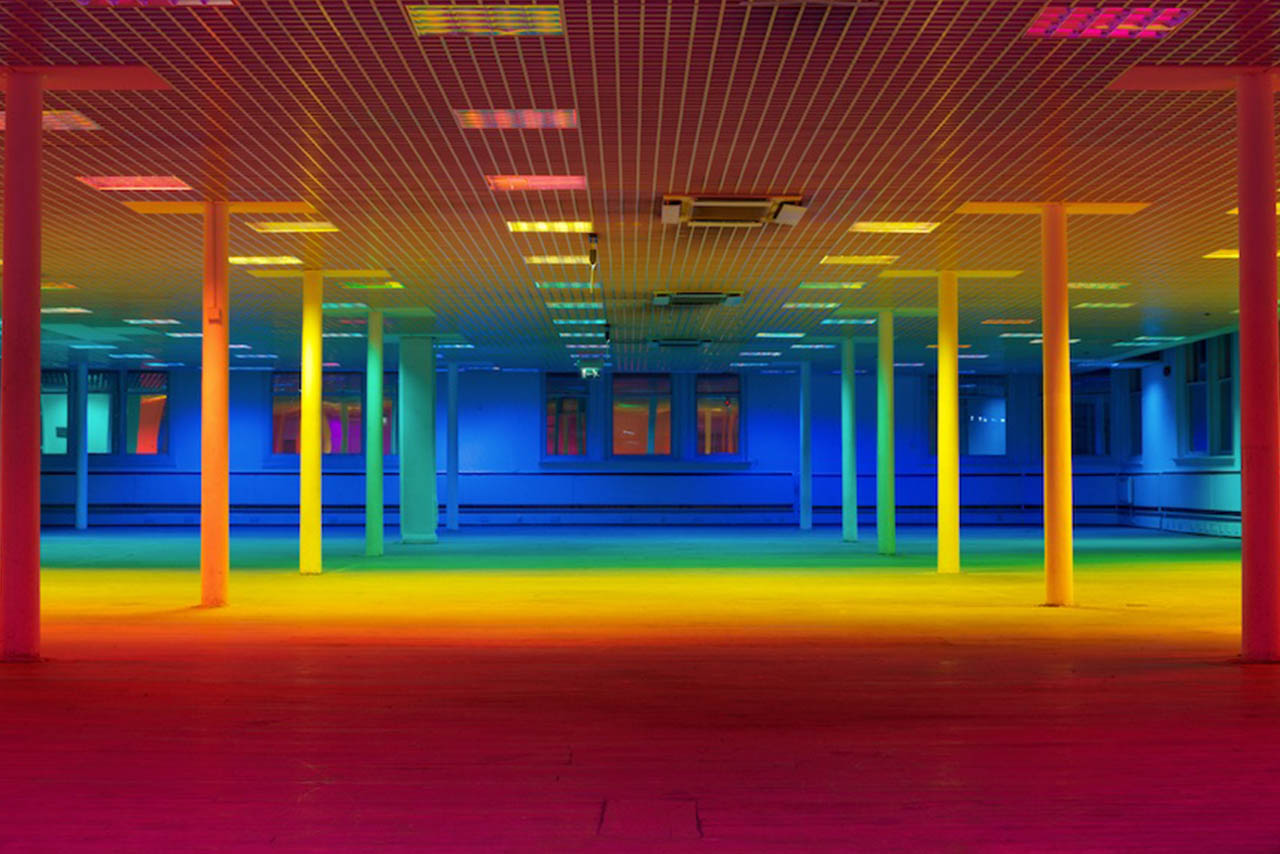
The passion of which West describes her work, and her relation to light and colour is contagious. Her fascination with the interrelationships between colour and light is tangible in her art, quite physically for the visitor to experience.
– I’m obsessed with materials – whether that is luminaires or physical things like glass or mirrors - I like illusions, West says. And any sort of material that can create a space that can heighten someone’s sensory and perception is great.
When observing her peers in the lighting design industry, she is concerned about the possibilities to create something new – rather than to conform.
– As an artist, I exist more in the artworld - which is quite small compared to the lighting world, West explains. I find the lighting world very nurturing and all-inclusive, which is a lovely thing. But when I have looked at designs made in the lighting design world, they can be a bit boring. I have often thought to myself “come on!”. These are lighting designers, and I couldn’t see the creativity in the work. I think it is because a lot of lighting designers and architects must conform to a brief, for so much of their career. And I strive do the exact opposite of that. Sometimes I want to shake up lighting designers and tell them to get their pens and pencils out and be a bit looser and more creative in their approach. I believe we should be able to play more, I think that is a great thing.
Liz West - work and exhibitions
If you wish to get to know more of Liz West colourful world, please visit her website: http://www.liz-west.com/
If you wish to see some of her installations in real life she has two upcoming art installations:
• Hyvinkää Art Museum, Finland ( “Physical Reality”)
• The Wilson, Cheltenham, UK (“Colour-ways: Light works by Liz West”).
Related News

Melanopic lux: lighting for education influenced by human biology
Light is essential in our daily lives, influencing our ability to see, overall well-being and performance. In educational environments, lighting quality can significantly impact students' focus, mood, and energy levels. So, how do we know what is the right amount and quality of light for this setting? Traditionally, light has been measured in lux, a unit of measurement for the intensity of light. It's used to measure how much light falls on a surface or the amount of light in a given space. One lux is the amount of light that falls on a surface that is one square meter in area when one lumen of light is spread out evenly. Recent advancements in research have unveiled the importance of melanopic lux, which goes beyond mere visibility. This measures how effectively light stimulates specific eye cells that regulate crucial non-visual functions such as sleep and alertness. In classrooms and lecture theatres, the melanopic ratio has become vital in lighting design, enabling educators to create spaces that support visual tasks and align with students' biological rhythms. In this article, we explore how lighting solutions can align with our biology, and how this helps to create optimum conditions for educational environments. The science of vision and light The human eye is a remarkable organ designed for high-resolution colour vision within a small area (approximately 2 degrees of the visual field) while relying on peripheral vision for motion detection. This dual-function system, shaped by evolution for survival, continues to influence how we perceive and interact with our surroundings. Our eyes are particularly susceptible to green and yellow light, reflecting our evolutionary adaptation to naturally lit environments. In contrast, blue light, which is chief in modern LED lighting, requires higher intensity to be perceived at the same level. Effective lighting design carefully considers brightness, timing, and distribution to support visual clarity and biological functions like mood and alertness. For example, exposure to bright light in the morning helps regulate circadian rhythms, boosting alertness and mitigating the effects of seasonal darkness. This is particularly important in educational environments, such as schools and universities, where lighting impacts mood, focus, and overall performance. Our Organic Response system provides an innovative solution tailored for these spaces. This smart lighting technology automatically optimises light levels, featuring daylight-responsive sensors and advanced occupancy detection, maintaining a balance between natural and artificial light. Doing so supports visual comfort and reduces energy consumption, making it an ideal choice for creating dynamic, efficient, and student-friendly learning environments. To further support students, well-lit spaces with minimal glare are essential for reducing eye strain and maintaining focus during extended study sessions. Adjusting light intensity and colour temperature for different tasks—such as reading, group discussions, or creative activities—enhances light's visual and non-visual effects. By integrating thoughtful lighting strategies like those offered by Organic Response, educational environments can promote healthier, more productive, and engaging learning experiences. Integrative lighting: Supporting health and well-being. Integrative lighting (also referred to as human-centred lighting) combines visual and non-visual benefits (such as emotional effects) to support biological rhythms and psychological well-being. This approach goes beyond traditional lighting solutions by considering how light impacts circadian rhythms and hormonal balance. Light exposure in the morning is critical for suppressing melatonin (the sleep hormone) and increasing cortisol (the alertness hormone). Proper timing helps align students' natural rhythms with school schedules, which often require a lot of focus. Consistent exposure to bright, cool light early in the day can enhance energy levels and cognitive performance. The melanopic ratio compares the spectral composition of a light source with daylight. Using this information, you can determine its melanopic lighting intensity. This enables the design of lighting setups that precisely meet both visual and biological lighting needs. Lighting recommendations for educational spaces Each learning environment has unique lighting needs. Libraries benefit from direct lighting on the floor, paired with ambient lighting on walls and ceilings. Vertical shelf lighting (200-300 lx) makes it easier to browse titles. Lecture halls, on the other hand, require glare-free, comfortable lighting with flexible control, ideally with pre-programmed scenarios. In auditoriums and classrooms, strong vertical lighting is crucial for clear visual communication, especially over greater distances, enhancing facial expressions and engagement. General lighting recommendations apply to all educational spaces. Our solutions meet industry standards, ensuring reading and writing areas maintain 500 lx for effective visual tasks. Using daylight-responsive sensors for luminaire rows can reduce energy consumption while maximising natural light. The number and arrangement of luminaires should be adjusted based on the room's size and function to ensure consistent illumination. The role of dynamic lighting A Double Dynamic lighting system can be a game-changer in educational environments. It allows for intensity and colour temperature adjustments to match the specific needs of activities, from quiet reading sessions to collaborative group work. Fagerhult's distinct approach to lighting means that our design is human-centric; we integrate scientific insight into light and human psychology, creating environments that support academic performance and well-being. Our focus on energy efficiency also means our advanced control systems optimise light usage while minimising energy consumption, contributing to a building’s sustainability goals. The customisable setting and flexible solutions ensure that educational environments can create tailored lighting profiles for different times of the day or specific learning activities. Long-term benefits of melanopic lighting Melanopic lighting, designed to mimic the natural light spectrum, helps regulate the circadian rhythm, which is essential for maintaining focus, energy, and emotional balance. In classrooms and study areas, proper lighting can reduce eye strain, improve sleep patterns, and enhance mood, which are critical for students' mental health and academic performance. By incorporating lighting that aligns with our biological needs, schools and universities can foster healthier, more productive learning environments,. This is particularly important during the winter months when daylight is limited. Whether through advanced tuneable white light systems, designs that maximise daylight, or energy-efficient solutions, we are dedicated to leading the way in lighting innovation for educational environments, delivering brighter futures—one classroom at a time.
The inspiration behind Nobel Week Lights: ”Light, art and technology intertwined.”
Nobel Week Lights has quickly become a beloved public celebration. During Nobel Week, Stockholm residents flock outdoors to marvel at the spectacular light installations, where contemporary lighting technology meets artistic expression. ”We aim to create a moment of gathering: around light and around something meaningful”, says Lara Szabo Greisman. Nobel Week Lights is a light festival that illuminates Stockholm during the darkest time of the year – a free cultural experience for everyone. Presented by the Nobel Prize Museum, the festival invites international and local artists, designers and students to create light artworks inspired by the Nobel Prize. The installations shed new light on the scientific discoveries, literature and peace efforts of Nobel laureates while offering a fresh perspective on the city. Fagerhult is Principal Partner of Nobel Week Lights 2024, and this year’s edition features 16 different light installations across Stockholm. The artworks can be experienced from 7–15 December, including ”The Wave”, a light installation by the art collective Vertigo, located in front of the Parliament House where visitors can walk right through the luminous wave. The Wave by Vertigo ”Light and art and creativity is incredibly intertwined because these are technologies that are constantly evolving. So part of the fun working with the artists is that they are constantly testing new technologies. And we see these incredible visual results which are based on just pure innovation”, says Lara Szabo Greisman, co-founder and producer of Nobel Week Lights. Lara Lara Szabo Greisman and Leading Lights by Les Ateliers BK The significance of light as a collective force, its ability to encapsulate life and death, joy and sorrow – indeed, the very essence of what it means to be human – makes lighting a powerful medium of artistic expression, she argues: ”The dream for the festival is that this becomes a personal experience for each and every member of the audience. A moment that they remember and cherish . A moment that they think about later and bring forward as their story of connecting with the city.”