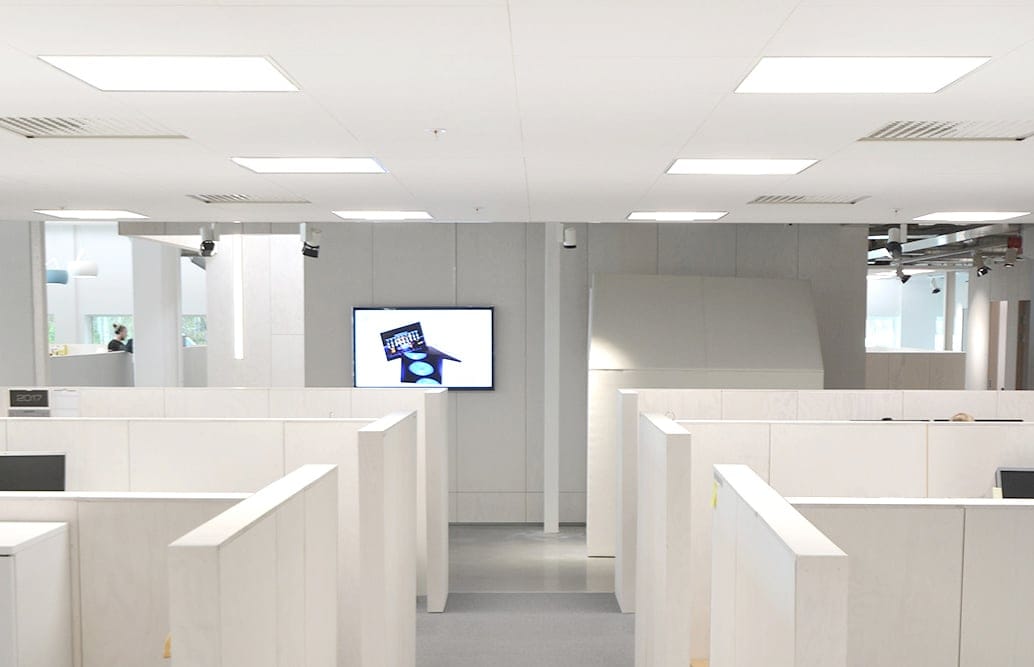
The office environment – the most common workplace in Sweden
Today nearly 60% of all employees in Sweden work in an office environment at least 25% of their working hours. As a result of digitisation, conditions in the office environment have changed significantly. Technology has enabled mobility and flexibility in a completely new way; iPads and smart phones have helped make us mobile and flexible in brand new ways. One in three people working in an office environment has their own room, while about 15% do not have their own desk or room, but have to choose from non-personal desks/workstations . But regardless of the type of office you work in, activity-based office work has seen a breakthrough. Flexibility permeates the entire day. You can have customer meetings, work at home, work on the train, or go to other premises or departments within the company.
The sustainable office of the future
Sustainability and climate issues are also subjects of current interest in office research. What form should the transition to a sustainable perspective take when it comes to the office workplace? How can we develop modern offices that assures the health of employees, companies and the planet?
According to Susanna Toivanen, Professor of Sociology at Mälardalen University, Sween, a ‘sustainable office’ is an office that satisfies the current needs of an office environment without compromising on the needs of future generations.
“This classification of sustainability is based on the classic Brundtland definition. This involves environmental, economic and social sustainability. The social aspect includes employee health, as well as the health of society and the planet. We also talk about ‘healthy offices’ – where we start from a definition that derives from a large research project that looked at long-term healthy companies to discover what distinguishes them. This is measured, among other things, by looking at sick leave statistics based on office type.”

SLA – sound, light, air
In the physical environment, we usually talk about SLA – sound, light and air. These are usually the major challenges in office workplaces, particularly in open-plan offices. For example, in terms of light, it may involve how the lighting can be distributed evenly throughout the premises, as well as in the centre of the office landscape. In many landscapes that are in deep buildings, this can be a problem. There you can quickly see which places are most popular – those at the window with a view and natural light.
Sound can become a problem in open-plan office landscapes. It is important to get the help of an acoustician early in the planning stage in order to plan the sound environment as well as possible. There are no guidelines for noise as a work environment factor in an office environment, and disruption is a subjective experience for each employee.
In terms of air, the issues are both temperature and ventilation. For example, in office refurbishments where walls have been removed and existing environments have been refurnished, the ventilation may not be designed to cope with the number of employees required. In that instance, it may feel like there is not enough air.
These are physical factors that affect a person’s perception of the working environment as a whole. Often it is a combination of stresses – sound, light and air – perhaps all at the same time, that influences how we experience the environment, and affects our wakefulness and performance at work.

The working life of the future
If we instead look at the challenges for the working life of the future, we can already see that we are moving through a period of rapid and constant change.
“The symptoms you see during such a rapid development are that people cannot keep up with the changes, which can lead to increased sick leave,” says Professor Toivanen. “Each era has experienced the same pattern. The introduction of electricity changed the conditions for work – suddenly we could work even when it was dark. The arrival of trains was also a stress factor. All periods have seen their social changes, and have expressed a level of stress and associated worry. The reality of our time is that the planet’s population is huge, and the technological revolution is advancing like no other previous change, as far as we know.”
Another new factor is the concept of ‘boundaryless work’ in our 24/7 connected society. As an individual, you are never truly at rest. The means, technology and software that we have access to, which should be able to help us work less, have actually led to us being able to work more. This also means that time for recovery and relaxation has decreased. A break that is crucial for us to feel good and maintain our health.
Toivanen continues:
“This limitless working life, and this limitless way of working, place much greater demands on the individual to plan and perform their own work. Nowadays office work is also performed in alternative workplaces and work environments, at home or perhaps on a train. As a result, you can also talk about ‘boundaryless offices’, linked to these ‘new ways of working’. This way of working is the result of digitisation.”

New rooms – inside and out
So what will the workplaces of the future look like if we are becoming increasingly digital and mobile? Could you even do office work outdoors?
“We have been working on the issue of outdoor offices since 2014, and my PhD student is working with Sweden’s, maybe even Europe’s, first dissertation on office work outdoors,” says Toivanen. “The objection usually raised is often it is cold and unpleasant for much of the year in Sweden, so who would want to go out then? We don’t think that you should work 8 hours outdoors, but it should be possible to introduce elements of outdoor working during the work day and see how it affects health, performance and cognition.”
“In Växjö, Sweden, property company Castellum has developed what we know is the first permanent outdoor office workplace in Sweden (2016). There is a meeting table, a roof with solar cells and a space that can be booked for meetings. Different tenants and companies have access to this facility as an added value to their own premises. There is electricity for powering computers, and there are different types of seating. Several types of outdoor office have now been developed, with other companies, including some with mobile outdoor modules that you can move around in an outdoor environment and work with portable devices.”
Toivanen concludes with a couple of examples of work that can be performed outside:
“You can quite simply go outside for a while, to recover, for instance, or make a call. You can take a lunchtime walk, hold Monday meetings or customer meetings, sit and read or get inspiration for your work projects. The most important thing is recovery, and variation in the work. After a while outdoors, it is quite possible that you will gain a new perspective on your work indoors.”
Related News

Melanopic lux: lighting for education influenced by human biology
Light is essential in our daily lives, influencing our ability to see, overall well-being and performance. In educational environments, lighting quality can significantly impact students' focus, mood, and energy levels. So, how do we know what is the right amount and quality of light for this setting? Traditionally, light has been measured in lux, a unit of measurement for the intensity of light. It's used to measure how much light falls on a surface or the amount of light in a given space. One lux is the amount of light that falls on a surface that is one square meter in area when one lumen of light is spread out evenly. Recent advancements in research have unveiled the importance of melanopic lux, which goes beyond mere visibility. This measures how effectively light stimulates specific eye cells that regulate crucial non-visual functions such as sleep and alertness. In classrooms and lecture theatres, the melanopic ratio has become vital in lighting design, enabling educators to create spaces that support visual tasks and align with students' biological rhythms. In this article, we explore how lighting solutions can align with our biology, and how this helps to create optimum conditions for educational environments. The science of vision and light The human eye is a remarkable organ designed for high-resolution colour vision within a small area (approximately 2 degrees of the visual field) while relying on peripheral vision for motion detection. This dual-function system, shaped by evolution for survival, continues to influence how we perceive and interact with our surroundings. Our eyes are particularly susceptible to green and yellow light, reflecting our evolutionary adaptation to naturally lit environments. In contrast, blue light, which is chief in modern LED lighting, requires higher intensity to be perceived at the same level. Effective lighting design carefully considers brightness, timing, and distribution to support visual clarity and biological functions like mood and alertness. For example, exposure to bright light in the morning helps regulate circadian rhythms, boosting alertness and mitigating the effects of seasonal darkness. This is particularly important in educational environments, such as schools and universities, where lighting impacts mood, focus, and overall performance. Our Organic Response system provides an innovative solution tailored for these spaces. This smart lighting technology automatically optimises light levels, featuring daylight-responsive sensors and advanced occupancy detection, maintaining a balance between natural and artificial light. Doing so supports visual comfort and reduces energy consumption, making it an ideal choice for creating dynamic, efficient, and student-friendly learning environments. To further support students, well-lit spaces with minimal glare are essential for reducing eye strain and maintaining focus during extended study sessions. Adjusting light intensity and colour temperature for different tasks—such as reading, group discussions, or creative activities—enhances light's visual and non-visual effects. By integrating thoughtful lighting strategies like those offered by Organic Response, educational environments can promote healthier, more productive, and engaging learning experiences. Integrative lighting: Supporting health and well-being. Integrative lighting (also referred to as human-centred lighting) combines visual and non-visual benefits (such as emotional effects) to support biological rhythms and psychological well-being. This approach goes beyond traditional lighting solutions by considering how light impacts circadian rhythms and hormonal balance. Light exposure in the morning is critical for suppressing melatonin (the sleep hormone) and increasing cortisol (the alertness hormone). Proper timing helps align students' natural rhythms with school schedules, which often require a lot of focus. Consistent exposure to bright, cool light early in the day can enhance energy levels and cognitive performance. The melanopic ratio compares the spectral composition of a light source with daylight. Using this information, you can determine its melanopic lighting intensity. This enables the design of lighting setups that precisely meet both visual and biological lighting needs. Lighting recommendations for educational spaces Each learning environment has unique lighting needs. Libraries benefit from direct lighting on the floor, paired with ambient lighting on walls and ceilings. Vertical shelf lighting (200-300 lx) makes it easier to browse titles. Lecture halls, on the other hand, require glare-free, comfortable lighting with flexible control, ideally with pre-programmed scenarios. In auditoriums and classrooms, strong vertical lighting is crucial for clear visual communication, especially over greater distances, enhancing facial expressions and engagement. General lighting recommendations apply to all educational spaces. Our solutions meet industry standards, ensuring reading and writing areas maintain 500 lx for effective visual tasks. Using daylight-responsive sensors for luminaire rows can reduce energy consumption while maximising natural light. The number and arrangement of luminaires should be adjusted based on the room's size and function to ensure consistent illumination. The role of dynamic lighting A Double Dynamic lighting system can be a game-changer in educational environments. It allows for intensity and colour temperature adjustments to match the specific needs of activities, from quiet reading sessions to collaborative group work. Fagerhult's distinct approach to lighting means that our design is human-centric; we integrate scientific insight into light and human psychology, creating environments that support academic performance and well-being. Our focus on energy efficiency also means our advanced control systems optimise light usage while minimising energy consumption, contributing to a building’s sustainability goals. The customisable setting and flexible solutions ensure that educational environments can create tailored lighting profiles for different times of the day or specific learning activities. Long-term benefits of melanopic lighting Melanopic lighting, designed to mimic the natural light spectrum, helps regulate the circadian rhythm, which is essential for maintaining focus, energy, and emotional balance. In classrooms and study areas, proper lighting can reduce eye strain, improve sleep patterns, and enhance mood, which are critical for students' mental health and academic performance. By incorporating lighting that aligns with our biological needs, schools and universities can foster healthier, more productive learning environments,. This is particularly important during the winter months when daylight is limited. Whether through advanced tuneable white light systems, designs that maximise daylight, or energy-efficient solutions, we are dedicated to leading the way in lighting innovation for educational environments, delivering brighter futures—one classroom at a time.
The inspiration behind Nobel Week Lights: ”Light, art and technology intertwined.”
Nobel Week Lights has quickly become a beloved public celebration. During Nobel Week, Stockholm residents flock outdoors to marvel at the spectacular light installations, where contemporary lighting technology meets artistic expression. ”We aim to create a moment of gathering: around light and around something meaningful”, says Lara Szabo Greisman. Nobel Week Lights is a light festival that illuminates Stockholm during the darkest time of the year – a free cultural experience for everyone. Presented by the Nobel Prize Museum, the festival invites international and local artists, designers and students to create light artworks inspired by the Nobel Prize. The installations shed new light on the scientific discoveries, literature and peace efforts of Nobel laureates while offering a fresh perspective on the city. Fagerhult is Principal Partner of Nobel Week Lights 2024, and this year’s edition features 16 different light installations across Stockholm. The artworks can be experienced from 7–15 December, including ”The Wave”, a light installation by the art collective Vertigo, located in front of the Parliament House where visitors can walk right through the luminous wave. The Wave by Vertigo ”Light and art and creativity is incredibly intertwined because these are technologies that are constantly evolving. So part of the fun working with the artists is that they are constantly testing new technologies. And we see these incredible visual results which are based on just pure innovation”, says Lara Szabo Greisman, co-founder and producer of Nobel Week Lights. Lara Lara Szabo Greisman and Leading Lights by Les Ateliers BK The significance of light as a collective force, its ability to encapsulate life and death, joy and sorrow – indeed, the very essence of what it means to be human – makes lighting a powerful medium of artistic expression, she argues: ”The dream for the festival is that this becomes a personal experience for each and every member of the audience. A moment that they remember and cherish . A moment that they think about later and bring forward as their story of connecting with the city.”