”COULD YOU PLEASE DESCRIBE THE SOUND?”
”Do you recognize it?”
”Is it too loud – or maybe too low? ”
”How does it make you feel?”
To define, describe and compare different kind of sounds is quite easy, as we share a common understanding and vocabulary. That’s why user panels are common when designing different types of sounds and experiences. For example, the roaring engine of a prestige car is no coincidence. It's the result of the work of professional sound designers, and based on studies carried out in advanced sound laboratories. And this is why you – if you’re a car nerd – actually can identify different car brands from each other, only by hearing the sounds of their engines.
One of the most famous sound and vibrations experts is Danish Brüel & Kjær. Covering the full acoustic spectrum, Brüel & Kjær evaluates building acoustics, wind turbine noise, vibrations in car engines and mobile telephone sound quality. The company also has a close collaboration with DTU, The Technical University of Denmark, which has resulted in the university building one of the world’s most sophisticated laboratory facilities within audio research.
FROM SOUND TO LIGHT
Within audio research, there is a well-developed language that makes it easy for the common users to tell and evaluate their experience.
In lighting research, the situation is quite the opposite. The specialist language is advanced and the common user does not understand the terminology and cannot describe what they experience in the form of light levels, light distributions and color temperatures.
But now, a collaboration between DTU and Aalborg University, which is internationally renowned for its Lighting Design Master Programme, has changed the game plan. It all started with DTU reaching out to Aalborg University offering to share a new software for evaluating user experiences of sound. Would the Aalborg University be interested to adapt it, in order to create a new type of lighting evaluation?
”Of course, we were – the timing was just right”, explains Henrik Clausen, Director Education & Research at Fagerhult and Associated Professor at the Aalborg University Master Programme.
The initiative resulted in a research project conducted at Aalborg and led by professor Marc Fontoynont. Fagerhult has participated in the evaluation of the projects’ test room and has contributed with knowledge in research and tests.
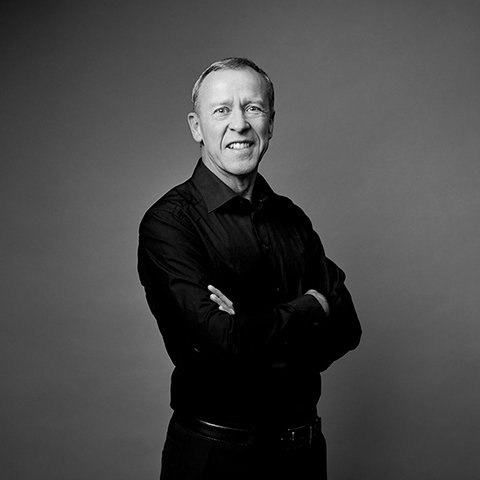 "This gave us the possibility to navigate around the main obstacle: that you cannot separate the light from the light source, making the actual product or product design a factor that could affect the perception." Henrik Clausen, director of Fagerhult Lighting Academy
A PHOTO REALISTIC CINEMA EXPERIENCE
”We’ve used the latest technology to create a lighting research studio that offers the subjects of the test panel an IRL-experience. Different settings are projected on screens by the help of powerful high intensity projectors with excellent resolution and possibilities to create images that are completely realistic in colour and intensity. This makes it possible to create settings with different properties regarding luminance and lighting levels as well as the light’s colour temperature and colour rendering. It also gives us the possibility to navigate around the main obstacle: that you cannot separate the light from the light source, making the actual product or product design a factor that could affect the perception. Instead of traditional mock-ups we invite the subjects to this great cinema experience where you get caught up in the story”, says Henrik Clausen.
IT’S ALL ABOUT THE NARRATIVE
Actually, it is all about the narrative. During the different test sessions, the subjects are introduced to different lighting stories with focus on office environments. When telling a story about a day in the office, the subjects will experience different light settings presented with the various events. As the lighting scenery change they will answer the question: ”do you like this setting” with a simple ”yes” or ”no” on their electronic devices. The data are collected by the specially developed software that will create a real time algorithm for the most agreeable sceneries. This means that the subjects don’t have to be familiar with lighting terms to describe their experience, nor is it necessary to develop a ”lighting lingo” as the software will do the translation.

”NO LIMITS”
The research project has involved six different tests in collaboration with several leading lighting and architect companies. It has been a great success, and the plan is to investigate the possibility of building an advanced full-scale research and test laboratory that can offer its services to the industry. A place to go to evaluate a lighting design – from outdoors to indoors, from schools and offices to hospitals and private homes – or individual products. The cinema set up means no limits.
”The possibility to get immediate feedback on the changes taking place in the room is invaluable. This kind of lighting design laboratory could save a lot of time and money for lighting consultants and designers, architects, contractors and producers. In the end it will gain society as well as individuals. Customers and end-users will have the opportunity to say ”I don't like that – but I want this”, before anything is realized, meaning that we have an excellent opportunity to create lighting environments that are optimized right from the start. I also think that it will simplify the whole light planning procedure, cutting down the number of adjustments” Henrik Clausen muses.
”From a Fagerhult perspective this kind of r&d is in line with our very existence. Our competitive edge has always been our interest in, and deep knowledge about, human centric lighting designs. Lighting that does not only meet up to standard requirements but adds extra value regarding well-being and performance. This is a great opportunity to take our concept to the next level.”
Related News

Beyond what we see – exploring the biological role of light
For most of human history, people lived almost entirely under natural daylight. The rhythms of sunrise and sunset shaped sleeping patterns, activity levels and the way the body responded to the environment. Today, modern life looks very different. Humans now spend 90% of their time indoors, surrounded by artificial light and increasingly separated from the full spectrum of daylight under which humans evolved. In conversations around wellbeing and the health of the human body, some researchers are beginning to ask whether light may influence the body in ways that extend beyond vision alone. One of those researchers is neuroscientist Professor Glen Jeffery at UCL’s Institute of Ophthalmology, whose research explores the relationship between light, mitochondria, ageing and visual function, including the potential biological role of longer wavelengths beyond the visible spectrum. This interview explores his research, insights, and the growing conversation about how modern indoor environments may be changing humanity’s relationship with light - not just visually, but biologically as well. The Evolution of Humans Under Daylight At the centre of Glen’s thinking is a relatively simple idea: the human body evolved under the full spectrum of sunlight over millions of years. “So many parts of your body and systems in your body were set over exposure to sunlight over millions of years,” he explains. “Your body has lost contact with your evolutionary history.” He explains that this evolutionary perspective is central to understanding why light may matter biologically. Human physiology developed in outdoor environments where daylight exposure was continuous, dynamic and spectrally rich. Modern indoor life, by comparison, represents a dramatic environmental shift. This does not mean modern lighting is inherently harmful, but rather society may only now be beginning to understand how profoundly modern environments have changed the way humans experience light. Beyond the Visible Spectrum When it comes to designing light, conversations often focus on what people can see: brightness, colour temperature, contrast, glare and visual comfort. Glen’s research, however, explores the possibility that wavelengths outside visible vision may also influence the body. “You only see a minute amount of the spectrum of sunlight, between roughly 400 nanometres (nm) to 700nm,” he explains. Visible light occupies only a relatively narrow band within the wider electromagnetic spectrum. Beyond it sit ultraviolet wavelengths on one side and infrared wavelengths on the other - both largely invisible to the human eye. Much of his recent work has focused on longer infrared wavelengths and their potential relationship with mitochondria - the structures within cells responsible for energy production. He argues that much of the sunlight exists beyond the visible spectrum that humans experience with the naked eye. This is where the conversation begins to move beyond traditional lighting discussions and into broader biological territory. Mitochondria, Energy and Ageing A significant portion of his recent work has explored how longer wavelengths of light - particularly around 670nm and near-infrared ranges - may influence mitochondrial performance and age-related decline in both animals and humans. A term many people may be unfamiliar with, but one that plays a fundamental role in the human body, is mitochondria. Often described as the body’s energy systems, mitochondria are essential to almost every biological process. “Everything you’re doing is relying on mitochondria,” Glen says. “Whether that’s using your muscles to kick your legs out of bed, or reach out for that cup of coffee.” In simple terms, mitochondria produce ATP, the molecule that powers cellular activity. His research explores how longer-wavelength light beyond 700nm may influence the efficiency of this process. “Long wavelength light lubricates each point where there’s a slight bit of resistance,” he explains, describing how photons may help support electron transfer within cellular energy pathways. While much of the science remains under investigation, Glen believes mitochondria may sit at the centre of broader questions around ageing, metabolism and human health. “The theory that sticks to the wall hardest is called the mitochondrial theory of ageing,” he says - the idea that ageing is closely linked to the gradual decline of mitochondria over time. As mitochondria become less efficient, the body’s ability to produce energy and maintain healthy function may also deteriorate. It is, however, important not to overstate conclusions. He emphasises that this is an evolving field with many unanswered questions, and believes the relationship between light, biology and human health deserves greater attention than it currently receives. Modern Indoor Life Whilst humans evolved under natural daylight, modern life is very different. People now spend much more time indoors than previous generations, fundamentally changing daily exposure to natural light. He points not only to artificial lighting, but to indoor lifestyles more broadly. Modern life increasingly takes place inside controlled environments, often with limited exposure to the full spectrum of daylight under which humans historically evolved. “We are making ourselves vulnerable because we’re living inside,” he says, “and we’re exacerbating that vulnerability with LED lighting.” Importantly, Glen does not separate modern indoor living from lighting technology itself. Instead, he sees them as interconnected parts of a much wider environmental shift. Beyond Circadian Lighting? Over the past decade, the lighting industry has increasingly explored circadian rhythms and human-centric lighting - particularly the role of light timing and blue wavelengths in regulating sleep and alertness. Glen does not see his research as contradicting that work, but rather broadening the conversation. In his opinion, it would be a mistake to think that light only does one thing. While circadian research largely focuses on visible wavelengths associated with the body clock, Glen’s work looks further into the infrared end of the spectrum and its potential biological effects. “These are two things that run hand in hand,” he explains. For him, the growing interest in circadian lighting reflects a wider shift towards understanding that light may influence people in multiple ways beyond visibility alone. A Conversation Still Emerging Glen believes researchers may now be approaching an important moment - not because all the answers exist, but because the questions themselves are beginning to change. For decades, conversations around light have understandably focused on visibility and visual performance. Increasingly, however, researchers are exploring whether light may also influence the body in broader biological ways that remain only partially understood. Exactly where this research may lead remains uncertain. But discussions around daylight, wavelength, and human biology are beginning to open new conversations about the relationship between people, light, and the environments they spend most of their lives in. In Part 2, we explore what these emerging ideas could potentially mean for lighting design, architecture and the future of healthy indoor environments.
Celebrating Retail Design: Inside Fagerhult's Health & Beauty Retail Safari
In retail, there is still no substitute for experiencing stores in person. That idea sits at the heart of Fagerhult's Retail Safari programme. Hosted by retail consultant Phil D'Souza, the initiative brings together retailers, designers and industry specialists to explore standout store environments, share perspectives and celebrate the creativity shaping the sector. With more than 30 years of experience spanning visual merchandising, store design, retail format development and customer experience, Phil has spent much of his career exploring how physical environments influence customer behaviour, brand perception and commercial success. Today, through his consultancy work and collaboration with Fagerhult, he helps retailers create spaces that engage, inspire and perform, making him an ideal guide for these immersive retail explorations. The recent Health & Beauty Retail Safari saw participants spend an afternoon visiting 12 stores across London's West End. Rather than critiquing brands against a checklist, the safari created space for observation, discussion and inspiration, examining how retailers use layout, materials, merchandising and lighting to shape customer experiences. Phil Different Brands, Different Answers Health and beauty proved a particularly interesting sector to explore because of the diversity of brands operating within it. "It's a really dynamic sector," says Phil. "You've got legacy brands alongside direct-to-consumer startups that have successfully transitioned into physical retail. That creates a really diverse environment." For the retailers and designers attending, that diversity was evident throughout the safari. Across the stores, participants encountered very different approaches to customer experience, despite many brands ultimately selling similar categories of products. By focusing on a single sector, the group could compare how brands interpreted space, atmosphere and product presentation in distinct ways. "You're able to look at what could ostensibly be a similar product type being presented through very different combinations of design, layout, materials and architecture," says Phil. "Ultimately, that respects the brand and creates a more immersive experience for the consumer." The Power of Product Presentation One of the standout examples came from Molton Brown's Regent Street flagship. The store uses ambient lighting to create a warm and welcoming atmosphere, with lighting also integrated directly into the shelving displays. "The thing about Molton Brown is that most bottles are clear, so customers often recognise and select products by colour," explains Phil. "What they've done by adding lighting into the shelving is almost illuminate the product from within." Unlike many brands where colour sits on the packaging, Molton Brown's clear bottles showcase the product itself. The distinctive colours of the shower gels, hand washes and bath products become a visual shorthand for different fragrances and collections, helping customers quickly spot familiar favourites or explore new options. The effect transforms the presentation of the products, amplifying the intensity of colour and helping customers navigate the range intuitively. "It almost creates this ethereal glow," he says. "They've not only lit the space, they've exploited the intensity of the colour of the product itself." For participants, it demonstrated how lighting can become part of the product experience rather than simply illuminating it. Creating Atmosphere Through Design Another memorable stop was Penhaligon's on Regent Street. For Phil, the store illustrated how lighting works most effectively when considered alongside every other element of the environment. "Penhaligon's felt like walking into someone's wonderful home," he says. Artwork, warm timber finishes, brass detailing, rich colours and discreet lighting combined to create a calm and highly immersive experience. "You suddenly realise that when you add all these things together and light them correctly, you feel very calm and very immersed in the environment," says Phil. "That's the power of good retail design underpinned by fantastic lighting solutions." Rather than drawing attention to individual features, the design worked as a cohesive whole to reinforce the brand's identity. One Brand, Two Very Different Stores One of the most interesting discussions emerged from comparing two stores operated by the same retailer. Participants visited two Aesop locations situated only a short distance apart: one on Regent Street and another on Beak Street. Despite sharing the same brand, the stores felt entirely different. The Regent Street location reflected the scale and character of its flagship surroundings, while the Beak Street store adopted a much simpler aesthetic more suited to its local context. "What was really interesting was that the store design on Beak Street reflected Beak Street, and the store design on Regent Street reflected Regent Street," says Phil. This approach extended across the brand's wider portfolio. "If you go to Kensington it's completely different again. If you go to Islington it's different again." For participants, it highlighted an increasingly sophisticated approach to retail design, where consistency comes from brand values and customer experience rather than identical store formats. "They're thinking about who's visiting the store," says Phil. "It doesn't really matter that every store isn't exactly the same. They reflect the consumer who's shopping in that location." Looking Beyond the Store Interior While much of the discussion focused on interiors, Phil encouraged participants to consider the customer experience before entering the store. "Standing outside a store is as important as being inside it," he says. Storefronts, windows and exterior lighting all play a role in shaping expectations and attracting attention within a competitive retail environment. "It's what you spot when you're walking past," he explains. "The better the environment is, the more likely you are as a consumer to consider that space." For retailers and designers alike, it served as a reminder that customer experience begins long before a purchase decision is made. Celebrating Great Retail A consistent theme throughout the safari was the desire to celebrate great retail design rather than critique it. That sense of celebration extended into the stores themselves. Ahead of the safari, the Fagerhult team spoke with the retailers they planned to visit. Phil says the response was overwhelmingly positive. “Pretty much every store said, ‘This is fantastic. Thank you so much. Yes, please come in,’’ he recalls. For him, that reaction reflected something important about physical retail: when a store has been carefully designed and invested in, teams are often proud to share it. Their enthusiasm adds another layer to the experience, reinforcing the relationship between brand, environment and people. Across the twelve stores, participants encountered a variety of approaches to lighting, layout, product presentation and customer engagement. While no two environments were the same, each demonstrated how considered design can shape the way customers experience a brand. "When you see some really good retail design, it creates fantastic ideation and fantastic creativity," adds Phil. Explore how Fagerhult can support your next retail project — from store openings to refurbishments — by getting in touch with our team. Coming soon: In a forthcoming profile feature, Phil D'Souza shares insights from more than 30 years in retail, exploring how store design, visual merchandising, customer experience and lighting have evolved, and what today's retailers can learn from creating environments that engage, inspire and perform.