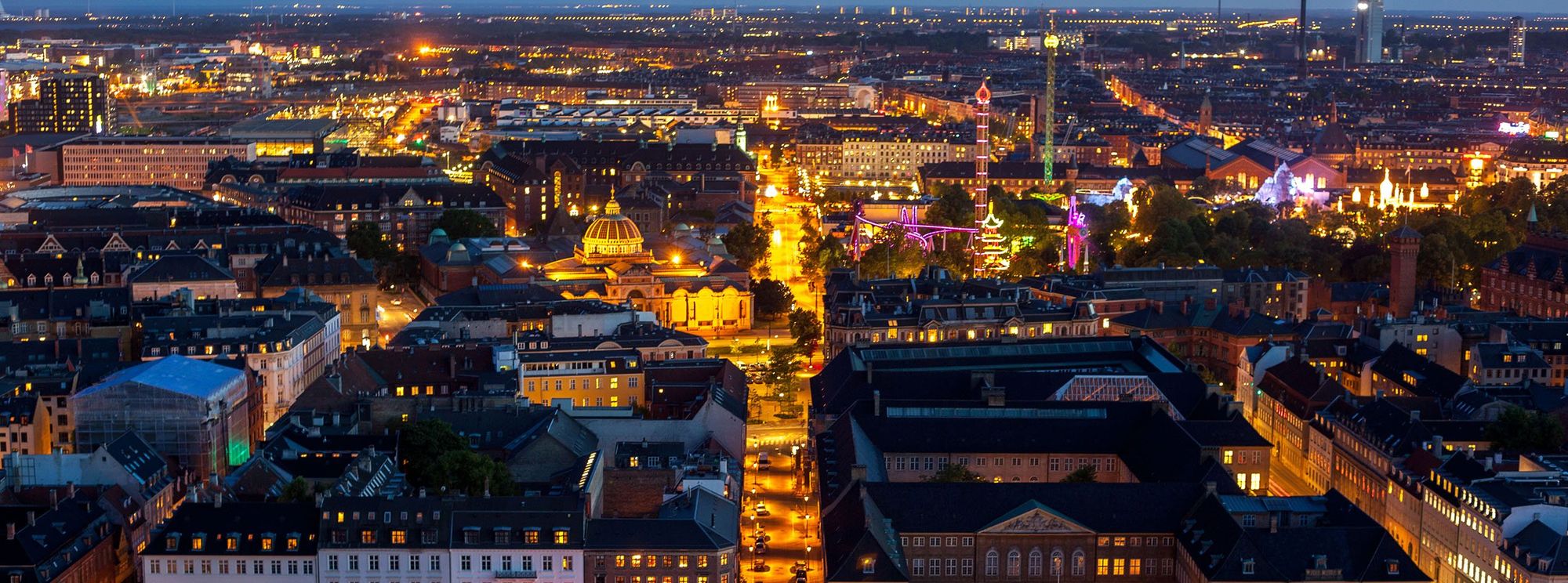
Every city wants to be one – but what is it? Opinions on how a “smart city” should be are as many as the aspirants, though there is an end result which counts for them all. By using modern technologies knitted together, the smart city is a step towards a more sustainable society.
The development is driven by urbanisation. In Metropolitan areas the concept is a way to meet the pressures resulting from an increasing population. The EU is an enthusiastic promoter of the movement and is running its own “Smart Cities Initiative” in order to accelerate the transformation of cities into fossil-free and low-resource communities.
Holistic approach
Copenhagen is considered a frontrunner and was recently awarded the Smart Cities Award for its “Copenhagen Connecting”-project.
“It’s extremely important that you don’t embark on this kind of project for technology’s own sake. A smart city should be created for the benefit of the citizens, to improve their quality of life. For Copenhagen this is also an important step to realise our vision of a C02-neutral city in 2025”, says Søren Kvist, spokesperson and Project Manager at Copenhagen Solutions Lab, the City of Copenhagens incubator for smart city initiatives.
Copenhagen Solutions Lab works cross-departmental with the city’s administration, in partnership with local and international companies and knowledge institutions. This task group provides a 360 sounding board to evoke and test new ideas, technologies and solutions to create a more liveable city in Copenhagen.
“The smart city cannot be seen solely as a matter for the community. We need to interact with many different stakeholders: universities, business life and companies related to energy, water, gas, telecom, sanitation and so on… The realisation of a smart city needs a holistic approach and we’ve found this is an easier way to communicate.”
Lighting as infrastructure
And even if the potential is endless, the connected society has to be born according to a plan. Before heading off, experts were hired to identify possibilities and socio-economic effects. Right now, Copenhagen Connecting is entering a new phase. A test area is built for evaluating different solutions and techniques.
“We’re not first to the ball, many of these technologies have been tried in other cities – but we need to make sure that they’ll work in our Nordic climate and environment”, says Søren Kvist.
An innovative twist is how Copenhagen is planning to use outdoor lighting as infrastructure for the smart initiative. Street lighting is everywhere and every luminaire is connected with electricity, something that’s crucial to get all this tech stuff working. In the coming years 20 000 existing streetlights will also be changed into LEDs.
“Of course it’s a good thing for the environment as they are very energy efficient. But it’s interesting how lighting is also turning into an infrastructure solution, as a vital part when building connectivity”, says Søren Kvist.
Every LED-module can be connected to the city’s IT-system where they can interact with each other. The lighting poles are also excellent for housing sensor equipment for water, wind and pollution as well as for traffic sensors.
“LED-luminaires also have an important advantage as they are always operating. They’re never totally switched off, only dimmed to extremely low levels. This means that other equipment will have power supply, regardless of the time of day.”

From traffic to flooding
The ideas are flowing.
“Traffic is a core subject. For example, we can use the system to generate data for traffic lights, in order to create green waves for car drivers, cyclists and pedestrians. This means reduced pollution related to red light starts and stops and a safer traffic environment with less accidents. But it also saves valuable time for our citizens. Parking is crucial. If the system can be used to guide drivers directly to a free parking lot, it will save a lot of driving, irritation and CO2”, Søren Kvist explains.
“Sanitation is another area that we are looking into. With the help of ‘intelligent trashbins’ we can keep the city clean and plan our routes in a more efficient way. Recently we’ve had some problems with heavy rains and flooding and this system could provide us with the information to guide our efforts”
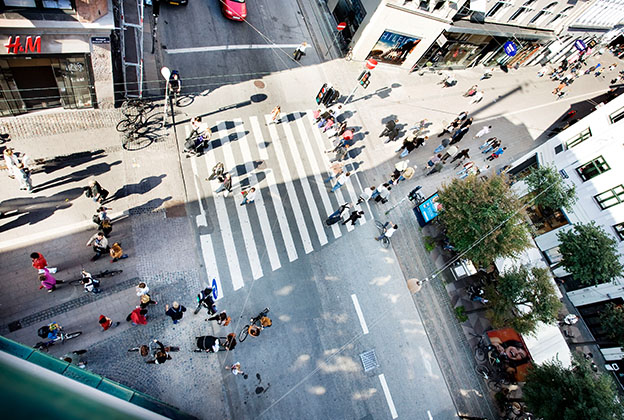
Some of the ideas are already up and running as the municipality of Copenhagen is gifted with an enterprising traffic department. For instance, one has developed a ‘green wave’ application helping commercial traffic to avoid red lights. Copenhagen is known for its well-developed cycling infrastructure and some routes are paved with LEDs shifting between red and green light. This helps the cyclists to keep the right speed and avoid unnecessary stops.
A sharing society
So, what can the lighting industry do to keep up the pace?
“Actually, I think the industry is doing a lot. After many years focusing solely on energy efficiency, producers have started to develop products adapted to network technology. I think it is important to continue on this path, focusing on connectivity and Internet of Things. For us it is also vital that developers within the lighting industry choose to work with open technology”, says Søren Kvist.
Open technology means flexibility and the possibility to share information for the greater good.
“Our vision is to generate open data that can be shared with local entrepreneurs and companies with business ideas that contribute to the smart city and peoples wellbeing. Of course, we carefully consider integrity issues at all times and living in a big data era we have to design all smart city solutions with citizens privacy rights in mind”.
Related News

The flexible office - Long-term investment for property owners
As a property owner, meeting the needs of tenants while creating sustainable and smooth management is often a complex equation. With Control Track Versa, new and sustainable opportunities are created to streamline the process and offer good lighting for tenants. Petter Berg works with pre-sales for extensive property projects at Fagerhult in Oslo. Discussions with customers and more prominent property owners often revolve around the problem of meeting multiple interests both during the construction process and after the tenants have moved in. “The interests of the various actors often clash at the expense of the lighting quality. And then no one is delighted with either the process or the result,” says Petter Berg, Lighting Adviser Manager at Fagerhult. Petter Berg quote Petter Berg has closely observed the development of Control Track Versa and sees future opportunities for property owners. Not least, those who work actively with reuse and sustainability and want to create attractive environments for existing and future tenants can quickly achieve profitability in larger projects. “Being able to offer tenants good lighting without replacing the entire system every time someone moves is a huge sustainability advantage as a property owner. With Control Track Versa, each luminaire can be reused throughout its entire life cycle. In addition, the track itself can take on a new shape if the office changes design.” Property owners can benefit from the advantages of Control Track Versa during construction. The track can be installed earlier during construction and is completely independent of the future furnishings and the tenant’s choice of luminaires. “The fact that the installation can be done in principle at any time and is not dependent on the premises being cleaned of construction dust or that it takes place just before the property is completed makes a big difference. It is an ingenious way to buy time,” says Petter Berg. Collage three rooms - same Versa solution In parallel, installations can be made in fixed areas such as corridors, elevators, toilets, and public places that are not affected by the tenants’ choices. With fewer installation points, installation is also faster and easier. “The track has a flexible 230V system, so there is no need for cable ladders or extra wiring. Therefore, Control Track Versa is also very suitable for open ceilings. Since it is completely independent, the system is also future-proof. Each luminaire can be supplemented with a sensor for smart lighting control.” According to Petter Berg, Control Track Versa bridges the gap between electrical consultants and interior designers. He clearly sees that the track can be very useful in larger construction projects where many parts need to fit together. “When we work together, it often turns out very well. It is clear that a party is needed that connects the developer, electrical consultant and interior designer, and that is where Control Track Versa is now becoming an important party for us at Fagerhult.”
From the turn of the century to rebuilding in the ’70s, our schools are now getting smart lighting
Across Sweden’s municipalities, work is underway to replace fluorescent lamps with LEDs and to adapt luminaires and installations accordingly. Jönköping Municipality is working systematically and efficiently to meet users’ needs for good lighting and create solutions that suit different buildings and styles. We visited three of Jönköping municipality’s school properties: a high school that was built at the turn of the century and two schools from the 1970s. Each school has its own style and architectural expression, but with a common denominator for the future: freestanding LED pendant luminaires with Organic Response control. Peter Honkala is responsible for the electrical installations in two of the municipality’s districts and he is now busy planning and designing new lighting for both properties and businesses: “Now that we are moving from fluorescent lamps to LEDs, we have the chance to create a good learning environment for students, improve the working environment for teachers, increase energy efficiency and reduce cost, all while improving the expression of the properties,” says Peter. Slideshow 1 Architecture rarely an obstacle to lighting control The installation is simple and does not require any major modification of the property. All that is needed is phase, neutral and earth, and wireless buttons for the control. Although the property portfolio contains many types of buildings from different periods and with varying styles, architecture is rarely an obstacle. “We need to be a little more careful in some school properties, like the Per Brahegymnasiet high school, which is over a hundred years old,” explains Peter. “But the installation itself is not very different from a school built in the seventies, or even today. If we miss something during planning, or if a control button is needed after everything is complete, it is very easy to adjust: instead of an installer rerouting cabling, we can simply take down and move luminaires and the lighting control according to the needs of the business.” According to Markus Winnert, Smart Lighting Manager at Fagerhult Sweden, Jönköping Municipality is following a clear trend. Since schools cannot be shut down for extended periods during construction, an efficient and smart solution is needed that is both easy to install and serves as a long-term solution. Winnert quote “As municipalities replace their fluorescent lamps, they take advantage of the opportunity to improve the lighting environment, broadly increase energy efficiency, and secure lighting for the future,” says Markus Winnert. “With pendant luminaires with Organic Response, we create an optimal solution that works in different environments and is easy to install without needing to tear down anything or major rebuilding. At the same time, the luminaires are suitable for different environments - regardless of when the school was built or its style.” Peter Honkala has worked in the industry for many years, and, for a time, the recommendation was to use LED ceiling panels in classrooms. But this recommendation was quickly abandoned, and now pendant luminaires are solely used. “Pendant luminaires provide indirect light, ambient light, with lower luminance,” says Peter. “Modern luminaires are also more efficient and spread light better, so in many classrooms we only need two rows of luminaires instead of three. It improves the light quality and the ceiling becomes significantly airier. We frequently hear how pleased they are with the result, which is very gratifying.” Image block 1 Lighting that can be adapted to the business Moving from fluorescent lamps to LEDs generally reduces energy consumption by fifty percent. And by adding a sensor and lighting control, an additional fifty percent can be saved. At the same time, the working life of both the ballast and the luminaire is extended, which increases the burn-time. But, according to Peter Honkala, the real advantage is that the lighting can be adapted according to each business. “Improving the lighting environment for students is invaluable, and at the same time we are doing something really good for the environment.” “Besides for being easy to install and operate, the major benefit is the use and that we save so much energy,” explains Peter. “Improving the lighting environment for students is invaluable, and at the same time we are doing something really good for the environment. It’s an honour to be part of this development.” Slideshow 2