
Fagerhult is now taking the next step in the evolution of lighting technology. Going forward, the luminaires will be supplied with the latest generation of LEDs featuring Flip Chip technology. For our customers, this means lighting that offers higher energy efficiency, lower energy consumption and superior light quality – while also doubling the operating time.
“Flipped” technology
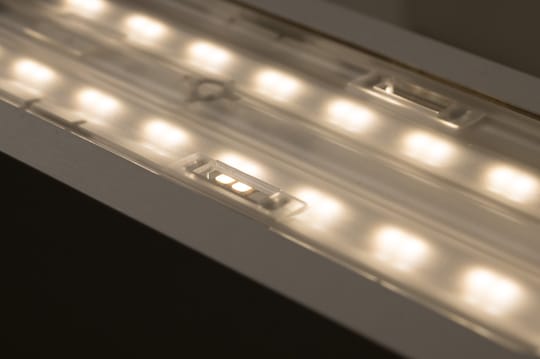
Flip Chip is a premium-segment LED chip that is based on proven technology. The thing that sets Flip Chip apart from standard LEDs is its design.
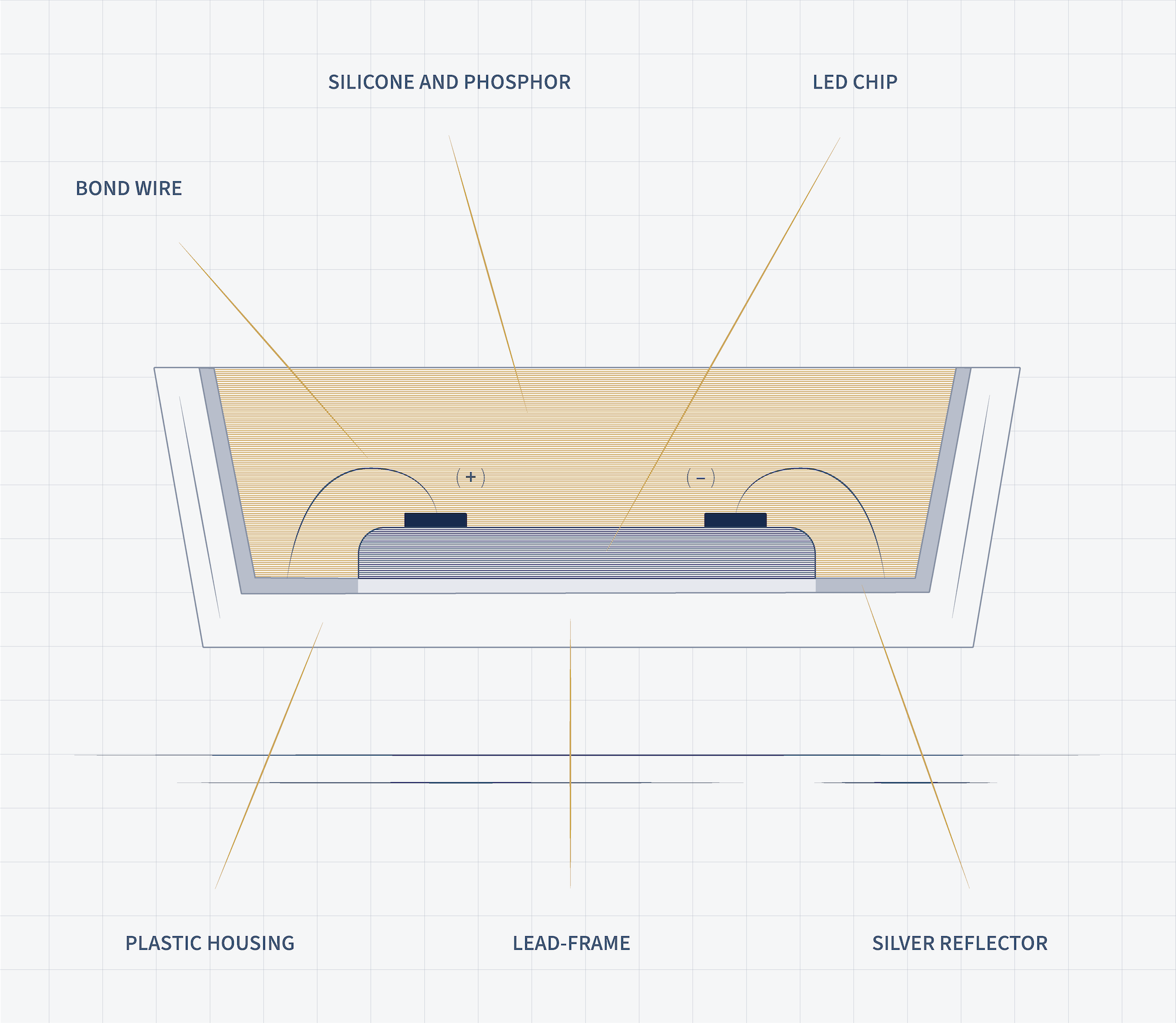
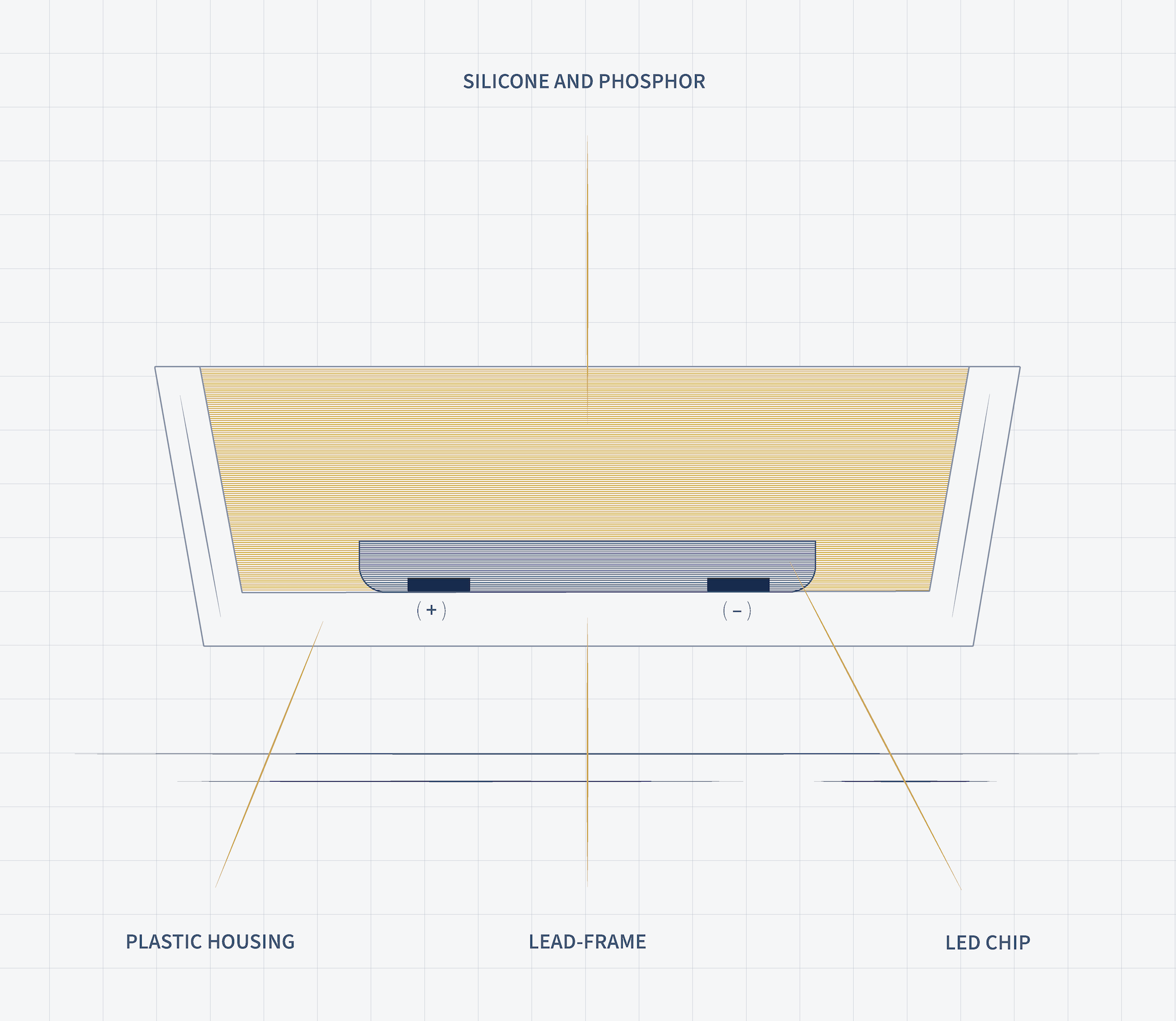
Conventional LED chip vs Flip Chip
“An LED chip is made up of several different layers of material that determine the light’s wavelength and properties. A traditional standard chip is built like a cake with multiple layers, which the light shines up through from the bottom. Electrodes are attached at the top of the ‘cake’ and connected via gold or silver wires. Since these contact surfaces are located at the top, they also block some of the light, which affects the light output and, consequently, energy efficiency. These metal wires are also subjected to ‘stress’ in the event of temperature changes, making them a potential source of failure that can affect the working life of the LED chip,” explains Marcus Fagerlind: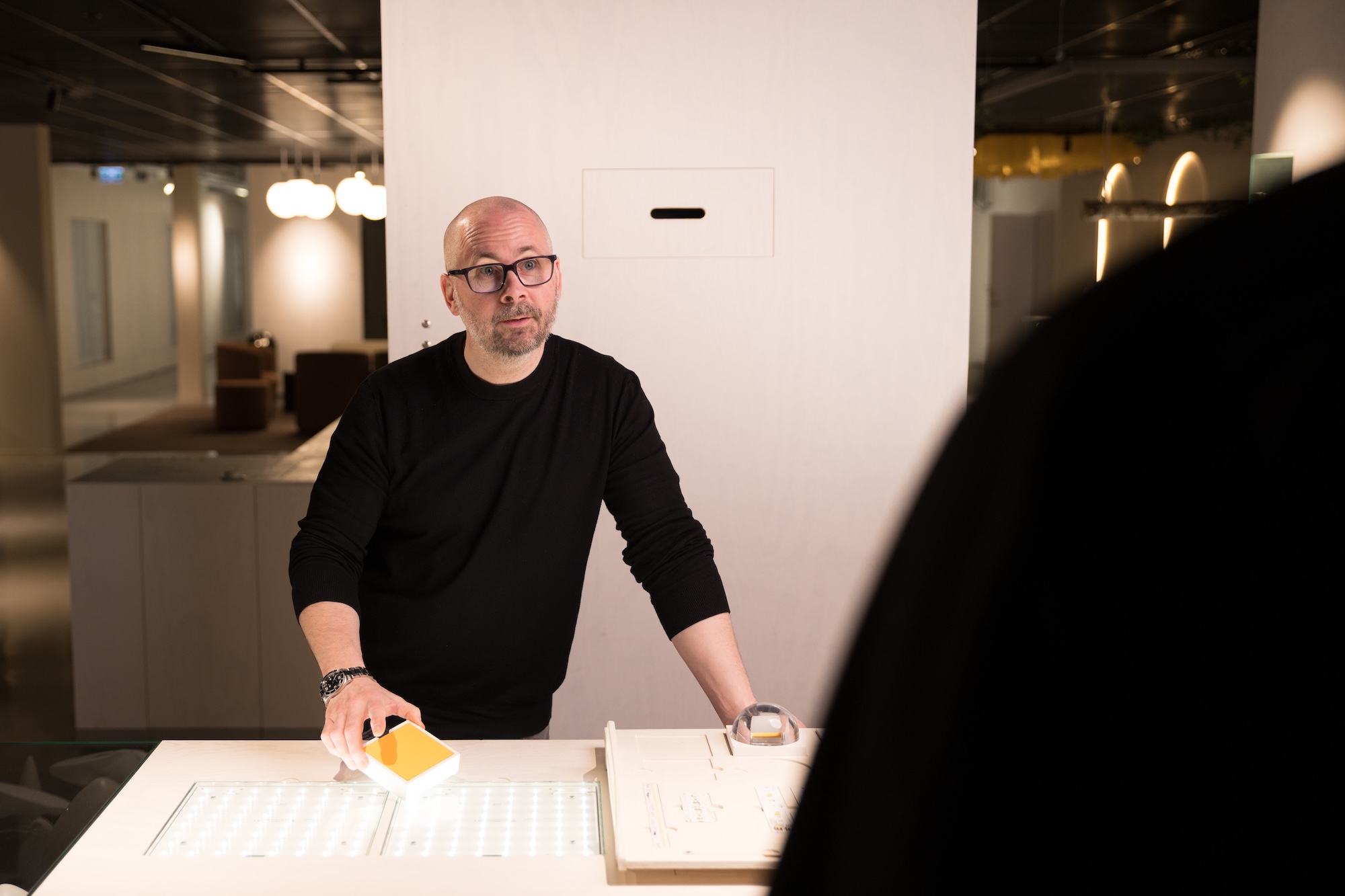
Marcus Fagerlind, Technical Manager for Smart Lighting at Fagerhult, at the Experience Centre in Habo, where lighting solutions are explored and demonstrated.
In a Flip Chip, the cake is simply turned upside down, with all the contact surfaces at the bottom of the chip. This allows the light to flow freely, and the chip operates more efficiently without interference. Placing the contact surfaces at the bottom also helps avoid potential sources of failure in the connecting wires. As a result, the Flip Chip technology delivers a product that is both more efficient and more robust.
Significant energy savings
Equipped with the latest generation of Flip Chip LEDs, Fagerhult’s luminaires will increase energy efficiency by 5–10 percent, depending on their previous configuration.
An efficiency improvement of this magnitude naturally has a significant impact on energy consumption and operating costs, but also on the system’s climate impact.
“In an uncertain world, with energy crises following hot on the heels of each other, it has become even more important to accelerate the green transition – and to ensure that energy efficiency, economic considerations and environmental concerns go hand in hand. Every kilowatt-hour counts,” says Marcus Fagerlind.
The operating time is also being extended – from 50,000 hours to 100,000 hours. A doubling of the working life, in other words, which makes Fagerhult’s luminaires a safe and profitable investment for the future. All upgraded luminaires will also have a constant light output, providing secure, stable, high-quality light throughout their working life.
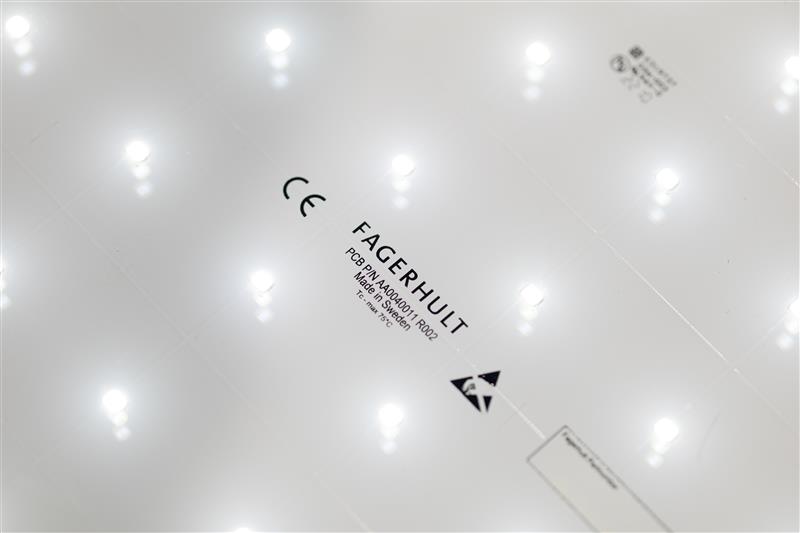
Extended lifetime from 50,000 to 100,000 hours, with stable, high-quality light throughout.
New industry standard
The switch from standard LEDs to Flip Chip covers the majority of Fagerhult’s Indoor range. Luminaire models that already feature Flip Chip will be upgraded to the latest generation of Flip Chip, as will all models that were previously equipped with standard LEDs. This change can improve the energy efficiency of the luminaires and reduce electricity consumption, meaning that with a small amount of effort, it is possible to achieve a very big impact.
That sounds like a major change, doesn't it? “Absolutely,” says Marcus Fagerlind:
“But this approach – daring to take the lead and make the tough decisions needed to bring about change – is very much part of Fagerhult’s DNA. We have never compromised between ergonomics and energy efficiency, choosing instead to drive our innovation efforts to find new solutions. This is an obvious step we have to take, not least for the sake of the climate. We want to take our share of the responsibility. This ought to be the industry standard.”
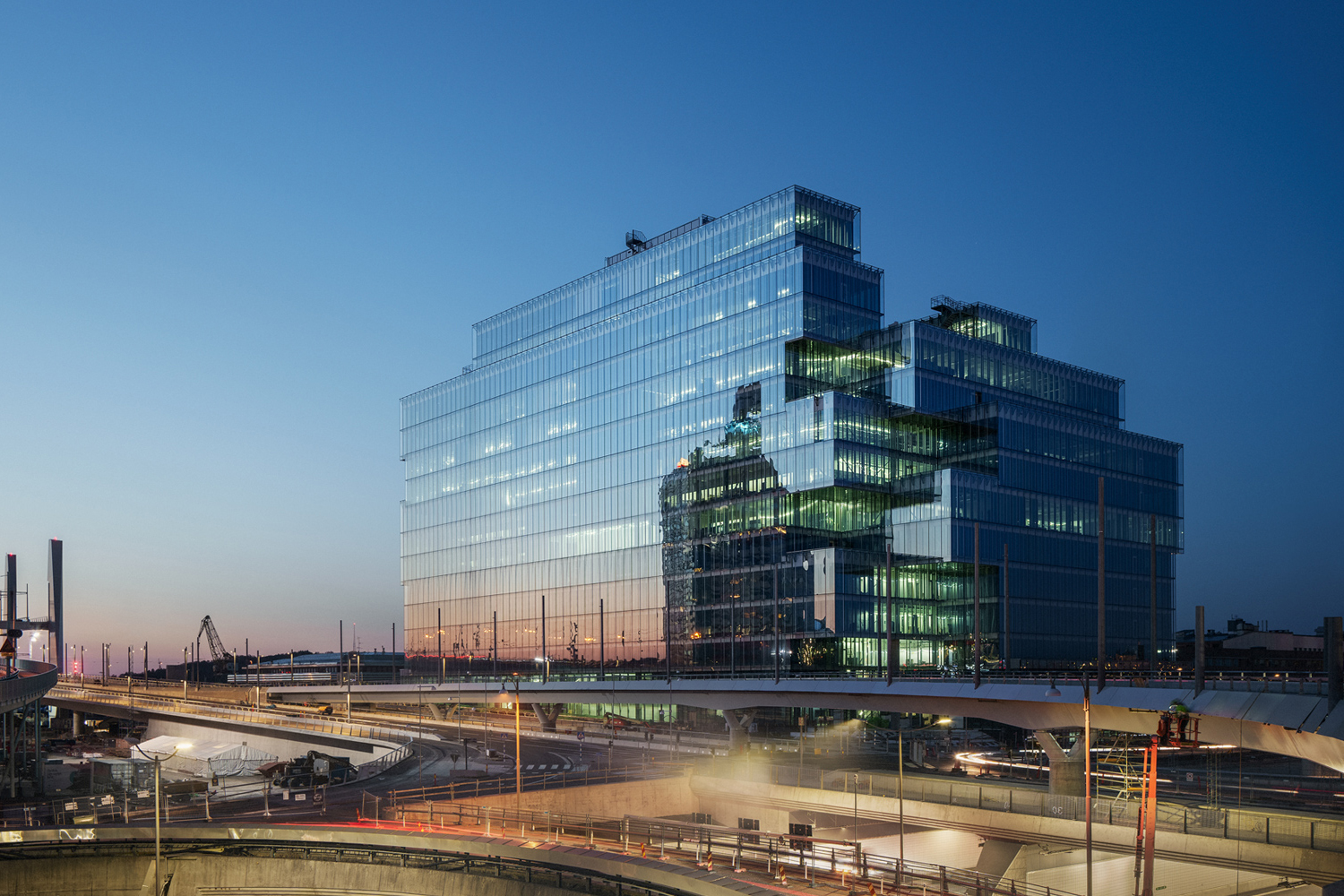
Platinan in Gothenburg features 12,800 luminaires in one of Fagerhult’s largest innovation projects - demonstrating how the latest LED chip technology supports improved light quality and energy efficiency.
Does this mean that the luminaires will become more expensive?
“That’s exactly the point. We don’t want our customers to have to choose between what’s good and what’s actually even better. We also don’t think they should have to choose between strong finances and climate considerations. The cost of the upgrade will not be passed on to customers in the form of more expensive luminaires, but will be financed through the logistical benefits that the change will bring. With our pricing model, our customers gain access to the latest technology – at the same price as before.”
Related News
Fagerhult is switching LEDs to reduce its climate impact
Fagerhult is implementing a major change with the aim of reducing the climate impact of its luminaires. By switching to the latest LED technology, Fagerhult is able to reduce annual emissions by 2,250 tonnes CO₂e from the products it sells. “A small change in each luminaire that has a huge overall impact,” says Niclas Thulin, Sustainability Manager at Fagerhult. The decision to replace the LED technology in the luminaires is a strategic one and has been made at management level. In practice, this means that the majority of Fagerhult’s Indoor range will be equipped with new LEDs featuring the latest generation of Flip Chip technology. This change will improve efficiency and reduce energy consumption by 5–10 percent, depending on the luminaire model. A small change with a big impact “Successful sustainability efforts entail focusing on the right things. In all, 85 percent of Fagerhult’s total climate impact across the entire value chain – Scopes 1–3, in other words – comes from the energy consumption associated with the use of our products. If we can improve efficiency and reduce electricity consumption from a significant portion of our product range, this will have a major impact,” says Niclas Thulin. Extended lifetime from 50,000 to 100,000 hours, with stable, high-quality light throughout. “It’s always difficult to predict exactly how much a change will save, since there are many factors at play. But by using data from 2025 – how many luminaires we sold and to which markets – and assuming that they are used for an average of 50,000 hours without lighting control, we estimate potential savings of approximately 2,250 tonnes of CO₂e each year*.” That is basically an entire forest: “That’s roughly equivalent to the amount of carbon dioxide absorbed by 90,000 trees in a year**. As a result, this change could have a significant impact on both our own and our customers’ environmental efforts.” A small LED upgrade can reduce emissions by approximately 2,250 tonnes of CO₂e per year – equivalent to the amount of carbon dioxide absorbed annually by 90,000 trees. Doubling the operating time The change also offers other sustainability benefits. The operating time of the luminaires is doubled from 50,000 hours to 100,000 hours. In the long run, this will entail a reduction in the consumption of resources such as raw materials and other materials. It will also provide financial benefits for our customers, who can make a secure and profitable investment in energy-efficient lighting with a longer working life. With this new technology, all luminaires will also have a Constant Light Output, providing stable, high-quality light throughout the luminaire’s working life. Put simply, good lighting ergonomics at work. How it works A small change that produces big results – what exactly makes the difference from a technical standpoint?“Our approach involves replacing standard LEDs with the latest generation of Flip Chip technology. In simple terms, Flip Chip has a more advanced design in which electrodes and other contact surfaces are positioned in such a way that they do not block or affect the light output. Flip Chip LEDs are simply more energy-efficient and robust,” explains Niclas Thulin.Luminaire models that already feature this type of LED will be upgraded to the latest generation of Flip Chip, as will all models that were previously equipped with standard LEDs. A win-win for everyone The cost of the upgrade will not be passed on to customers in the form of more expensive luminaires but will be financed through the logistical benefits that the change will bring. Sustainability Manager Niclas Thulin regularly meets customers in Fagerhult’s Sustainability Hub —bringing to life how informed lighting choices can deliver both climate and cost savings. “Larger purchase volumes and fewer item numbers mean we can offer these added benefits. Improved energy efficiency, a longer working life and better light quality, lower energy consumption and, above all, a significant contribution to the climate,” says Niclas Thulin.“Here at Fagerhult, we are committed to fulfilling our social responsibility and offering solutions that can address both climate change and the challenges associated with future electricity supplies. In our opinion, our customers shouldn’t have to choose between affordability and sustainability when it’s possible to have both. It's a win-win for everyone.” * Emission factors by country, based primarily on data from the Association of Issuing Bodies (AIB).** Based on average carbon dioxide absorption according to Ecotree.
Innovation in every fold – Wrapped exceeds in engineering brilliance
As sustainability is no longer a choice but a necessity, innovation must begin with the question: What if we did things differently? For Fagerhult’s R&D team, that question became the spark behind Wrapped, the world’s first pendant luminaire made of cardboard. Traditionally, pendant luminaires are built with metal frames, which is a durable, familiar, and safe method. But the team behind Wrapped wanted to explore another path. Together, they decided to find out if they could create a luminaire that not only performed at a premium level but with minimized environmental impact. After thorough consideration, Solid board – a renewable and recycled cardboard material that had previously only been used in hidden components – now plays the leading role. Wrapped is more than a luminaire, it’s an exploration of forward-thinking and creativity. With no ready-made solutions to lean on, the design team had to start from scratch. Every element, from the construction to the mounting, was looked into and the result is a luminaire that’s both technically solid and environmentally conscious. Gallery: Wrapped details The luminaire body is made of up to 65% recycled cardboard and folds together with high precision cut-outs that fit perfectly. Engineering elegance Wrapped’s body is composed of two primary parts: the inner body and the outer body, both designed to work in harmony for strength and stability. The outer body is held together by a rib made of 75% recycled post-consumer aluminium, locking the folds in place and ensuring shape retention. Its end caps are made from 100% recycled post-consumer plastic and snap into precision-cuts, securing the structure without the need for screws. The junction box is snapped into place and the driver is mounted using small clips, made from recycled post-consumer plastic. The LED board is mounted onto the lens, protected by a cover of Solid board, and the entire light module is locked into place with a louvre. The result is a seamless, screw-free construction that embodies thoughtful design. Design with purpose Fredrik Beckius, Design Engineer at R&D, reflects on the journey:“The challenge was working with a material that we had never used for a pendant luminaire before. We couldn’t mount components the usual way, so we had to find alternative solutions.”Martin Gustafsson, also a Design Engineer, adds:“We had to find a way to produce the luminaire cost-efficiently, both for us and our suppliers. Every design component had to serve more than one purpose.” This dual-purpose thinking is evident throughout Wrapped’s design. It’s not just about aesthetics or sustainability – it’s about engineering brilliance and making every part count. Quote: Martin Gustafsson Sustainability without compromise Wrapped is manufactured in Fagerhult, Habo, using locally sourced recycled and renewable materials. It’s a product born from Swedish innovation, rooted in the legacy of previous sustainable designs like Multilume Re:Think and Kvisten. Unlike many eco-conscious products, Wrapped is quietly confident – and sustainable in its DNA. With high-precision cut-outs, a stable construction, and rigorous testing throughout the process, Wrapped meets all quality standards without compromising its environmental ethos.