
Related News
NEWS ARTICLE |
Fagerhult is switching LEDs to reduce its climate impact
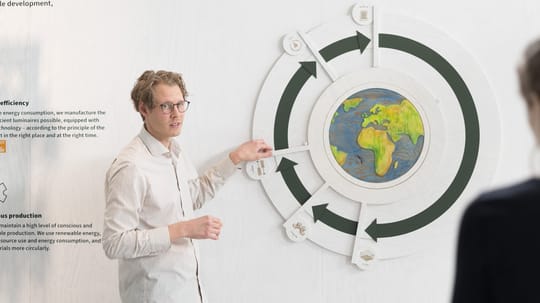
Fagerhult is implementing a major change with the aim of reducing the climate impact of its luminaires. By switching to the latest LED technology, Fagerhult is able to reduce annual emissions by 2,250 tonnes CO₂e from the products it sells. “A small change in each luminaire that has a huge overall impact,” says Niclas Thulin, Sustainability Manager at Fagerhult. The decision to replace the LED technology in the luminaires is a strategic one and has been made at management level. In practice, this means that the majority of Fagerhult’s Indoor range will be equipped with new LEDs featuring the latest generation of Flip Chip technology. This change will improve efficiency and reduce energy consumption by 5–10 percent, depending on the luminaire model. A small change with a big impact “Successful sustainability efforts entail focusing on the right things. In all, 85 percent of Fagerhult’s total climate impact across the entire value chain – Scopes 1–3, in other words – comes from the energy consumption associated with the use of our products. If we can improve efficiency and reduce electricity consumption from a significant portion of our product range, this will have a major impact,” says Niclas Thulin. Extended lifetime from 50,000 to 100,000 hours, with stable, high-quality light throughout. “It’s always difficult to predict exactly how much a change will save, since there are many factors at play. But by using data from 2025 – how many luminaires we sold and to which markets – and assuming that they are used for an average of 50,000 hours without lighting control, we estimate potential savings of approximately 2,250 tonnes of CO₂e each year*.” That is basically an entire forest: “That’s roughly equivalent to the amount of carbon dioxide absorbed by 90,000 trees in a year**. As a result, this change could have a significant impact on both our own and our customers’ environmental efforts.” A small LED upgrade can reduce emissions by approximately 2,250 tonnes of CO₂e per year – equivalent to the amount of carbon dioxide absorbed annually by 90,000 trees. Doubling the operating time The change also offers other sustainability benefits. The operating time of the luminaires is doubled from 50,000 hours to 100,000 hours. In the long run, this will entail a reduction in the consumption of resources such as raw materials and other materials. It will also provide financial benefits for our customers, who can make a secure and profitable investment in energy-efficient lighting with a longer working life. With this new technology, all luminaires will also have a Constant Light Output, providing stable, high-quality light throughout the luminaire’s working life. Put simply, good lighting ergonomics at work. How it works A small change that produces big results – what exactly makes the difference from a technical standpoint?“Our approach involves replacing standard LEDs with the latest generation of Flip Chip technology. In simple terms, Flip Chip has a more advanced design in which electrodes and other contact surfaces are positioned in such a way that they do not block or affect the light output. Flip Chip LEDs are simply more energy-efficient and robust,” explains Niclas Thulin.Luminaire models that already feature this type of LED will be upgraded to the latest generation of Flip Chip, as will all models that were previously equipped with standard LEDs. A win-win for everyone The cost of the upgrade will not be passed on to customers in the form of more expensive luminaires but will be financed through the logistical benefits that the change will bring. Sustainability Manager Niclas Thulin regularly meets customers in Fagerhult’s Sustainability Hub —bringing to life how informed lighting choices can deliver both climate and cost savings. “Larger purchase volumes and fewer item numbers mean we can offer these added benefits. Improved energy efficiency, a longer working life and better light quality, lower energy consumption and, above all, a significant contribution to the climate,” says Niclas Thulin.“Here at Fagerhult, we are committed to fulfilling our social responsibility and offering solutions that can address both climate change and the challenges associated with future electricity supplies. In our opinion, our customers shouldn’t have to choose between affordability and sustainability when it’s possible to have both. It's a win-win for everyone.” * Emission factors by country, based primarily on data from the Association of Issuing Bodies (AIB).** Based on average carbon dioxide absorption according to Ecotree.
NEWS ARTICLE |
When material matters – Wrapped adds a new view on sustainable lighting
In a world where every gram of material and every gram of carbon dioxide counts, Wrapped emerges not just as a luminaire – but as a statement. It’s Fagerhult’s most sustainable pendant to date, and it didn’t happen by accident. Every detail, every decision, every material was chosen with intention. Sustainability often starts with a simple question: What is it made of? For Wrapped, the answer is a trio of materials that each carries its own environmental story. Solid board: a familiar friend At Fagerhult, we first met Solid board in 2021 with Multilume Re:Think. But for Wrapped, we’ve taken it further. The material consists of a three-layer construction featuring a 100% recycled core, a renewable FSC-certified top layer, and a thin protective plastic film. All in all, a material that’s 65% recycled – and a 89% reduction in CO₂ emissions compared to virgin extruded aluminium. Image gallery: Solid board Wrapped is made of organic Solid board, recycled aluminium and post-consumer recycled plastic. Reimagining plastic Plastic is often a hot topic in sustainability conversations. But not all plastic is created equal. Wrapped uses post-consumer recycled plastic: the kind that has lived a life before, perhaps as a shampoo bottle or food container. Pre-consumer plastic, on the other hand, is different as it never made it to the shelf. Quote: Josefin Carlsson Aluminium with a past Inside Wrapped, two structural components are made from 75% post-consumer recycled aluminium. This material is also part of a circular infrastructure – and may even have been part of a Notor luminaire once. Compared to virgin aluminium, this choice reduces emissions by 64%. Designing with less - built to last However, sustainability isn’t just about what you use – it’s about how much. At just 900 mm, Wrapped is shorter than a conventional 1200 mm pendant. That reduction in size alone cuts the climate impact by 25%, without compromising the luminaire’s lighting performance. Josefin Carlsson compares the climate impact of products in Fagerhult's Experience Centre in Habo. To understand the impact of Wrapped, it helps to look at where we started. In 2021, Notor 65 – made from virgin aluminium – had a climate impact of 34 kg CO₂e. By 2024, with 75% recycled aluminium, that number was reduced to 25 kg CO₂e. Today, Wrapped comes in at just around 12 kg CO₂e. “That’s a third of the original Notor 65, and half of the current version, and a quiet revolution, measured in kilograms of CO₂e,” says Josefin Carlsson. After its long life – estimated at 100,000 hours – Wrapped is ready for an equally sustainable exit. Its design makes it easy to disassemble, with each material being recyclable and prepared for its next chapter in the circular economy.
PRESS RELEASE |
Fagerhult uses recycled aluminium for high-volume products — ensuring circular use of resources
With a focus on reducing its long-term greenhouse gas emissions, Fagerhult now choose extruded aluminium profiles containing 75% recycled material from end users. The material is used for product families manufactured and sold in larger volumes — and where the material can make a real difference. The initiative reduces Fagerhult’s climate footprint by approximately 225 tons of CO2e per year.Aluminium is a lightweight and durable material that can be reused multiple times if recycled properly. Its environmental impact depends on several factors, including whether it is made from virgin aluminium, how it is produced, whether fossil fuels or renewable energy sources were used in its production, and if it is derived from recycled materials.Niclas Thulin is Sustainability Manager at Fagerhult:“We are taking a significant step forward by moving from renewably sourced aluminium to recycled aluminium (post consumer). The Notor family – together with several other product families – is now made of extruded aluminium that is 75% recycled. This results in around 70% lower climate impact than the average impact from European primary aluminium and 88% lower than the global average for primary aluminium*.”The change affects products sold in larger volumes. The products Notor 65, Notor Recessed, Notor 36, Fjord, Vil, Multilume Hydro, and Sentra are now made of recycled aluminium.“We intentionally upgrade the materials for our larger product series because it significantly impacts Fagerhult's greenhouse gas emissions. For the Notor family alone, we used approximately 65 kilometres of aluminium profiles in 2024, and nearly all of this volume has now been replaced with recycled material,” says Niclas Thulin.The change is part of Fagerhult's systematic sustainability work and a considerable step in reducing greenhouse gas emissions in Scope 3: the company's indirect emissions from purchased materials. The Science Based Targets validate Fagerhult's climate targets, and the ambition is to achieve net zero emissions from the entire value chain by 2045.“This is our most important decision regarding materials, at least with reduced climate impact as the fundamental incentive. The majority of our emissions come from Scope 3, and through this change, we are making a difference where it has the greatest impact. Based on last year's volumes, the switch to recycled aluminium can reduce emissions by approximately 225 tons of carbon dioxide equivalents annually.”*Climate impact excluding the extrusion process. EPD compared to the European average for primary aluminium (European Aluminium) and the global average for primary aluminium (International Aluminium).
Return to top