At Fagerhult there is a deeply rooted innovation culture that undoubtedly influences all aspects of the work. Possibly it springs from the founder Bertil Svensson’s mindset of solving problems with sometimes small means, but with a lot of curiosity and stubbornness. Even though sustainability was not a buzzword during Bertil’s days, durability and quality have always been cornerstones for the company. And the ongoing climate awareness has urged us all to challenge previous ways of thinking, and made us conscious of new fields possible for more long-lasting solutions.
For many years, BESPOKE LIGHTING SOLUTION (BLS), Fagerhult’s bespoke development department has developed unique luminaires and adapted solutions. They produce newly built luminaires, and refurbished and updated old fixtures - but has not previously had an outspoken sustainable agenda as motif from their clients. But the will and interest to refurbish and rebuild old luminaires is a sustainable trend that is increasing. A process in which yesterday’s design and technology are brought up to speed by todays advances, in order to meet the requirements of tomorrow.
 "It is more frequent now, than previously, that our clients has an outspoken will to save materials and energy in their projects." Johan Ericsson, project manager
Rebuild, refurbish or repair?
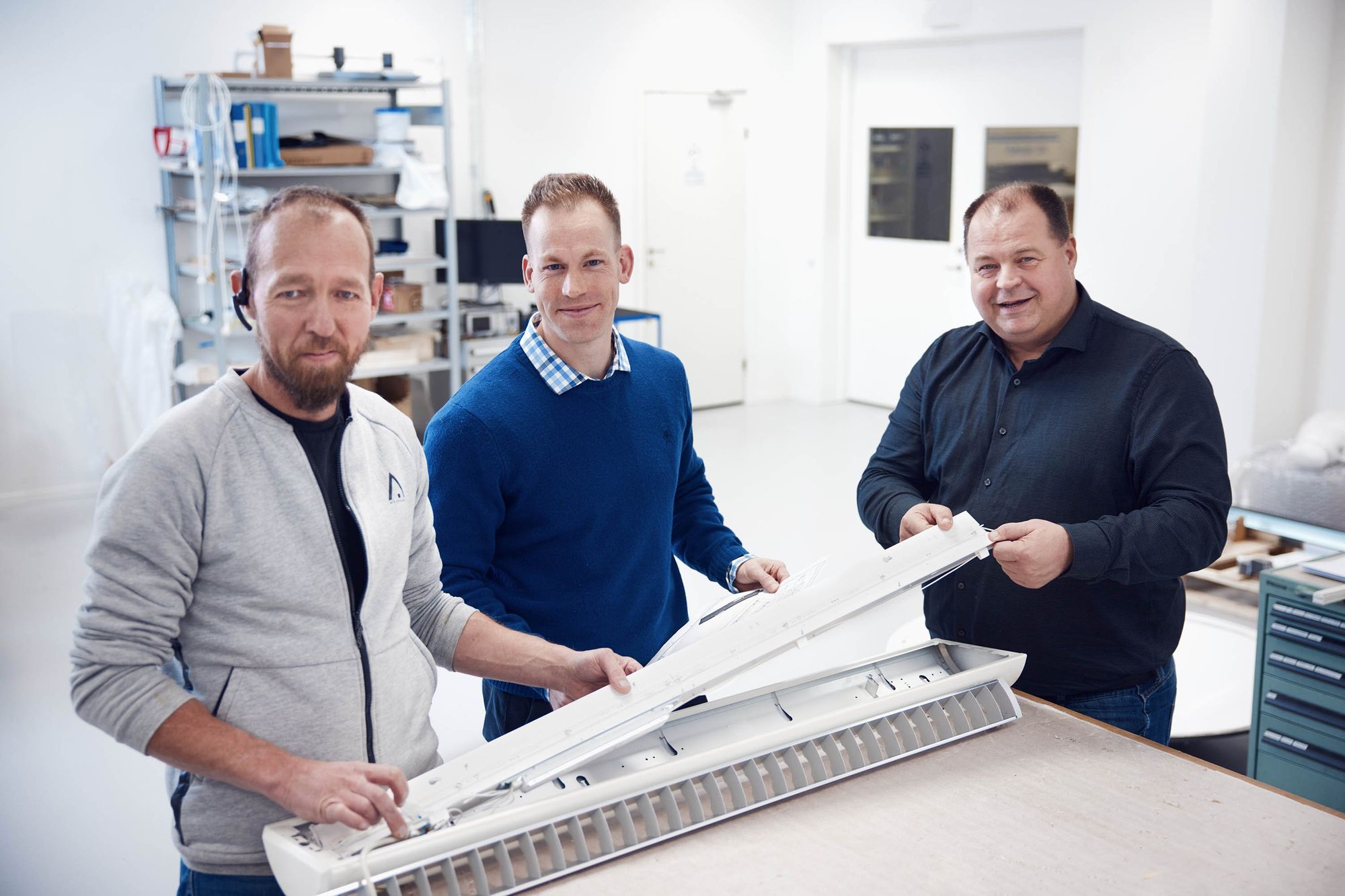
Johan Ericsson and Peter Eklund are both project managers at BLS, where unusual questions and close to impossible solutions are a part of their everyday work. Together with their colleagues, they manage inquiries from all Fagerhult’s markets, regarding special developed lighting solutions for different projects. But what kind of projects choose to refurbish, instead of investing in a new luminaire – and why?
– There are many different reasons as to why a luminaire might need to be rebuilt or refurbished instead of just replaced, Johan Ericsson explains further. There are circumstances when the luminaire is a part of the aesthetics or the design of the premises and cannot be replaced or altered. In other cases the luminaire is a part of the construction, or is built in a way where it cannot be removed, just updated. In yet other cases, and that is more frequent now than previously, there is an outspoken will to save materials and energy – and make an environmental effort by updating the luminaires instead of buying newly produced ones.
– No matter what the background is, the main focus for us is – as always – to help the client to solve the problem at hand, says Peter Eklund. In order to do so we have different solutions for different situations. But all our solutions are carefully evaluated before suggested to the client, whether it is to refurbish, rebuild or develop a new luminaire. For us, the quality of the product and its outcome, is the most important part of the process. Apart from making our client satisfied, of course.
Safty first
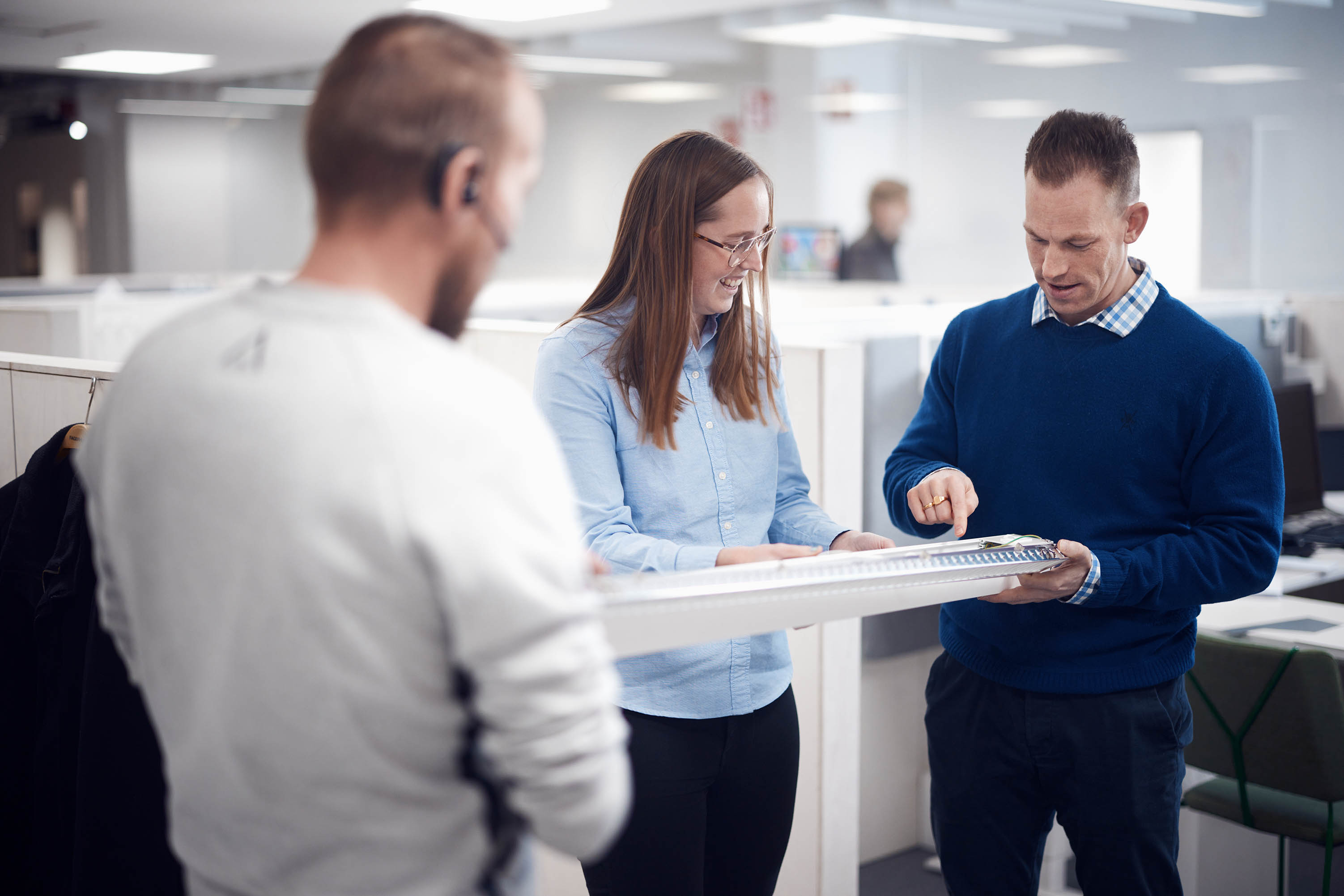
No matter the project, safety and quality are the red thread combining all Fagerhult’s products. And the special projects are sure to be no exceptions. But to be able to guarantee a secure and comfortable lighting solution it needs to be tested. For refurbishment projects that could seem like a tricky part, but there are solutions even for this. Peter Eklund explains:
– A crucial issue is the CE-marking and testing in cases like these. The request from our Technical Centre is that we deliver a unit that is as close to a complete luminaire as possible. If we send loose parts that are assembled on site, we cannot guarantee the quality of the end product. But if the LED package is assembled and tested in our centre, as a unit, we can ensure that it works and keep up to standards even when it is inserted in the old luminaire body.
– In these cases, we have made calculations to ease the assembling part as much as we can, Johan Ericsson develops further. We produce the new light packages so that they fit into the old screw holes, to facilitate installation as much as possible.
 "No matter what the background is, the main focus for us is – as always – to help the client to solve the problem at hand." Peter Eklund, project manager
Old and used or old and gold?
In a very environmental aware era, it is easy to get caught up in the will of doing something good, when the outcome might in fact be the very opposite. Not all old luminaires are meant to live forever, some of them are outdated and is better to be recycled instead of refurbished. Johan Ericsson explains:
– We have already pinpointed a few luminaires in our range where we know that it is more efficient to actually buy a new luminaire, than refurbish an old. This because in the process of updating it, we need to add as much new material as in a new luminaire. Then we also have the aspect of lighting comfort. Some of the old design and materials are just not as good as today’s modern techniques. And I don’t think you should forget the aesthetic aspect, since people do have these fixtures in their working environment in some cases. Even if a luminaire can be ledified, it may not be certain that it is nice and cheeky to have in your office today.
– No matter the reasons, we always calculate and balance the effort and gain by rebuilding, refurbish or updating an existing luminaire compared to buying, or developing, a new one, says Peter Eklund. Our primary goal is always that the client is equipped with the best lighting solution for the project, and we want it to be safe and secure – whether it might be a refurbished luminaire or a new one. We would never do a refurbish project if it is not the best solution for the client and the environment. Some products are suitable and others not, and we have the competence to make that decision.
Related News
Fagerhult halves CO₂ emissions – 49% reduction since 2021
Material choices, product innovations, reuse initiatives, and a systematic analytical approach underpin Fagerhult’s reduced climate impact. Over five years, total CO₂ emissions have decreased by 49 per cent – far exceeding the company’s own targets. Using resources wisely has been a cornerstone throughout Fagerhult’s 80-year history, and it continues to shape the business today. Since 2021, this work has gained even sharper focus and direction, with clear carbon-emission targets, long-term plans, and a comprehensive sustainability programme based on life-cycle assessments (LCA).“A reduction of this magnitude in such a short time shows that systematic work truly makes a difference. It is the result of many large – and small – initiatives, where every improvement contributes to the whole,” says Josefin Carlsson, Sustainability Specialist at Fagerhult. Fagerhult's total CO₂ emissions have decreased by 49 per cent compared to 2021 levels. Many initiatives – one shared direction The success is underpinned by a series of strategic decisions in product development and processes. The work has been carried out across several parallel tracks, following the principle many small streams together create significant impact.“Innovation and sustainable solutions make a real difference for our customers and reduce emissions across the entire value chain – not just in our own production,” adds Josefin Carlsson. Josefin Carlsson, Sustainability Specialist at Fagerhult, Habo. The greatest impact is in the use phase, where emissions since 2021 have been steadily reduced by around 200,000 tonnes of CO₂e – a 49 per cent decrease. At the same time, emissions in Scope 1 and 2 have been reduced by 60 per cent compared with the base year. Sustainability in practice A decisive factor behind this progress is the many parallel initiatives, with material choices playing a central role.Since 2025, the majority of luminaires with housings made from extruded aluminium profiles contain up to 75 per cent recycled material. This contributes to an annual climate saving of approximately 225 tonnes of CO₂e.In 2025, Fagerhult reused more than one hundred luminaires per working day through the ReLight initiative. By upgrading existing luminaires with new technology and extending their life cycle, the climate impact from materials and production is significantly reduced. In total, more than 50,000 products have been given a new lease of life through reuse.Product development is also a key driver of the transition, and several innovations have both reduced climate impact and increased energy efficiency: Multilume Re:Think has reduced Scope 3 emissions by over 320 tonnes of CO₂e through smart design and environmentally sustainable material choices since its launch in 2021. This is equivalent to planting and growing 1,300 trees for ten years. Twin Dual Driver has reduced the climate impact of control gear by 49 per cent through more efficient electronics and improved material composition. Wrapped’s Solid Board housing has up to 89 per cent lower climate impact per kilogram compared with virgin aluminium. Gallery - products At the same time, more than one in ten luminaires sold today includes an integrated sensor, helping to reduce energy consumption during operation. A key factor behind the success is the long-term, fact-based approach.“Based on life cycle assessments, we have identified where and when climate impact occurs – and which actions have the greatest impact. We’re now carrying that knowledge forward in our continued efforts to further reduce our climate impact,” concludes Josefin Carlsson.
Fagerhult is switching LEDs to reduce its climate impact
Fagerhult is implementing a major change with the aim of reducing the climate impact of its luminaires. By switching to the latest LED technology, Fagerhult is able to reduce annual emissions by 2,250 tonnes CO₂e from the products it sells. “A small change in each luminaire that has a huge overall impact,” says Niclas Thulin, Sustainability Manager at Fagerhult. The decision to replace the LED technology in the luminaires is a strategic one and has been made at management level. In practice, this means that the majority of Fagerhult’s Indoor range will be equipped with new LEDs featuring the latest generation of Flip Chip technology. This change will improve efficiency and reduce energy consumption by 5–10 percent, depending on the luminaire model. A small change with a big impact “Successful sustainability efforts entail focusing on the right things. In all, 85 percent of Fagerhult’s total climate impact across the entire value chain – Scopes 1–3, in other words – comes from the energy consumption associated with the use of our products. If we can improve efficiency and reduce electricity consumption from a significant portion of our product range, this will have a major impact,” says Niclas Thulin. Extended lifetime from 50,000 to 100,000 hours, with stable, high-quality light throughout. “It’s always difficult to predict exactly how much a change will save, since there are many factors at play. But by using data from 2025 – how many luminaires we sold and to which markets – and assuming that they are used for an average of 50,000 hours without lighting control, we estimate potential savings of approximately 2,250 tonnes of CO₂e each year*.” That is basically an entire forest: “That’s roughly equivalent to the amount of carbon dioxide absorbed by 90,000 trees in a year**. As a result, this change could have a significant impact on both our own and our customers’ environmental efforts.” A small LED upgrade can reduce emissions by approximately 2,250 tonnes of CO₂e per year – equivalent to the amount of carbon dioxide absorbed annually by 90,000 trees. Doubling the operating time The change also offers other sustainability benefits. The operating time of the luminaires is doubled from 50,000 hours to 100,000 hours. In the long run, this will entail a reduction in the consumption of resources such as raw materials and other materials. It will also provide financial benefits for our customers, who can make a secure and profitable investment in energy-efficient lighting with a longer working life. With this new technology, all luminaires will also have a Constant Light Output, providing stable, high-quality light throughout the luminaire’s working life. Put simply, good lighting ergonomics at work. How it works A small change that produces big results – what exactly makes the difference from a technical standpoint?“Our approach involves replacing standard LEDs with the latest generation of Flip Chip technology. In simple terms, Flip Chip has a more advanced design in which electrodes and other contact surfaces are positioned in such a way that they do not block or affect the light output. Flip Chip LEDs are simply more energy-efficient and robust,” explains Niclas Thulin.Luminaire models that already feature this type of LED will be upgraded to the latest generation of Flip Chip, as will all models that were previously equipped with standard LEDs. A win-win for everyone The cost of the upgrade will not be passed on to customers in the form of more expensive luminaires but will be financed through the logistical benefits that the change will bring. Sustainability Manager Niclas Thulin regularly meets customers in Fagerhult’s Sustainability Hub —bringing to life how informed lighting choices can deliver both climate and cost savings. “Larger purchase volumes and fewer item numbers mean we can offer these added benefits. Improved energy efficiency, a longer working life and better light quality, lower energy consumption and, above all, a significant contribution to the climate,” says Niclas Thulin.“Here at Fagerhult, we are committed to fulfilling our social responsibility and offering solutions that can address both climate change and the challenges associated with future electricity supplies. In our opinion, our customers shouldn’t have to choose between affordability and sustainability when it’s possible to have both. It's a win-win for everyone.” * Emission factors by country, based primarily on data from the Association of Issuing Bodies (AIB).** Based on average carbon dioxide absorption according to Ecotree.