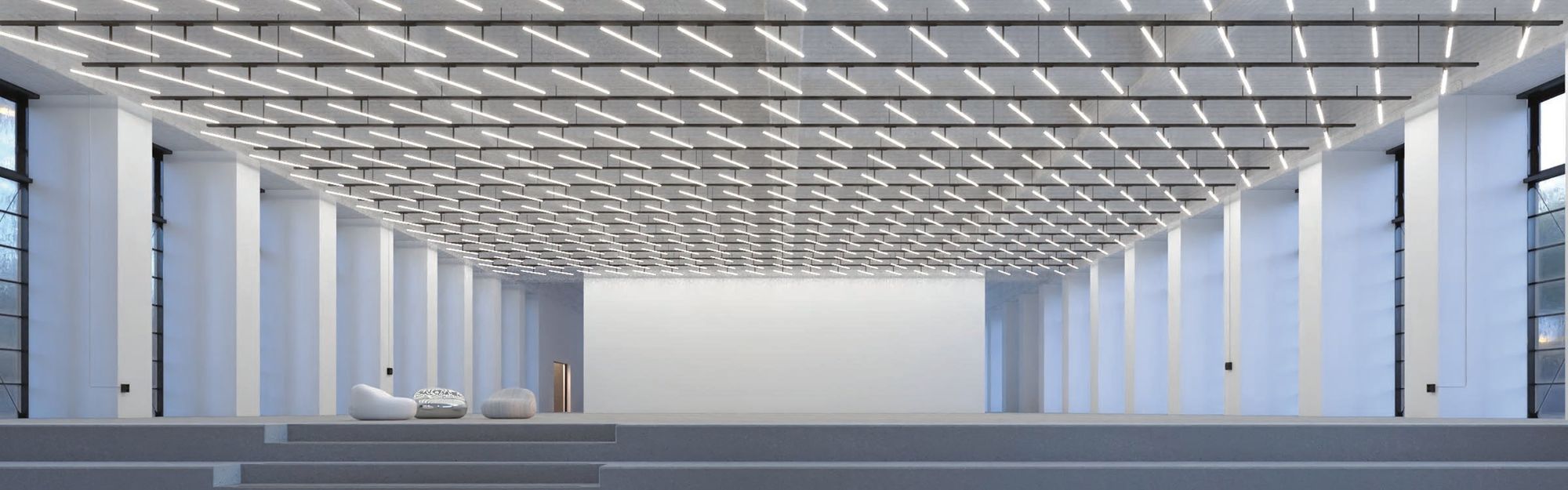
Spotlight Twister and her sibling Twister Line, designed by architect Jani Kristoffersen, is a sophisticated homage to the geometric lines of the 1980’s and to light itself. Originally bespoke for Fotografiska London, a project unfortunately delayed due to the situation in the world, the Twister family sprung from a flirt with the industrial romance. A romance, that soon turned in to a love affair.
”The Fotografiska house has been a joy to work with. It is a 1980’s office building with all the qualities of the postmodern era. It has strong, geometrical primary forms that we’ve pushed further, building our own universe based on squares and circles”, explains Jani.
In this project, the devil is truly in the details. Merging the disciplines of architecture and product design, Design Campus had the opportunity to take a holistic approach on the interior design.
”We wanted to make sure that this world we’ve created was a perfect one, down to the floor mats. We’ve designed our own products, integrating the building’s geometric shapes into the design.”
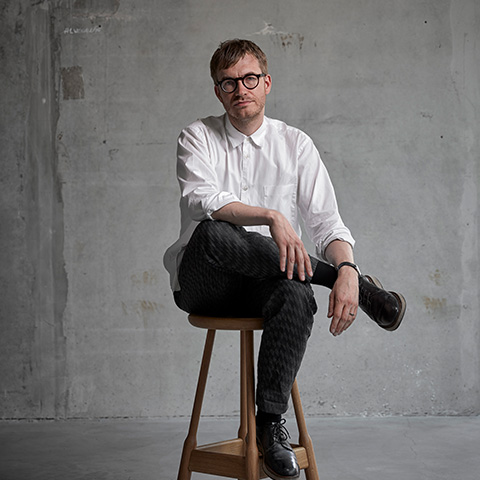 "It felt really good working with people that know lighting technology and how to solve all the details. As we didn’t want to compromise on size and shape it took some serious engineering skills." Jani Kristoffersen, Design Campus
Primary light form
The result of the collaboration is called Twister, a sleek spotlight for focused accent lighting, and her sibling Twister Line, a generic tube of light that creates patterns and directions. With a design that communicates its area of use and architectural residence, the Twister family has the qualities of a future post-postmodern classic.
”When it comes to lighting, working with geometrical forms comes naturally. Going back in history the circular form has been the primary choice when letting daylight in to a building”, says Jani. ”We’ve played with the primary forms, with the ambition to reduce the design as far as possible. I think the shape of the handle, for Twister, has a strong symbolism, which corresponds with the postmodern expression.
The same goes for her sister, Twister Line, that is a generic luminaire – a product that, when it is used creatively, can enhance and transform a venue and its impression. With simple adjustments you can easily create multiple patterns, or recipes, with these glowing tubes. I find it to be a an amazing tool for me as a designer.”
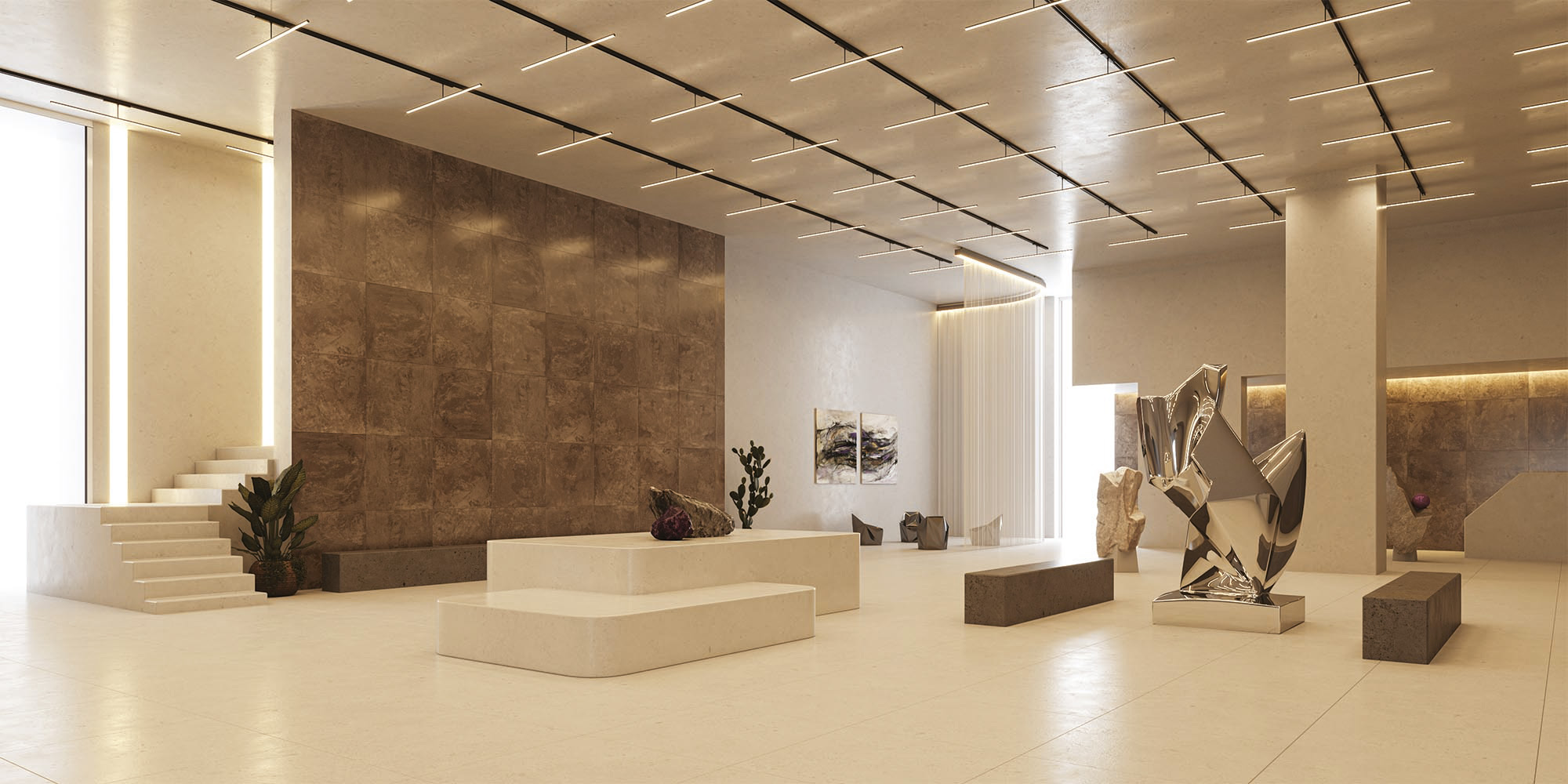
Lighting was no exception
Established by the Broman Brothers in Stockholm in 2010, Fotografiska has become a huge success and one of Sweden’s most popular destinations. In 2019 they opened in New York and Talinn. The London branch, located in the dynamic Whitechapel area, is housed in a 1980’s office building that has undergone a radical transformation orchestrated by Design Campus.
”We’ve had the honour to work with Fotografiska in their original venture and of course we were really happy to get this opportunity”, says Design Campus's co-founder Jani Kristoffersen.
”We looked at a number of different luminaires but didn’t find anyone that corresponded with our world. So we decided to go for our own design. The trick was to find a partner that could develop our ideas with the proper lighting technology and put the luminaires into production. We were told that Fagerhult was the obvious choice.”
The co-operation with Fagerhult has been a creative meeting between the architect’s ideas and human centred lighting design. The Twister family’s design doesn’t give away anything about its high tech properties: True to Fagerhult’s philosophy it has state of the art lighting quality and is packed with contemporary solutions for lighting control.
”It felt really good working with people that know lighting technology and how to solve all the details. As we didn’t want to compromise on size and shape it took some serious engineering skills. I’ve learned a lot about lighting technology through this collaboration”, says Jani who is happy to announce that his design will be set into mass production.
Related News

Innovation in every fold – Wrapped exceeds in engineering brilliance
As sustainability is no longer a choice but a necessity, innovation must begin with the question: What if we did things differently? For Fagerhult’s R&D team, that question became the spark behind Wrapped, the world’s first pendant luminaire made of cardboard. Traditionally, pendant luminaires are built with metal frames, which is a durable, familiar, and safe method. But the team behind Wrapped wanted to explore another path. Together, they decided to find out if they could create a luminaire that not only performed at a premium level but with minimized environmental impact. After thorough consideration, Solid board – a renewable and recycled cardboard material that had previously only been used in hidden components – now plays the leading role. Wrapped is more than a luminaire, it’s an exploration of forward-thinking and creativity. With no ready-made solutions to lean on, the design team had to start from scratch. Every element, from the construction to the mounting, was looked into and the result is a luminaire that’s both technically solid and environmentally conscious. Gallery: Wrapped details The luminaire body is made of up to 65% recycled cardboard and folds together with high precision cut-outs that fit perfectly. Engineering elegance Wrapped’s body is composed of two primary parts: the inner body and the outer body, both designed to work in harmony for strength and stability. The outer body is held together by a rib made of 100% recycled post-consumer aluminium, locking the folds in place and ensuring shape retention. Its end caps are made from 100% recycled post-consumer plastic and snap into precision-cuts, securing the structure without the need for screws. The junction box is snapped into place and the driver is mounted using small clips, made from recycled post-consumer plastic. The LED board is mounted onto the lens, protected by a cover of Solid board, and the entire light module is locked into place with a louvre. The result is a seamless, screw-free construction that embodies thoughtful design. Design with purpose Fredrik Beckius, Design Engineer at R&D, reflects on the journey:“The challenge was working with a material that we had never used for a pendant luminaire before. We couldn’t mount components the usual way, so we had to find alternative solutions.”Martin Gustafsson, also a Design Engineer, adds:“We had to find a way to produce the luminaire cost-efficiently, both for us and our suppliers. Every design component had to serve more than one purpose.” This dual-purpose thinking is evident throughout Wrapped’s design. It’s not just about aesthetics or sustainability – it’s about engineering brilliance and making every part count. Quote: Martin Gustafsson Sustainability without compromise Wrapped is manufactured in Fagerhult, Habo, using locally sourced recycled and renewable materials. It’s a product born from Swedish innovation, rooted in the legacy of previous sustainable designs like Multilume Re:Think and Kvisten. Unlike many eco-conscious products, Wrapped is quietly confident – and sustainable in its DNA. With high-precision cut-outs, a stable construction, and rigorous testing throughout the process, Wrapped meets all quality standards without compromising its environmental ethos.
Fagerhult introduces the world’s first premium pendant luminaire made of cardboard
The new Fagerhult luminaire Wrapped is designed and made in Sweden – and combines premium lighting, high efficiency, and low weight with being the company’s most climate-friendly, premium luminaire to date.Wrapped’s luminaire body is made of organic recycled cardboard – Solid board – which has 89% less climate impact per kilogram than aluminium. The few details made of plastic and metal are also sourced from recycled post-consumer materials. The result is a pendant luminaire with minimised environmental impact throughout, without compromising on light quality or design. “By choosing Solid board, we’re stretching the idea that a pendant luminaire must be made of aluminium. We simply asked ourselves: Can we use another renewable and recycled material that is part of an established circular infrastructure?” says Christer Liljegren, Product Manager at Fagerhult.Sustainability meets affordabilityWrapped combines premium lighting performance with a favorable price point – and makes sustainable lighting solutions available to a wider audience. The lighter choice of material also enabled a total weight of 1.6 kilograms (Pendant, 900 mm).“I think the installers will appreciate Wrapped just as much as we do. It really is surprisingly light and easy to handle,” says Christer Liljegren.The launch includes Wrapped Pendant 900 mm. The low amount of material makes it a truly sustainable choice as it performs just as good as a general 1200 mm luminaire in many applications. It is available with the Beta Opti louvre and has a 50/50 direct and indirect light distribution – and maintains excellent visual ergonomics. The product family will be expanded with additional variants in 2026.Continuing a legacy of sustainable innovationWrapped builds on Fagerhult’s innovative work with sustainable materials, following the Multilume Re:Think (also made of Solid board) and the Kvisten wooden luminaire.“Wrapped embodies our idea of light for a brighter tomorrow – combining premium lighting with sustainability at an accessible level,” says Paula Backman, Product and Marketing Director at Fagerhult.