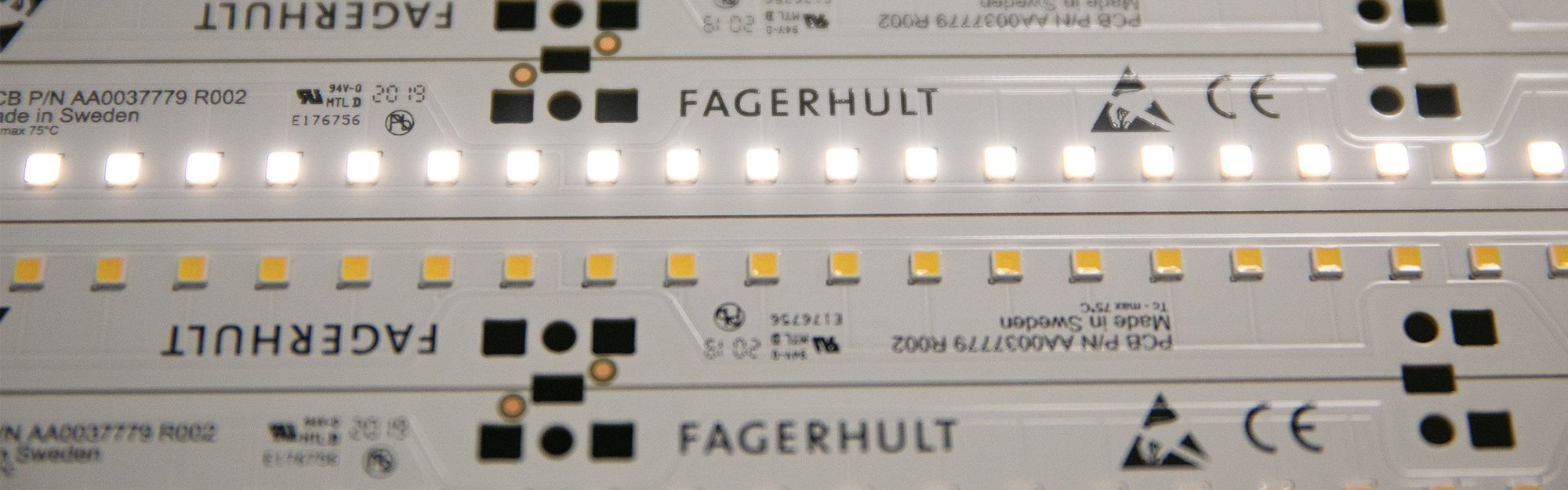
Ever since the mid-1940s, our factory in Fagerhult has been producing luminaires to brighten people’s lives. In that time – nearly 75 years – technologies and trends have come and gone. New materials, tools and innovations have brought the company to where we are today, one of Europe’s leading manufacturers of high-quality luminaires. At Fagerhult, we have closed a chapter of our history, putting traditional light bulbs to rest. Our light source production is 100% LED. Another step towards more sustainable and energy-efficient luminaire use.
Where it all began
Fagerhult’s LED journey began in 2003. At that time, we used them as emergency lighting in our luminaires. Two key issues determined how and when Fagerhult was to implement LED. Back then, the technology was considerably more expensive and not yet efficient enough compared to existing T5 fluorescent lamps. We also saw how others were using LED technology in a manner that was unacceptable to us, as it went against one of our core values, lighting comfort.
However, the technology developed rapidly and we’ve been offering LED luminaires as general lighting since 2009. At Fagerhult, we soon realised that investments were needed. Not only in expertise in this new technology, but also in equipment and in-house production capabilities.
“Many new – and at the time ‘unknown’ – LED suppliers popped up; suppliers whose knowledge of lighting technology was lacking. We had to try to get them to understand our needs,” says Kenneth Rudenbrandt, Technical Product Manager. “Having stood on the sidelines following development, we realised that LED technology was here to stay. That’s when we appointed a technical manager at Fagerhult, who through study visits, trade fairs and seminars gathered information on what others were doing and planning. This then provided a basis for further efforts in our LED technology development work.”
Quality over quantity
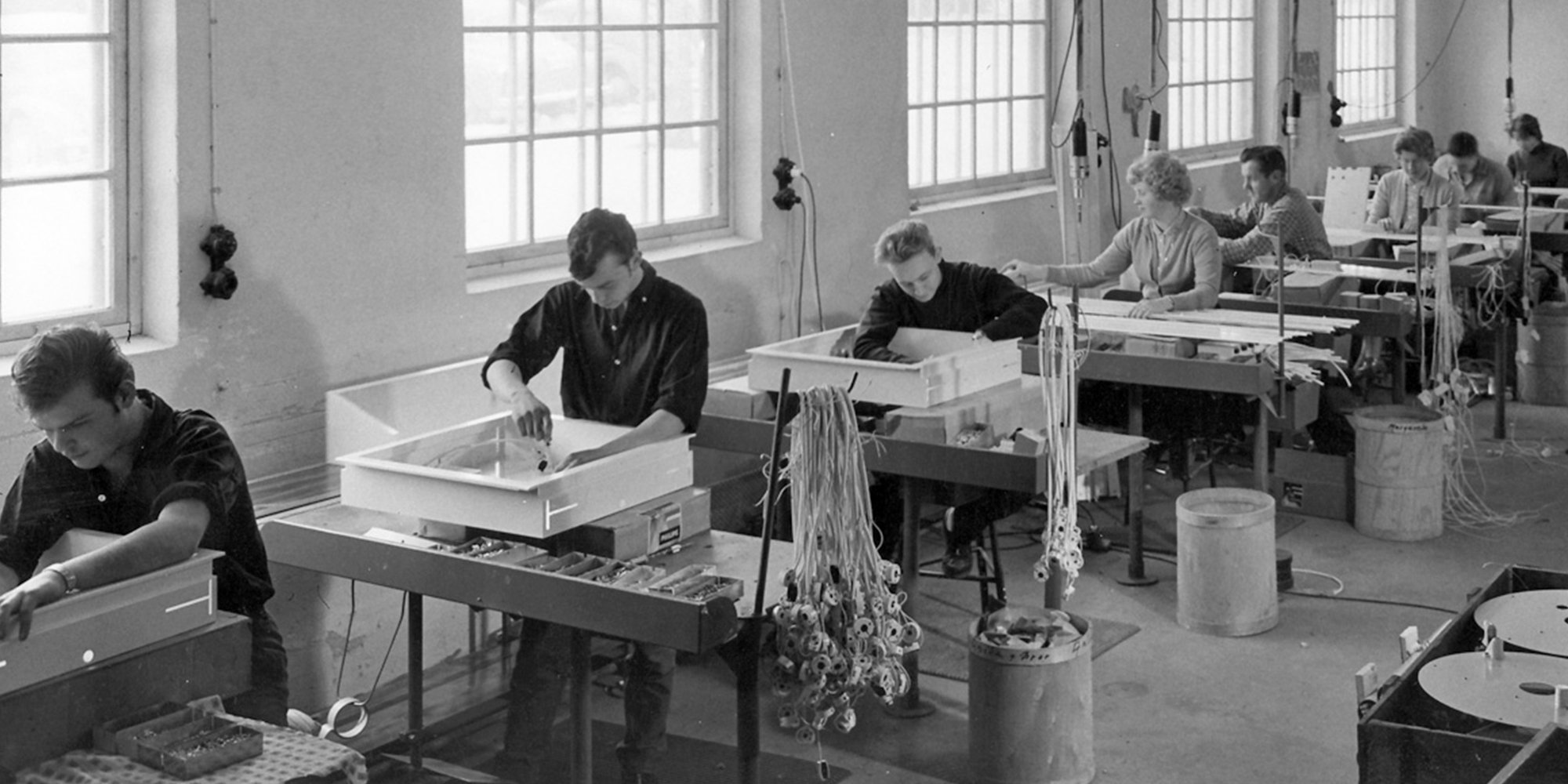
We have always priroitised quality. Fagerhult's own Technology Centre has been a certified test facility for INTERTEK SEMKO since 1993. This means that we can test, and third-party certify, our luminaires in-house.
“Because LED technology was so new at the time, our employees also needed training. Back then, there were no standards fully adapted to LED light sources,” explains Leif Norrby, Product Development Director at Fagerhult. “Our goal has always been to test our luminaires and guarantee the high quality we offer customers, but this was completely new ground for us and we needed to learn the ropes quickly.”
Our expertise was broadened and product quality assurance remained the domain of our Technology Centre in Fagerhult, under the same roof as our design and production operations. This has always been considered a major advantage in our work with innovation and new development, this close collaboration between safety and quality, the ability to test and reconsider things at an early stage.
 "Our goal has always been to test our luminaires and guarantee the high quality we offer customers." Leif Norrby, Product Development Director
In-house LED production
Since 2014, Fagerhult boasts its own in-house LED moduleproduction. Production founded on extensive preparations that involved identifying and developing the requirements for such proprietary production. Thanks to the investment in our own production capabilities, Fagerhults Belysning can not only ensure production quality, but also tailor the resulting products more easily, quickly and reliably than if we ordered our light sources from an external supplier.
“By keeping control of the entire process in house, we simplify all stages of production,” says Kenneth. “In-house LED module production has also enabled us to amass even more expertise. Should anything go wrong during production, due to damage or defects, we can more quickly rectify matters than if we’d ordered from an external supplier. Moreover, in-house production enables variants and customisation, enabling us to quickly meet customer requirements and needs.”
Green lighting for sustainability
The new light sources are not only smaller, they’re also incredibly more energy efficient than traditional light sources.
“Our modern lighting solutions help customers to reduce energy consumption and environmental impact,” Kenneth explains. “A 10–15-year-old system consumes five times as much energy as a new system. 95% of the environmental impact caused by lighting comes from energy use, which can be reduced by up to 80% with modern LED luminaires and control systems.”
Developments in LED technology are moving fast, with further innovations and new materials most certainly on the horizon. One area that is already gaining momentum is the IoT and control, a new filed in which Fagerhult is also developing solutions.. As for the market situation in 75 years’ time, that we can only speculate about…
LED Facts
- The light-emitting diode (LED) is currently the most energy-efficient lighting technology available for consumer and business use.
- A diode is an electronic component that emits light when powered by direct current.
- A semiconductor is used to convert electricity into light without producing heat, usually within a very small area measuring about 1 mm² or less (the diode).
- An LED lamp is comprised of multiple light-emitting diodes.
Related News

Innovation in every fold – Wrapped exceeds in engineering brilliance
As sustainability is no longer a choice but a necessity, innovation must begin with the question: What if we did things differently? For Fagerhult’s R&D team, that question became the spark behind Wrapped, the world’s first pendant luminaire made of cardboard. Traditionally, pendant luminaires are built with metal frames, which is a durable, familiar, and safe method. But the team behind Wrapped wanted to explore another path. Together, they decided to find out if they could create a luminaire that not only performed at a premium level but with minimized environmental impact. After thorough consideration, Solid board – a renewable and recycled cardboard material that had previously only been used in hidden components – now plays the leading role. Wrapped is more than a luminaire, it’s an exploration of forward-thinking and creativity. With no ready-made solutions to lean on, the design team had to start from scratch. Every element, from the construction to the mounting, was looked into and the result is a luminaire that’s both technically solid and environmentally conscious. Gallery: Wrapped details The luminaire body is made of up to 65% recycled cardboard and folds together with high precision cut-outs that fit perfectly. Engineering elegance Wrapped’s body is composed of two primary parts: the inner body and the outer body, both designed to work in harmony for strength and stability. The outer body is held together by a rib made of 100% recycled post-consumer aluminium, locking the folds in place and ensuring shape retention. Its end caps are made from 100% recycled post-consumer plastic and snap into precision-cuts, securing the structure without the need for screws. The junction box is snapped into place and the driver is mounted using small clips, made from recycled post-consumer plastic. The LED board is mounted onto the lens, protected by a cover of Solid board, and the entire light module is locked into place with a louvre. The result is a seamless, screw-free construction that embodies thoughtful design. Design with purpose Fredrik Beckius, Design Engineer at R&D, reflects on the journey:“The challenge was working with a material that we had never used for a pendant luminaire before. We couldn’t mount components the usual way, so we had to find alternative solutions.”Martin Gustafsson, also a Design Engineer, adds:“We had to find a way to produce the luminaire cost-efficiently, both for us and our suppliers. Every design component had to serve more than one purpose.” This dual-purpose thinking is evident throughout Wrapped’s design. It’s not just about aesthetics or sustainability – it’s about engineering brilliance and making every part count. Quote: Martin Gustafsson Sustainability without compromise Wrapped is manufactured in Fagerhult, Habo, using locally sourced recycled and renewable materials. It’s a product born from Swedish innovation, rooted in the legacy of previous sustainable designs like Multilume Re:Think and Kvisten. Unlike many eco-conscious products, Wrapped is quietly confident – and sustainable in its DNA. With high-precision cut-outs, a stable construction, and rigorous testing throughout the process, Wrapped meets all quality standards without compromising its environmental ethos.
Fagerhult introduces the world’s first premium pendant luminaire made of cardboard
The new Fagerhult luminaire Wrapped is designed and made in Sweden – and combines premium lighting, high efficiency, and low weight with being the company’s most climate-friendly, premium luminaire to date.Wrapped’s luminaire body is made of organic recycled cardboard – Solid board – which has 89% less climate impact per kilogram than aluminium. The few details made of plastic and metal are also sourced from recycled post-consumer materials. The result is a pendant luminaire with minimised environmental impact throughout, without compromising on light quality or design. “By choosing Solid board, we’re stretching the idea that a pendant luminaire must be made of aluminium. We simply asked ourselves: Can we use another renewable and recycled material that is part of an established circular infrastructure?” says Christer Liljegren, Product Manager at Fagerhult.Sustainability meets affordabilityWrapped combines premium lighting performance with a favorable price point – and makes sustainable lighting solutions available to a wider audience. The lighter choice of material also enabled a total weight of 1.6 kilograms (Pendant, 900 mm).“I think the installers will appreciate Wrapped just as much as we do. It really is surprisingly light and easy to handle,” says Christer Liljegren.The launch includes Wrapped Pendant 900 mm. The low amount of material makes it a truly sustainable choice as it performs just as good as a general 1200 mm luminaire in many applications. It is available with the Beta Opti louvre and has a 50/50 direct and indirect light distribution – and maintains excellent visual ergonomics. The product family will be expanded with additional variants in 2026.Continuing a legacy of sustainable innovationWrapped builds on Fagerhult’s innovative work with sustainable materials, following the Multilume Re:Think (also made of Solid board) and the Kvisten wooden luminaire.“Wrapped embodies our idea of light for a brighter tomorrow – combining premium lighting with sustainability at an accessible level,” says Paula Backman, Product and Marketing Director at Fagerhult.