
Related News
NEWS ARTICLE |
Lighting for Cognitive Load in Education
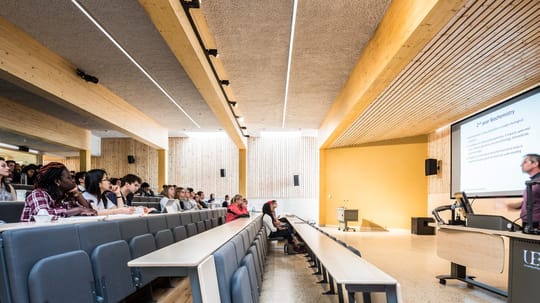
In educational settings, students’ attention can shift rapidly between screens, presentations, discussions and independent work. In these environments, the physical setting plays an important role in either supporting learning or subtly making it harder. Well-designed learning environments should reduce unnecessary mental effort, allowing students to focus on learning rather than coping with distractions or discomfort. In educational psychology, this is often described as reducing extraneous cognitive load. Lighting plays an important role in this. Thoughtfully designed lighting can help reduce strain, support focus and create learning environments that work with students rather than against them. What is Cognitive Load? Cognitive load refers to the amount of mental effort required to process information. In a learning environment, students are constantly absorbing new concepts, solving problems and switching between tasks. Educational psychology typically identifies three types of cognitive load: Intrinsic load - the complexity of the material itself. Germane load - the effort used to understand and build knowledge. Extraneous load - the unnecessary effort caused by poor instructional or environmental design. The goal of well-designed learning spaces is to minimise extraneous cognitive load, allowing students to dedicate their mental energy to learning rather than coping with distractions or discomfort. While this is often discussed in relation to teaching methods, the physical environment also plays an important role. Glare, insufficient light levels (lux), uneven light distribution and repeated visual adaptation between bright and dim areas can subtly increase cognitive strain. Over time, these environmental inefficiencies require the brain to expend more energy simply to navigate the space. Why Lighting Matters Education spaces are complex environments. Whether it is a library, classroom or lecture hall, the tasks carried out can vary significantly, and attention may need to shift constantly. In the classroom, for example, students often shift from the teacher to a whiteboard or projector, then back to their screens or notebooks. Each transition requires visual adjustment. If lighting levels are inconsistent or poorly balanced, the brain must continually compensate. Thoughtful lighting design reduces this effort. By supporting visual clarity and comfort, lighting can help minimise fatigue, maintain concentration, and create conditions better suited to learning. Effective lighting design carefully considers light distribution and brightness to support visual comfort and performance, and can also consider timing, to help optimise biological functions such as alertness, mood and overall wellbeing. The Role of Light Levels in Learning Environments One of the most fundamental considerations in educational lighting design is light level, measured in lux. Lux measures the amount of light illuminating a specific area, making it an essential unit for understanding lighting conditions in a space. Appropriate light levels help ensure that students can comfortably read, write, view screens and engage with teaching materials without unnecessary visual strain. If light levels are too low, students may experience eye fatigue and reduced alertness. If they are too high or poorly distributed, glare and discomfort can occur. General lighting recommendations apply to all educational spaces. Industry guidance suggests that reading and writing areas maintain around 500 lux to support effective visual tasks and ensure students can clearly see learning materials. Effective lighting design, therefore, balances horizontal illumination on desks and work surfaces with vertical illumination on walls, boards and faces. This helps maintain visual clarity while reducing the need for constant visual adaptation when students shift their attention between different tasks. However, light levels alone do not tell the whole story. Understanding Melanopic Lux Traditional lighting standards primarily focus on how easy or difficult things are to see. However, modern lighting research increasingly considers how light affects the body’s non-visual biological systems. This is where the concept of melanopic lux becomes important. Melanopic lux refers to the effectiveness of light in stimulating specialised photoreceptors in the eye that influence the body’s circadian rhythm – the internal system that regulates sleep, alertness and hormonal cycles. These receptors respond particularly strongly to short-wavelength, blue-rich light, similar to spectrum often found in natural daylight. For education environments, this biological response is highly relevant. Students spend long periods indoors, often under artificial lighting. If lighting does not provide sufficient melanopic stimulation, it may fail to support the natural signals that help maintain alertness and cognitive performance. Lighting designed with appropriate melanopic lux levels can help mimic aspects of daylight, encouraging wakefulness during the day and supporting healthy circadian rhythms. Supporting Alertness Through Light Appropriate light levels and melanopic stimulation work together to support alertness in learning environments. Sufficient lux levels are needed for clear visual tasks, while appropriate melanopic stimulus helps reinforce the biological signals associated with daytime focus and energy. In classroom settings, this can help students maintain concentration and reduce mental fatigue during long periods of study. At the same time, lighting must remain visually comfortable. Excessive brightness or poorly controlled glare can counteract these benefits by increasing visual stress and cognitive load. Thoughtfully designed education lighting, therefore, aims to balance three key elements: adequate lux levels for visibility, appropriate melanopic stimulus to support biological alertness, and uniform light distribution to reduce visual strain. By aligning lighting design with both visual and biological needs, education environments can better support sustained attention, comfort and cognitive performance throughout the day.
NEWS ARTICLE |
Universities: Optimising buildings through data-driven lighting systems
Universities today face growing pressure to reduce carbon emissions, operate more efficiently, and create environments that actively support learning, research, and student wellbeing. From historic campuses to cutting-edge research facilities, managing such diverse estates is complex. Increasingly, data is proving to be a powerful tool in meeting these challenges. Smart lighting systems such as Fagerhult’s Organic Response are central to this transformation. By combining wireless technology with intelligent sensors, these systems collect and analyse data on energy use, occupancy patterns, and light levels. For university estates and facilities teams, this data-driven approach enables more informed decisions, helping to optimise building performance, reduce environmental impact, and create better spaces for students, staff, and visitors. So how does data-driven lighting work in a university context, and what are the benefits for higher education estates? Integrating smart lighting into complex university estates Smart lighting systems are no longer standalone solutions. They are an integral part of a wider, connected approach to campus building automation. At the application level, wireless lighting technology is particularly well suited to universities, where estates often include a mix of new developments, refurbished teaching spaces, and heritage buildings. For older campus buildings, where rewiring can be disruptive, costly, or impractical, wireless systems allow advanced lighting controls to be introduced with minimal structural intervention. This supports the decarbonisation of existing university estates while maintaining architectural integrity and minimising disruption to teaching and research activities. At the same time, smart lighting integrates seamlessly into new-build projects, enabling universities to future-proof their buildings from day one. Automating lighting to minimise waste across campus One of the biggest operational challenges for universities is ensuring that lighting is used only when and where needed. With long opening hours, irregular occupancy patterns, and a wide variety of space types, wasted lighting can quickly become both costly and unsustainable. Traditional lighting control systems are typically fixed at the point of commissioning. Once installed, they offer limited flexibility and often fail to adapt to changes in space usage, timetables, or occupancy. As a result, lighting may remain on in empty lecture theatres, corridors, or meeting rooms. A smart lighting system overcomes this by dynamically adjusting lighting in real time using sensor data. Lighting levels can respond automatically to occupancy, daylight availability, and predefined settings, while system parameters can be reconfigured manually or automatically throughout the building’s lifetime. For universities, this means: Lecture theatres and teaching rooms are lit only when in use Corridors and circulation spaces adapt to traffic levels Libraries and study areas maintain appropriate lighting while avoiding unnecessary energy use The result is optimised energy consumption without compromising visual comfort or safety. Turning lighting data into meaningful campus insight At the heart of smart lighting systems lies data. Large volumes of information on energy consumption, occupancy, and lighting performance can be securely collected and stored in cloud-based platforms, giving estates teams visibility across their campus. Quote Fagerhult has conducted studies analysing occupancy data to understand how small system adjustments can deliver significant energy savings. By fine-tuning sensor time-out periods and adjusting light levels relative to occupant proximity, it is possible to reduce energy use while maintaining a positive user experience. The findings show that: In high-traffic areas such as corridors, libraries, and open-plan study spaces, adjusting light levels delivers the greatest savings In spaces that are frequently unoccupied, such as meeting rooms or seminar rooms, optimising time-out periods is more effective For universities, this data-driven insight supports not only energy reduction but also improved understanding of space utilisation, helping inform future planning and investment decisions. Using lighting infrastructure as a data backbone Smart lighting systems also offer value beyond illumination. Because the lighting network spans the entire campus, it can act as a backbone for additional sensors and data collection. By integrating sensors for CO₂, temperature, and humidity into the lighting infrastructure, universities can reduce the need for multiple standalone networks. This provides a cost-effective and streamlined approach to monitoring environmental conditions across teaching spaces, libraries, laboratories, and social areas. Real-time environmental data can support: Improved indoor air quality management Health and wellbeing initiatives for students and staff Compliance with building and safety standards In some cases, this information can also be shared with building users through digital displays, increasing transparency and awareness of environmental quality. Proven performance in higher education environments Fagerhult’s smart lighting solutions are already delivering measurable benefits across higher education estates. At the University of Warwick Library, the introduction of intelligent lighting has resulted in significant energy and cost savings, while occupancy data has provided valuable insight into how students use different areas of the library throughout the day. Similarly, at Queen Mary University of London, smart, sustainable lighting has helped support long-term carbon reduction targets while enhancing visual comfort in teaching and study spaces. These projects demonstrate how data-driven lighting can support both operational efficiency and the academic mission of universities. The future of smart campuses As universities continue to prioritise sustainability, efficiency, and student experience, the role of data-driven technologies will only grow. Smart lighting systems offer a practical and scalable way to support these ambitions. “Data is the key to unlocking the full potential of smart lighting systems,” Nick concludes. “By harnessing the power of data, universities can improve energy efficiency, support wellbeing, and create more responsive and sustainable campus environments. As the technology continues to evolve, the opportunities for optimisation are virtually limitless.” Explore how Organic Response can help your estates team reduce energy use, gain insight into space utilisation, and future-proof your campus. Speak to our experts to find out more.
NEWS ARTICLE |
Marischal College, a historical building with a modern approach to efficiency and light control
Marischal College, the glorious granite landmark on Broad Street in Aberdeen, Scotland, has been the headquarters of Aberdeen City Council since 2011. The second-largest granite building in the world shares its space with the historic Town House and is a Category A listed structure, a testament to its national and international significance. Lighting such an iconic and historic structure presents unique challenges, requiring a balance between modern functionality and the preservation of its architectural integrity. Considerate planning is key to ensuring the building is both effectively illuminated and energy-efficient without altering its historic features. To learn more, Colin Sutherland, Northern Regional Manager at Fagerhult UK, who led the project, gave us some insights into the project scope and outcomes. Efficiency, longevity, and modernisation Due to ongoing issues on site with both the lighting and controls, the council looked into addressing this by replacing the lighting and the control system in the least obtrusive way possible, as this had to remain a live building throughout. Local consultants Atkins recommended Fagerhult for the job. After an in-depth interview process, including product demonstrations, Fagerhult was selected for its robust, user-friendly Organic Response system. The solution prioritised efficiency and incorporated emergency monitoring and heat mapping, ensuring optimal performance and minimal risk of human error. Overcoming challenges with precision The project wasn't without its obstacles. Marischal College's shared spaces, occupied by various departments and organisations, required a flexible system catering to diverse user needs. Similarly, the historical and architectural features of the building presented unique physical challenges: Granite-tiled Floors: When attempting to replace uplights, the team discovered that the bases were bonded directly to the granite. Removing them risked damaging the tiles, so they were left intact, and parts were retrofitted instead. Archway Preservation: A prominent archway, often used for wedding ceremonies, could not be altered. The team creatively adapted the existing fittings to meet modern efficiency standards without compromising the building's heritage. Despite these complexities, the project remained on schedule, showcasing Fagerhult's ability to innovate and adapt in the face of constraints. Energy efficiency and smart controls At the heart of the project was the transition to state-of-the-art LED lighting powered by Fagerhult's Organic Response control system. Key features included: Real-Time Monitoring: The system tracks faults, occupancy patterns, and energy usage across the building, allowing for responsive adjustments. Daylight Linking: Individual fittings automatically dim when natural light is sufficient, maintaining consistent light levels while reducing energy consumption. Emergency Testing Automation: The system runs function and duration tests, ensuring compliance and safety without manual intervention. Customisable Controls: With remote access, the council can adjust settings, such as dimming light levels, for optimal comfort and energy savings. The data collected from Organic Response allows for an open conversation between Fagerhult and the client and having insight into usage helps to educate the staff occupying the space which enables a smooth collaboration. This advanced technology has significantly improved both the efficiency and reliability of Marischal College's lighting, offering Aberdeen City Council a sustainable, cost-effective solution. A collaborative success The Fagerhult Group's involvement was instrumental in the project's success, with contributions from several of its lighting brands, including WE-EF, LTS, and ateljé Lyktan. The use of the popular pendants such as the striking Globia fitting in the reception area, enhanced the building's aesthetic appeal while meeting its technical requirements. A highlight of the installation was the one-up, one-down fitting design. Each fitting featured individual sensors and daylight linking, ensuring energy efficiency while maintaining optimal lighting conditions throughout the office spaces. A brighter future for historical buildings The Marischal College lighting project not only improved the functionality and sustainability of the building but also demonstrated Fagerhult ability to navigate complex challenges and deliver tailored solutions. With energy efficiency at the forefront, Aberdeen City Council now benefits from a modern, reliable, and cost-effective lighting system—a shining example of innovation meeting heritage.
Return to top