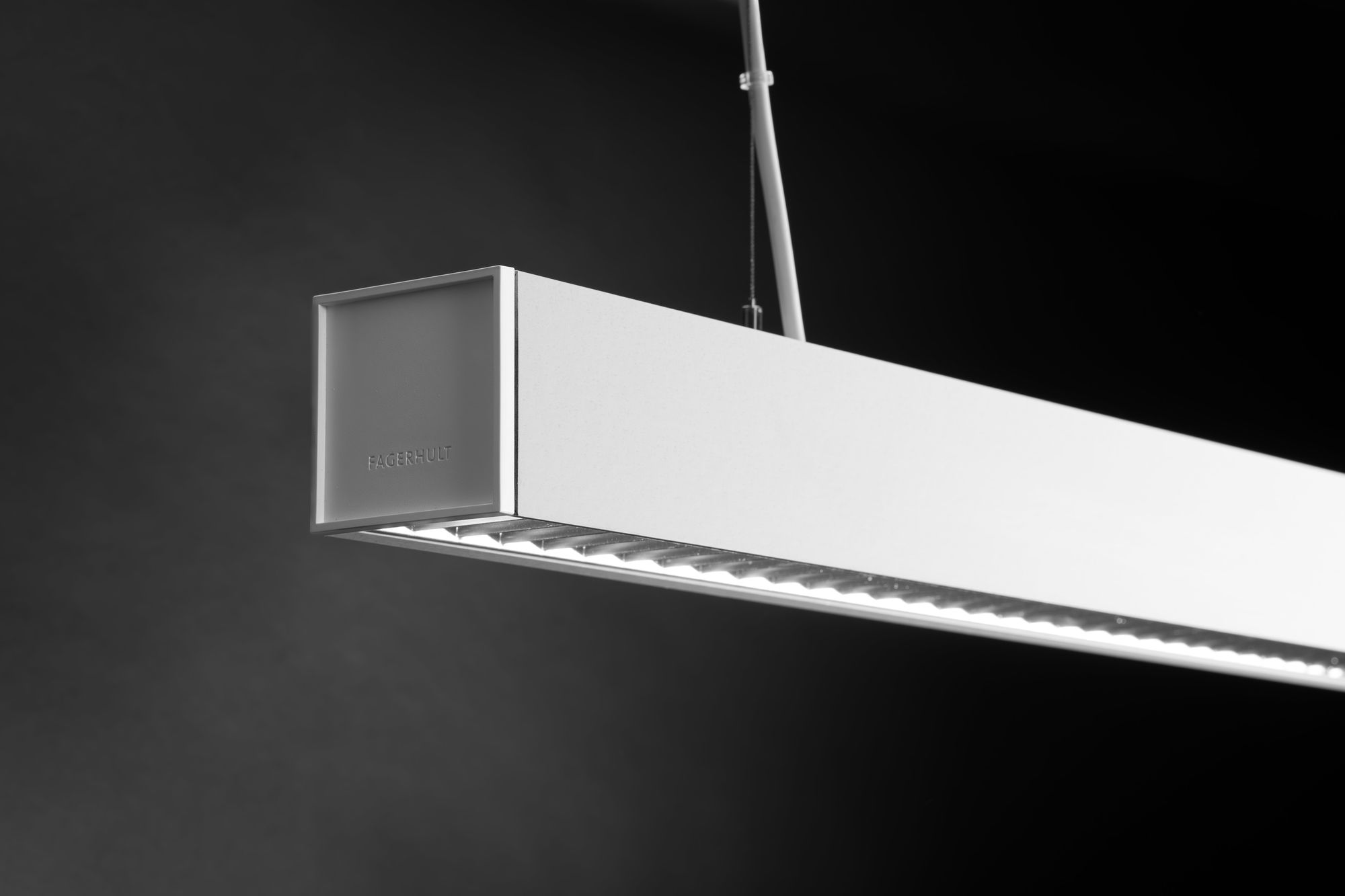
Here, we explore the journey so far, how well it has been received, what the next iteration of Wrapped looks like, and how this concept could help shape future Fagerhult lighting solutions.
From Idea to Innovation
The story of Wrapped began several years before its 2025 launch. During the development of Multilume Re:Think, Fagerhult started exploring alternatives to traditional steel sheet construction as part of a broader effort to reduce climate impact.
"We wanted to do something in the pendant product segment and use a more sustainable material," explains Product Manager Christer Liljegren. "We looked at a lot of different materials initially."
The team eventually settled on a solid board material inspired by an unlikely source: premium packaging.
 “Inspiration was taken from rigid boxes, like the packaging you get with high-end consumer products. They're very stable and robust. The way they're produced is similar to how we manufacture Wrapped” Christer Liljegren, Product Manager
The luminaire body is made from up to 65% recycled cardboard, folded together using precision cut-outs that create the sharp lines and detailing expected from a premium architectural luminaire. However, developing a luminaire from a material more commonly associated with packaging than lighting required extensive testing and refinement.
Wrapped was tested for strength, durability, UV exposure, humidity resistance and fire safety, meeting the same regulatory requirements as products manufactured from steel, aluminium or plastic.
Designed for Flexibility
One of the most distinctive decisions during Wrapped's development was its original sizing. Rather than following the traditional 1200 mm format that has dominated workplace lighting for decades, Fagerhult launched a shorter 900 mm version. The decision reflected how workplaces have evolved.
"Desks are generally smaller than they were 10 or 20 years ago," says Christer. "Sometimes the luminaire can be longer than the desk, which wouldn't look right if we used the conventional length."
As organisations adapt workplaces to support changing ways of working, flexibility has become an increasingly important consideration. Lighting solutions need to accommodate evolving layouts, changing occupancy patterns and a variety of working styles.
The shorter Wrapped luminaire helps to create a more open visual environment, particularly in open-plan offices, where reducing overhead lighting can make a space feel lighter and more spacious. "The shorter version was very well received, especially for open-plan offices. You create more volume in the room because there's less luminaire above you, so the space feels more open," says Christer.
Building on Success
The positive reception to Wrapped confirmed demand for a luminaire that combined sustainability, design and performance, while also providing valuable insight into how the product could evolve.
While the original 900 mm version proved particularly popular in open-plan workplace environments, some projects required greater light output and additional optical flexibility. This led to the introduction of a new 1200 mm version.
"We've now launched the conventional length because it allows us to add more features," says Christer. Wrapped Pendant is now available in both 900 mm and 1200 mm lengths, enabling designers to select the most appropriate solution for different applications. While the shorter version remains ideal for open-plan offices, the 1200 mm version extends the product's suitability to larger offices, classrooms and educational settings.
The additional length allows for multiple light distribution options, including direct-only and direct/indirect configurations, as well as a microprismatic louvre option and Fagerhult's Beta Opti and Delta louvres. These additions provide greater optical flexibility, high visual comfort, and a broader distribution of indirect light across the ceiling.
Both versions maintain the same distinctive design language and sustainability credentials while supporting different project requirements.
Performance Without Compromise
Introducing a cardboard luminaire inevitably generated some scepticism. Yet one of Wrapped's greatest achievements has been changing perceptions. Christer highlights that the product's success lies in its appearance and feel, which make it look and feel like a proper luminaire. When installed, many people assume the product is manufactured from more conventional materials such as steel or aluminium.
"When people get the fitting in their hands, that's normally what convinces them. It's really robust and doesn't look like a cardboard fitting," adds Christer.
Materials are not the only area in which Wrapped performs well — it also needed to deliver the performance, efficiency and longevity expected from a premium Fagerhult luminaire. Wrapped offers a lifespan of 100,000 hours, efficiencies of up to 165 lm/W and a range of control options, including Organic Response and BrightSwitch, helping it support increasingly connected and data-driven spaces. Combined with high-quality optics and advanced control solutions, it is designed to deliver long-term performance while remaining future-ready for smart building applications.
"The pendant luminaire is the most efficient in this segment. It has the lowest climate impact and a lifetime of 100,000 hours, so it ticks all the boxes," says Christer.
What Comes Next?
Wrapped's development is far from complete. Later this year, Fagerhult plans to introduce a ceiling-mounted version, extending the concept into environments where suspended luminaires may not be appropriate. This will open up opportunities in support spaces, circulation areas, printer rooms, canteens and office environments where a closer-to-ceiling solution is preferred. This ceiling-mounted version will complete the Wrapped pendant lineup.
At the same time, the lessons learned from Wrapped are influencing wider product development across the business. Christer notes that the Fagerhult team is constantly striving to evolve by improving processes and efficiency. That includes exploring more efficient LEDs, improving reflector performance, integrating sensors and controls, simplifying installation and considering every stage of a product's lifecycle.
"We try to think about the entire chain," explains Christer. "Everything from how we produce the fitting and improve efficiency, all the way through to installation and making life easier for the installer."
The search for alternative materials also continues. "We look at new materials all the time. Not necessarily paper, but materials that can help us reduce environmental impact.
Wrapped has provided a platform for learning, innovation and continuous improvement, giving the team key insights from the development process that they can carry into the next project.
Perhaps that is Wrapped's real legacy: not simply challenging assumptions about what a luminaire can be made from, but demonstrating how questioning convention can lead to better products, smarter design and new possibilities for the future.
Related News

The Latest Research on Retail Lighting Design: How Light Influences Shopper Behaviour, Perception, and Sales Outcomes
Retail environments are evolving fast. With online channels offering convenience and endless choice, physical stores must deliver compelling reasons for customers to enter, engage, and purchase. For retailers, lighting should be treated as an active contributor to customer behaviour and commercial performance. Retailers who integrate evidence-based lighting solutions are likely to see higher engagement and sales. This article draws together the most recent findings from 2025 studies, linking lighting design to customer psychology, perception, and business impact. Lighting as Part of a Holistic Retail Experience Studies of retail design often focus on singular elements such as store layout, failing to acknowledge that the act of shopping is always a multisensory, holistic experience. A 2025 study by the University of Kent sought to change this, examining flagship retail environments on Oxford Street, including Lush, Disney, and Primark. The research analysed atmospherics such as lighting, layout, flow, and sensory cues alongside observed shopper behaviour. In stores such as Lush and Disney, lighting reinforced brightness, colour, and product visibility, contributing to perceptions of energy, enjoyment, and immersion. By contrast, Primark’s lighting supported efficient, task-focused shopping. Shoppers were willing to accept a less enjoyable environment when their goal was rapid product acquisition. For retailers, this highlights that lighting should align with store purpose and brand positioning rather than follow generic standards. The study’s author, Cariad Martin, notes: “The process of shopping online is relatively one-dimensional, certainly not multisensory, and generally would be difficult for shoppers to differentiate much between shopping with one brand or another. This means that shoppers are much more likely to revert back to price being the sole factor when deciding between similar products.” “Multisensory, interactive retail experiences allow retailers to differentiate their goods from similar goods on the market, something that is significantly more difficult to do with ecommerce.” Exterior Lighting Affects Shopping Decisions A 2025 research paper, The Influence of Fashion Retailers on Customer Psychology Using Visual Merchandising and Store Layout to Improve Shopping Decision provides strong evidence that lighting influences how customers notice, enter, and navigate retail environments. The authors describe the window display as the store’s ‘first line of offence’, acting as a direct and immediate connection between the shopper and the merchandise. Lighting plays a key role in this interaction by enhancing visibility, creating contrast, and supporting visual storytelling. Key insights from the paper include: Well-designed exterior lighting helps create strong first impressions, particularly during evening or low-light conditions. Effective lighting increases the visibility of window displays, signage, and entrances, making stores easier to recognise and more inviting to approach. Brand colours, logos, and exterior lighting work together to strengthen brand identity and differentiation in competitive retail environments. The study concludes that: ‘Exterior lighting emerges as one of the most influential factors in shaping consumer behaviour and decision-making processes,’ and ‘Such findings underscore the importance of investing in high-quality, thoughtfully designed exterior lighting as an integral component of retail strategy, with a clear and measurable impact on attracting and engaging potential customers.’ Interior Lighting Affects Shopping Decisions The same study highlights the importance of interior lighting once customers enter the store. Adequate and well-distributed lighting allows customers to see fine details in fabrics, finishes, and colours, supporting confident product evaluation. Brighter environments are consistently associated with higher perceived value, better ambience, and more positive brand impressions. In the paper, the authors use the example of retailers like H&M, which use this concept to create a clean, well-lit shopping atmosphere that promotes a sense of value and quality. The study concludes that ‘The impact of interior lighting on customer shopping decisions is substantial and statistically significant.’ Light Influences Visual Perception and Product Evaluation A 2025 study published in the Journal of Business Research uncovered how lighting influences perceived product size. The research found that under bright lighting, certain products with convex shapes appear larger to customers — which shifts visual attention and can affect judgement of product desirability. Why this matters: lighting changes how products look in customers’ eyes, not just whether they can see them. This can influence choice, perceived value, and how merchandise is evaluated relative to competitors on display. Why Lighting is a Strategic Retail Investment “The latest research presents a consistent message: lighting is not decorative. It is a foundational element of retail design that supports experience, perception, and behaviour,” says Dave Hughes, Head of Lighting Design at Fagerhult. Key evidence-based insights include: Exterior and interior lighting are linked to store entry, exploration, and in-store behaviour. Lighting influences psychological comfort, mood, and well-being in retail spaces. Brightness and light quality affect how products are visually perceived and evaluated. Fagerhult combines research-led insight with technical expertise to help retailers translate evidence into lighting solutions that support both brand experience and commercial performance. Get in touch with our team to learn more about how we can help you.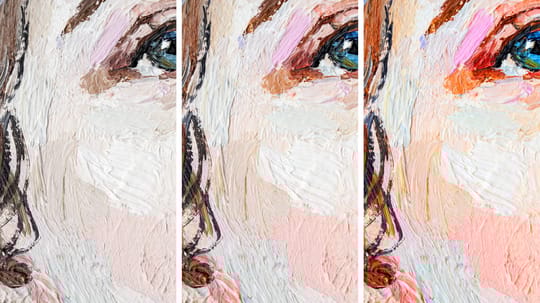
How New Colour Standards Could Change Retail Lighting
A customer stops at a cosmetics stand to try a lipstick. In the design studio, the colour was vibrant and flattering. Under the store spotlight it looks muted, and later, in daylight, it shifts again. The product hasn’t changed – the light has. For decades, retailers have used the Colour Rendering Index (CRI) to judge how lighting reveals colour. Colour rendering refers to the ability of a light source to accurately show the true colours of objects compared to a reference or natural light source. CRI gave the industry a shared benchmark, but it was built on narrow foundations. Today, a newer approach, Colour Fidelity Index (Rf) metrics, offers a broader way to evaluate how faithfully light sources render colours, but it is not without its challenges. To understand what this means for retailers, we spoke with Henrik Clausen, Director of the Fagerhult Lighting Academy. CRI: A Useful but Incomplete Measure The Colour Rendering Index was introduced more than 50 years ago by the International Commission on Illumination (CIE) and is still widely used in standards and specifications. CRI evaluates a light source using just eight test colours – soft, pastel shades that do not reflect the richness of real retail environments. HC quote The CIE has itself noted that ‘for some types of light sources, the CRI does not agree well with overall perceived colour rendering,’ particularly in cases of LED lighting with narrow-band spectral components – an issue that becomes especially relevant for saturated tones and complex materials. Rf: A Broader and More Comprehensive Measure The Rf metric, defined in the publications CIE 224:2017 and IES TM-30, was created to address these limitations. Instead of eight references, Rf evaluates 99 colour samples, selected to represent a broad range of real-world materials. Why Precision Matters in Retail In practice, much of retail design is built around appearance and perception. Premium packaging, cosmetics, fashion textiles, and even fresh food are all developed under specific lighting conditions. If colours shift when displayed in stores, the intended impression is lost. Rf metrics were designed to provide lighting specifiers with a broader toolset to preserve those intended appearances across a wider range of tones. “Rf could help to replicate the designer’s vision more faithfully,” Henrik says. “That is the real advantage for retail. The colours of a product or package are shown the way they were meant to be seen.” Image-colours Henrik was cautious, however, to note that end customers are unlikely to notice the difference directly.Instead, the benefit is mainly for specifiers and purchasing teams, who can use Rf data to help ensure consistency across stores and product categories; a high Rf is generally more likely to provide consistency than a high Ra. However, as the CIE notes, two different light sources with the same Rf value can still render the appearance of specific objects differently, so lighting booths will likely still be necessary to ensure accurate colour rendition across a range of sources. Since CRI is long-established, both CRI and Rf will continue to appear on product sheets for the foreseeable future. But the shortcomings of CRI are clear: a light can score highly while still distorting saturated or complex colours. Rf reveals these gaps by showing how a source performs across a much wider range of references. Customers Don’t Notice the Lights – But They Notice the Results While end customers are unlikely to consciously notice the difference between CRI and Rf, purchasing teams can use Rf data to increase the likelihood of consistency across stores and product categories. The benefit is indirect: customers may not name the technology, but they experience greater consistency in presentation when retailers apply it carefully. “Customers won’t walk in and say, ‘This is Rf lighting,’” Henrik points out. “But they will see products as they were designed to look, and that creates a sense of quality and trust.” Trade-offs and Practical Challenges Henrik noted important trade-offs with adopting Rf: higher colour rendering often means lower light output for the same energy input, raising environmental considerations. “There are pros and cons,” Henrik said. “More accuracy in specification is the benefit. But it is harder to measure, and you can lose efficiency if you push for the highest rendering levels.” The key recommendation is to carefully balance colour rendering accuracy with practical considerations such as energy efficiency and cost-effectiveness. He also pointed out that in practice, specifying exact values can be challenging, which is why Fagerhult often works with ranges such as ‘above 80’ or ‘above 90’ rather than precise figures. This approach gives customers confidence in quality without over-promising on measurement precision. The CIE also points out in its Position Statement on Colour Quality Metrics that the colour fidelity index alone does not encompass all aspects of colour quality; in particular it does not characterise colour preference. The Road Ahead Henrik underlined that Fagerhult has not yet adopted Rf metrics in its product documentation but is monitoring developments: “We are keeping track of what’s going on, and if customers want documentation in that way, then we’ll move. Our role is to support retailers with the standards and tools they find most valuable, helping them create lighting that reflects their products and brand as intended.” Take the Next Step in Retail Lighting Understanding and applying colour metrics can give retailers a competitive edge – ensuring products are seen as intended, building trust with customers, and strengthening brand perception. Fagerhult is here to guide you through this evolving landscape, balancing colour fidelity, efficiency, aesthetics, and practical considerations. Connect with our experts at Fagerhult to explore how precise lighting solutions can elevate your stores and bring your brand vision to life; get in touch.