
Innovations in lighting materials: A new era of sustainable design
In the rapidly evolving world of lighting, sustainability is no longer just a buzzword—it's a driving force behind the innovation of new products. Fagerhult Group has committed to the Science Based Targets Initiative (SBTi), setting targets to achieve net-zero emissions from our entire operations in the long term.
A large part of meeting these targets is based on the knowledge of our product’s impact on the planet, and we strive to move towards renewable and recycled materials wherever possible, aiming not only to reduce our products’ environmental footprint but also to meet the growing demand for sustainable products.
In 2023, Fagerhult launched Kvisten, made from 77% recycled or renewable materials, including wood and reflectors taken from end of life TV sets; and earlier this year atelje Lyktan partnered with leading Norwegian architecture firm Snøhetta to update their iconic 1970’s Supertube using hemp – now the Superdupertube!
Two further developments highlight our dedication to balancing sustainability, functionality, and design: the Fagerhult Multilume Re:Think and the updated Hood luminaire, designed by Form Us with Love in collaboration with atelje Lyktan.
The Multilume Re:Think
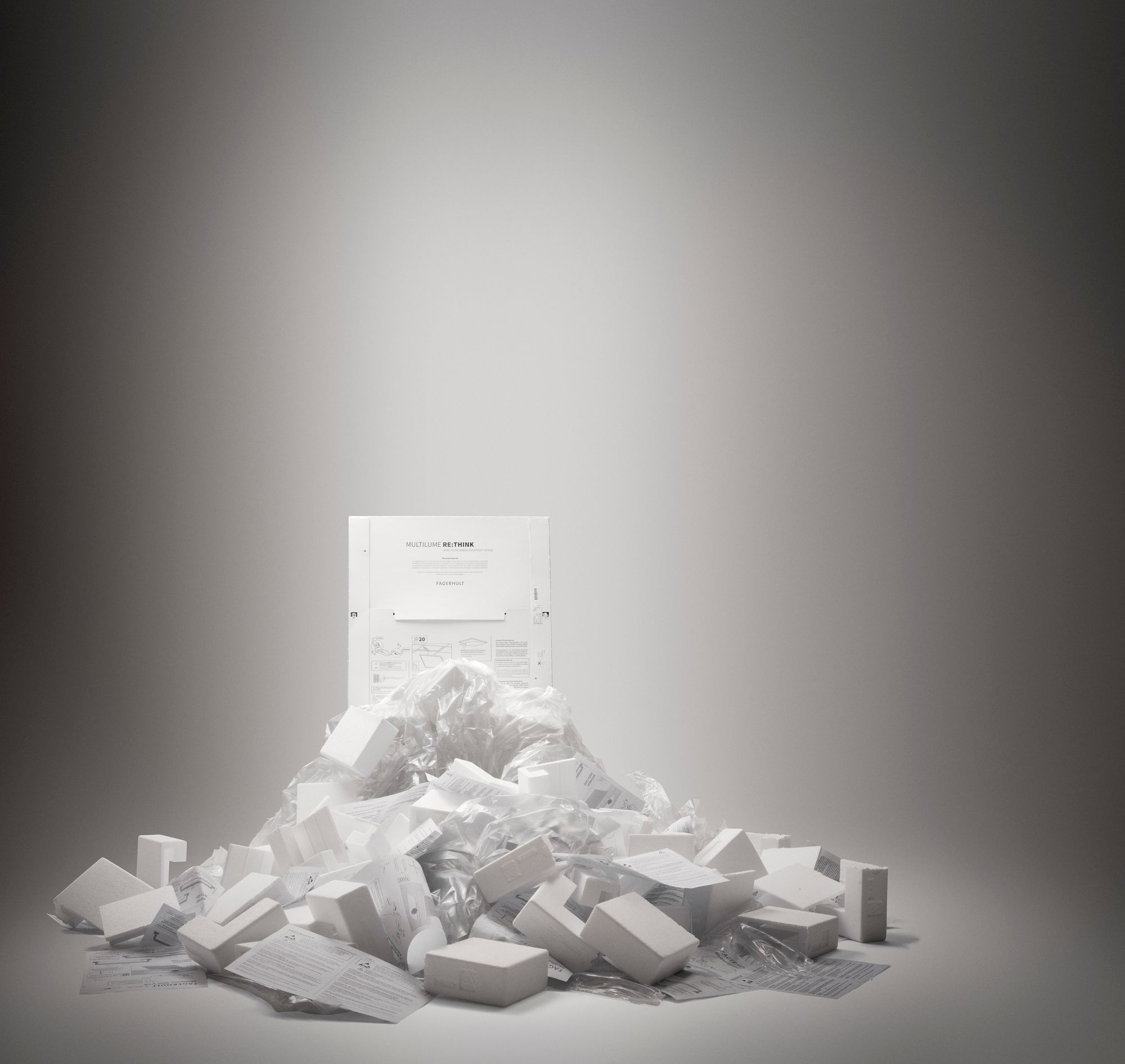
The Multilume Re:Think represents a significant breakthrough in the use of sustainable materials for lighting. Launched in May 2021, the purpose of this redesign was to reduce the environmental impact of the lighting fixture, by replacing traditional materials with more eco-friendly alternatives.
Lars Eriksson, Product Manager at Fagerhult, explains more about the innovation behind the Multilume Re:Think: ”The original Multilume luminaire was made from white-painted sheet metal, a standard material in the industry. However, driven by the company's sustainability goals, our team began exploring new materials that could reduce the product’s carbon footprint.
“After several trials with various materials, they landed on a surprising candidate: solid board, a type of stiff, recycled paper material.
“The solid board material, often used for packaging, proved to be an ideal choice; it’s durable, resistant to heat and humidity, and, crucially, 100% recyclable.”
Commenting on the impressive environmental benefits of the Multilume Re:Think, Lars says: “Each luminaire housing requires the equivalent of just seven recycled newspapers. This shift from metal to solid board reduced the product's carbon emissions by 83% and its weight by 32% (a reduction of 1kg), leading to significant reductions in transportation emissions as well.
“If the full volume of Multilume changes to Re:Think, 2.5 tonnes of paper per year will have been saved through the installation instructions being printed directly onto the back of the packaging, rather than using additional paper, and a reduction in the volume of labels.
“Despite some initial scepticism about using paper for lighting fixtures,” Lars continues, “rigorous testing proved the material's viability. The Multilume Re:Think has since been well-received, particularly in sectors like education, healthcare, and office spaces, where sustainability is a key concern.”
Beyond its clear environmental benefits, the Multilume Re:Think also boasts practical advantages. Lars explains: “The reduced weight and volume of the luminaires mean they require less space and energy for transportation. Additionally, the product’s design eliminated the need for plastic fastenings, instead utilising a clever hook system that ensures ease of assembly while maintaining structural integrity. These innovations not only enhance the product’s sustainability credentials but also make it more appealing from a cost and efficiency perspective.”
The Hood luminaire
In a similar vein, the Hood luminaire, originally launched in 2011, has this year been reimagined by design agency Form Us with Love in partnership with atelje Lyktan, with the aim of improving both its environmental and functional performance.
Malin Gadd, Product Director at atelje Lyktan comments:” Hood was initially made from recycled polyester, PET felt, which is widely recognized for its sustainability credentials. However, the design team chose to upgrade Hood by introducing wool as the primary material.
“Wool offers several advantages,” Malin explains,” it is naturally fire-retardant, which enhances the safety of the luminaire. It also has properties that reduce dust accumulation, making it a cleaner, more durable option. The decision to use wool was driven by a desire to offer a higher-quality product that maintains the sustainability ethos of the original design.
“Wool’s inherent qualities make it a perfect choice for environments that require both safety and cleanliness, such as schools, hospitals, and offices. In addition, in using a natural material like wool, sourced from within Sweden, the Hood luminaire continues to support the circular economy.”
The future of materials
Both the Multilume Re:Think and the Hood luminaire demonstrate the lighting industry’s ongoing shift towards more sustainable, innovative materials. These products highlight how companies can rethink traditional design and manufacturing processes to create lighting solutions that are not only environmentally friendly but also superior in performance and design.
As the demand for sustainable products continues to grow, the choice of materials used plays a central role in product development. Whether it’s by reducing carbon emissions, minimising waste, or enhancing product longevity, the lighting industry is proving that sustainability and innovation can go hand in hand.
Our commitment to pure materials.
The materials from which our products are made of constitute a substantial part of our total carbon footprint. The importance of materials will grow over time as the focus on more energy-efficient products increases and the electricity used becomes greener. Find out more about our commitment to pure materials.
Read moreRelated News
Exploring circularity: The only straight way forward
In the drive towards sustainability, the Circular Economy vs. Linear Economy is crucial. The Circular Economy prioritises material reuse and longevity to minimise waste. At Fagerhult, we're committed to circularity, designing products for durability and recyclability. In this series, we'll delve into our commitment with insights from Fagerhult Group brands. First, we spoke with Niclas Thulin, Fagerhult's Sustainability Manager. In the quest for a sustainable and environmentally conscious future, the distinction between the Circular Economy and the Linear Economy has become a central focus. Circularity prioritises maximising the reusability and lifespan of materials and resources, striving to reduce resource consumption and minimise waste generation. At Fagerhult, we believe circularity is the only way forward, and are committed to the development and design of products that both last over time and can be reused or recycled. In this four-part series, we spoke to brands within the Fagerhult Group to find out more about their targets, solutions, and approaches to circularity. First up, we caught up with Niclas Thulin, Sustainability Manager at Fagerhult. What approach do you take to circularity at Fagerhult? We are working to meet Science Based Targets in line with the Paris Agreement’s 1.5 °C target, which is ambitious. To achieve these science-based targets, we have four focus areas: circular solutions, energy efficiency, pure materials and conscious production. ‘Circular solutions’ focuses on how we will make the transition from a linear to circular economy. In terms of targets, our initial focus was to implement circular business models, and the second is to enable products to be repaired, refurbished, reused or recycled. Having these targets in place creates a direction for us when it comes to new product development. Do you design your products with disassembly and end-of-life recycling in mind? How easy is it to disassemble your products for recycling or refurbishment? We’ve learned a lot about refurbish and reuse, and we want to design for circularity. For example, we don’t use glue within our products, we try to think modular wherever possible, and we now not only test how to assemble our products, but also to disassemble, making adjustments where necessary to make them even easier to disassemble. Do you offer remanufacturing or refurbishment services for your lighting products? Our Re:Furbish concept is about giving old luminaires new life. A customer might have an existing solution they want to reuse or decrease their environmental impact from, so they may ask us to upgrade. We use as much from the existing light fitting as possible, whilst at the same time upgrading it so that it’s equally energy efficient and has the same function as a new luminaire. Our designers will put together a prototype based on reusing as much of the materials as possible – for example the body, the glare protector, the reflector – the good thing about using the body is that it is one of the components with the most embodied carbon. A lot of our products were initially designed over 20 years ago, and we have been good at using screws instead of glue, so most of the lights can be recycled or reused. The light fitting can be easily opened up and the electronics replaced with something we called a ‘Re:Furbish kit’ – it’s easy to install and doesn’t take much time. We send it to the customer so they can see the solution, having evaluated and tested it from an energy perspective, producing a climate calculation which the customer can compare to the old solution. What we are trying to do is find a way of minimising impact from the materials but ensure the products are equally or more efficient as a new alternative, whilst maintaining the light quality so that it is still beneficial for the end user, too. How do you ensure circularity throughout your supply chain, from sourcing raw materials to manufacturing and distribution? We take a holistic approach right from the beginning – reducing materials in new product development, making materials thinner, making luminaires smaller, and not over specifying products, so having less luminaries in the same space. Another example of our circular solutions concept is our product Kvisten, launched last year and built from both renewable material and reused plastic. The reflector is made from old TV screens, removed from the TVs at the end of life, then cut to size for their new function by our supplier. Through innovations like this we are trying to implement reused materials in our new product development, and our target is that by 2030 our products will be made of 80% renewable, recycled or reused content. In terms of minimising the impact of transportation, we do the installation on-site, which is a benefit because we don’t need to freight the product to site and back, so we are minimising the impact of transportation. This is only one piece of the lifecycle of course – our goal is for all of Fagerhult’s newly developed luminaries to have an environmental product declaration – providing transparent information about the environmental impact of a product during its life cycle.