

Related News

NEWS ARTICLE |
Why Home Feels Better Than the Office and What Commercial Spaces Can Learn
As millions shifted to remote work during the pandemic, productivity broadly held steady or improved, but comfort and well-being gained prominence in people’s minds. Studies now indicate that a majority of employees feel as productive - or more productive - at home, often because they experience better focus, autonomy and control over their environment. For example, a study found that 90% of remote workers report being as productive or more productive away from the office, with many surprised by their own performance. As organisations redefine the role of the office, they face a pivotal question: what can commercial spaces learn from the home - especially if the goal is to make workplaces feel better. The Evolution of the Office Workplace design has always reflected broader social, economic, and technological shifts, evolving alongside the organisation of work itself. Early offices were largely functional and hierarchical, shaped by clerical work and supervision. As industrialisation gave rise to white-collar professions, offices expanded in scale and complexity to support growing organisations. By the mid-20th century, workplaces were generally more stable and spacious. Employees typically had assigned desks, while managers worked from private offices that often incorporated elements of domestic interiors. Softer furnishings, desk lamps, layered lighting and personal artefacts introduced a sense of comfort alongside authority, reflecting an early understanding of the relationship between environment and performance. The 1960s saw the rise of the cubicle, originally intended to offer greater autonomy, visual privacy and flexibility within larger office floors. Over time, however, increasing standardisation and density reduced this human-centred ambition, shifting the focus back toward efficiency. From the 1970s onwards, open-plan layouts, standardised furniture and uniform lighting became dominant, prioritising flexibility and space optimisation over sensory richness and personal control. In more recent years, these trends accelerated through hot-desking and shared zones. While technically agile, many offices lost a sense of ownership and environmental control, resulting in spaces that feel efficient and dynamic - but often emotionally neutral. The Home Reveals What Was Missing Working from home reintroduced something the modern office had gradually lost: agency over the environment. At home, people instinctively adjust lighting, move between spaces, and adapt their surroundings to suit their mood, task, or time of day. These small acts of control shape comfort and focus. Lighting plays a central role in this experience. A single, flat overhead source rarely lights homes; instead, light is layered through a combination of daylight, task lamps and softer accent lighting. This creates visual richness and flexibility. By contrast, many offices still rely on uniform ceiling lighting that prioritises visibility over comfort, often contributing to glare, visual fatigue and a sense of detachment. Fagerhult’s research on the history of office lighting shows how, over time, many workplaces shifted away from more nuanced lighting approaches that supported human comfort and circadian alignment toward standardised solutions focused primarily on energy performance and compliance. The home, by contrast, retained many of those intuitive lighting principles. Bringing the Best of Home into the Office Redesigning workplaces to feel more comfortable - without losing their professional purpose - means creating environments that respond intelligently to human needs. One solution is tunable white lighting. By allowing colour temperature to shift over the course of the day - warmer in the morning and evening, cooler during peak focus times - spaces can better align with natural circadian rhythms. This supports alertness, reduces visual strain, and creates environments that feel more intuitive than those with static lighting. Layered lighting strategies - combining ambient, task and accent lighting - reflect the way people naturally light their homes, supporting comfort, focus and choice throughout the working day. Coupled with smart lighting controls, workplaces can become responsive rather than prescriptive. These systems adjust lighting based on time of day, occupancy or task, while still providing users with simple ways to customise their immediate surroundings. This balance restores a sense of personal agency without adding complexity. Designing for Belonging and Choice Beyond lighting technology, the way spaces are organised and understood matters. One reason a home feels comfortable is that it is personal - even if only at the level of choice and control. Commercial spaces can support that feeling by designing for legibility and behaviour. Lighting can define zones for focus, collaboration and restoration through subtle shifts in intensity or tone rather than physical partitions. These visual layers help people understand the space instinctively, reducing cognitive load and supporting fluid movement throughout the day. When environments prioritise choice and variety - from bright, alert task zones to softer, calmer areas - they feel less like tools for productivity and more like places where people can be productive in ways that suit them. From Places of Attendance to Places People Choose The pandemic didn’t render offices obsolete. It did, however, reveal what people value in a working environment: autonomy, comfort and control. The challenge - and opportunity - for commercial design is to bring those qualities into offices without diluting their purpose. Adaptable lighting solutions, such as tunable white systems, smart controls, responsive sensors, and task lighting, provide a clear path forward. These technologies support human-centred design, improve energy and operational performance, and help workplaces feel more supportive and intuitive. At their best, offices should not ask people to tolerate discomfort as a prerequisite for professionalism. They should make comfort part of how work happens - and in doing so, make the office a place people don’t just attend, but choose. If you would like to know more about how Fagerhult’s lighting solutions support comfort, flexibility and well-being, get in touch.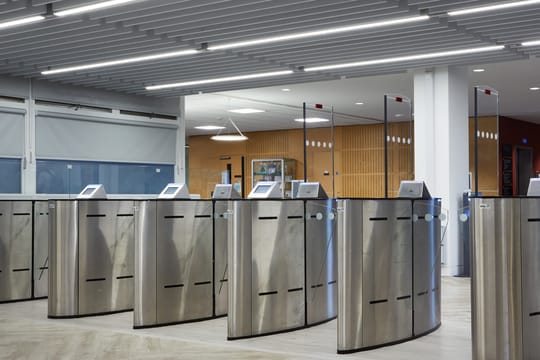
NEWS ARTICLE |
No one-size-fits-all: Why custom lighting matters in education design
Lighting in higher education does more than illuminate – it shapes how students learn, concentrate, and interact. Lecture halls, libraries, and common areas all have distinct functional and architectural requirements, and standard lighting solutions often fail to meet them. Custom lighting is helping universities to meet the evolving needs of their students and campuses, creating a vibrant and inspiring learning environment. In this interview, Michael Mulhall, Head of Client Solutions at Fagerhult UK, emphasises that lighting in education cannot be one-size-fits-all; each project requires a tailored approach to achieve optimal performance, usability, and sustainability. Lighting to enhance campus identity Universities compete for students, and campus identity can influence first impressions. Custom lighting in atriums, entrance halls, and circulation spaces can create distinctive architectural statements. “Anything that helps a university to stand out is crucial,” says Michael.“ Customisable lighting often in atriums or big entrance spaces, becomes a feature piece, giving the building personality and shaping the student experience from the moment they enter.” Bespoke lighting allows designers to infuse individuality into each project, transforming everyday circulation spaces into architectural statements that reflect a university’s character and ambition. Adapting lighting to building architecture Many universities operate in heritage or listed buildings, where architectural constraints create unique challenges. Michael explains: “Heritage buildings bring specific challenges. You can’t just fix large luminaires into old ceilings or insert new steel for support. You have to consider the weight, the fixing points, the acoustics, and how to maintain the look and feel of the space. Bespoke design gives flexibility, so the product fits the building rather than forcing the building to adapt.” Lighting for wellbeing and performance Beyond aesthetics, custom lighting plays a vital role in student wellbeing, comfort, and concentration. The right kind of light at the right time can affect alertness, mood, and circadian rhythms. Michael highlights an example of this at a UK university library project, which implemented task lighting: “We created customised desk lamps that gave students the ability to adjust light levels to suit their own tasks. That sense of control helps improve comfort and productivity. And of course, the quality of light – the colour temperature, uniformity, and intensity – has a direct effect on wellbeing.” Fagerhult’s human-centric lighting considers how light influences the human biological needs, such as circadian rhythms and cognitive performance. The goal is not just to illuminate a space, but to create environments that enhance comfort, alertness, and mental well-being. Smart lighting at Warwick University Technology is now redefining how lighting is used in educational spaces. At the University of Warwick, Fagerhult’s smart lighting systems are transforming how students and staff interact with their environment. The university’s library, initially designed for far fewer students than it now serves, faced challenges with congestion and underused areas. Fagerhult’s solution incorporated Organic Response technology into each luminaire, allowing lights to respond to occupancy and daylight while simultaneously collecting data on space usage. “Because we’ve got smart sensor nodes integrated in each of the luminaires, we were able to collect live data to create a visual heatmap across the library floor plan that shows the students which areas are being used most, and helps find available study spaces in real time.” The Warwick project demonstrates how bespoke lighting systems can deliver both operational and student benefits – optimising energy use, improving the experience, and providing insights that inform future campus planning. Embedding sustainability in every design Sustainability is another key driver shaping custom lighting solutions. From reducing embodied carbon to improving operational efficiency, universities are pushing for lighting that performs responsibly throughout its lifecycle. Michael notes: “We’re using more sustainable materials – recycled aluminium, wood, even cardboard – and pairing them with highly efficient optics and LEDs. Good lighting design means putting the right light in the right place so that you can use fewer luminaires and less energy.” He adds that around 80% of a luminaire’s lifetime carbon impact occurs during its use phase. By combining efficient design with smart controls, Fagerhult helps clients significantly reduce their overall energy footprint and support their decarbonisation goals. Balancing bespoke and customisable solutions Full custom lighting isn’t always necessary. For many education settings, the sweet spot lies between standard and bespoke – configurable products that can be tailored to fit the space. “There are benefits because universities, for example, want a specific aesthetic, but not every project requires a one-off product,” says Michael. “Our standard-customisable ranges offer flexibility without the extended lead times and costs.” This modular approach also supports sustainability by simplifying maintenance, allowing for future upgrades without complete replacement. Lighting for people, performance and place Fagerhult’s approach to custom lighting is about aligning design intent, human experience, and sustainability. Whether creating a striking entrance feature or an intelligent study environment, every project is about enhancing how people use and feel in the space. Michael concludes: “Design will always drive what lighting products are used in any space, but our role is to make sure it’s delivered in the most sustainable, efficient, and human-centric way possible.” For more information on how Fagerhult’s custom and configurable solutions can help you create inspiring, sustainable environments that support learning, wellbeing, and identity, get in touch.
NEWS ARTICLE |
Designing for Diversity: Inclusive Lighting in Education for Neurodivergent Learners
Creating learning environments where every student can thrive is at the heart of inclusive education. With an estimated one in seven people in the UK likely to be neurodivergent, the way classrooms, study halls and entrances are illuminated has never been more important. Lighting can strongly influence focus, comfort and sensory load, particularly for neurodivergent learners. This article draws on insights from a conversation with Flick Ansell, Associate Director, Lighting at AECOM following their presentation at IALD’s Enlighten Europe Conference in Valencia, Spain in June 2025, plus research led by Dr Jemima Unwin Teji from the Institute of Environmental Design and Engineering, Bartlett School of Built Environment, Energy and Resources, University College London, UK as well as key recommendations from the Society of Light and Lighting’s Lighting for Neurodiversity guidance (Factfile 19). Why Lighting for Neurodiversity Matters ‘Neurodiversity’ is an umbrella term for everyone. Neurodivergence is a description of a wide range of cognitive differences, including, but not limited to, attention deficit disorder (ADD), autism (ASD), OCD, dementia, dyslexia and dyspraxia. Each experiences sensory input differently; lighting that feels neutral to one student may be overwhelming to another. Flick Ansell notes: “If you’ve met one neurodivergent person, you’ve met one neurodivergent person. That person's reporting of their experience of the world will be unique to them.” They explain that two students sitting in the same space can interpret the environment completely differently – a reminder that lighting design must adapt to local preferences rather than rely on assumptions. This approach empowers designers and architects to craft flexible solutions that truly meet diverse needs. The SLL’s Lighting for Neurodiversity guidance recommends designing environments assuming neurodivergent individuals will be present and reducing potential discomfort wherever possible. What Research Is Telling Us Research supported by AECOM and students at University College London (UCL) is beginning to reveal consistent patterns in how neurodivergent people experience light. In one office lighting study, neurodivergent participants consistently preferred lower illuminance levels (200 lux rather than 500 lux) than neurotypical peers[1], one of the clearest findings to emerge so far. A PhD[2] student’s research at UCL is also exploring differences between neurotypical and neuro diverse subjects when Modulating Emotional Perception Through Different Colours, with Fagerhult providing space for experiments. This PhD study uses coloured light in space (whether direct or indirect) and coloured filters over facial-expression images on a screen or paper to investigate whether certain hues help neurodivergent individuals feel more comfortable and / or interpret emotions more ‘accurately’. Pilot studies provide preliminary evidence that personalised colour context can selectively modulate perceived emotional intensity, supporting the relevance of user-adjustable chromatic ambience as a potential direction for more inclusive lighting and built-environment design. These early research results reflect what practitioners report in real school settings. Flick notes that lived experience is as valuable as formal research; when students repeatedly report discomfort or avoid entering a room until lighting is dimmed, those responses offer meaningful evidence about how spaces truly perform, validating the importance of listening to user feedback. This aligns with an MSc[3] study completed this year within a North London SEND (special educational needs and disability) School, a collaboration that allowed for a number of qualitative and quantitative methods of study. Within the classrooms, a very simple dimming system is accessible. Teachers frequently dim the lighting below the standard 500 lx because students reported discomfort, and in some cases, learners refused to enter the classroom until the lighting was reduced. As part of the MSc study, a trial shifting classrooms from 4000 K to 2700 K and asking students to complete standard spelling tests under the different conditions reported no immediate clear findings. However, anecdotal information suggested some positive reactions, supporting growing evidence that warmer light may reduce sensory load. These results were from a tiny cohort of students, and UCL is currently exploring whether there is merit in conducting a broader study. If the budget allows, having access to different colour temperatures within classroom settings would be a welcome level of flexibility. Lighting Challenges for Students Glare and uniformity Slight variations in uniformity or reflections from glossy surfaces can trigger sensory discomfort. Reflections from desks, whiteboards or unexpected daylight can be particularly challenging. Flick notes that even the sheen of a surface or the angle of daylight can make a space feel totally overwhelming for neurodiverse students. Flicker sensitivity Neurodivergent individuals may be disproportionately affected by flicker or temporal light artefacts, even when these effects are subtle or invisible to most observers. Colour temperature Standard 4000 K lighting can feel harsh for some learners. Warmer light (2700–3000 K) tends to be more calming, especially in breakout zones, therapeutic rooms and SEND settings. “People often perceive colder colour temperatures as brighter. Making it warmer can make the space far more comfortable, teaching staff included,” Flick explains. New Guidance: Lighting for Neurodiversity The SLL’s Lighting for Neurodiversity guidance (Factfile 19, 2025) offers the most comprehensive framework to date for creating educational environments that minimise sensory stress. Its recommendations include: Appropriate illuminance and uniformity – meeting BS EN 12464-1 as a minimum, while avoiding sharp contrasts and enabling local dimming for individual comfort. Low-glare, indirect lighting – reducing discomfort from direct sources, veiling reflections and screen glare, supported by careful luminaire positioning. Flicker and stroboscopic management – specifying drivers that meet stringent PstLM (≤1) and SVM (≤0.4) thresholds to limit sensory strain. Colour temperature considerations – using warmer 2700–3000 K light in calm or breakout areas, and offering tunable options where tasks vary. The guidance emphasises that inclusive electric lighting cannot be delivered in isolation. It must be considered alongside interior design, surface finishes, furniture and daylighting. Flick highlights that practical success comes from understanding what learners genuinely experience: “You can have tools and technical solutions, but the right approach always begins with asking end users what they need.” The Role of Smart Lighting and Controls Technological advancements in smart lighting make inclusive design more achievable: Automated dimming and CCT tuning: Allows seamless adjustment of brightness and colour temperature for different tasks and times of day. Changes should be in tiny increments so they are not noticeable, and manual overrides should be provided to accommodate end-user requirements. Intuitive control interfaces: Wall panels with straightforward presets, or simple apps, ensure teachers can make quick adjustments without complexity. Glare reduction: Indirect lighting, shields and diffusers distribute light evenly. Flick stresses that flexibility only works when controls are simple. In many classrooms, the teacher or teaching assistant effectively becomes the lighting operator, so systems must be fast-acting and intuitive. In smaller SEND settings, students may also contribute to decisions about lighting settings. “When it comes to controlling the light, flexibility is everything – but only if people can actually use it easily.” Designing Spaces Where Learners Can Thrive Inclusive lighting requires an understanding of the diverse sensory experiences within a classroom. By integrating research insights, responsive technologies, and adaptable design strategies, schools can create environments that reduce sensory stress, support concentration, and enhance well-being. The guidance stresses that lighting and interiors must be developed together, as students do not experience surfaces, colours, daylight and electric lighting separately. Flick notes that the most successful projects involve user engagement and early collaboration across disciplines, with designers sharing decisions on finishes, daylighting and spatial layout to create coherent, comfortable spaces. Ultimately, designing with empathy – listening to students, empowering teachers and applying evidence-based guidance – ensures that every educational setting becomes a place where all learners can thrive. If you’re working on a project and want to discuss how lighting could make it more inclusive, please get in touch. Co-Authors Flick Ansell – Associate Director, Lighting. AECOM Dr Jemima Unwin Teji (UCL) Lecturer in Light and Lighting Research input from Beatrice Chui Ling Yuen – MSc in Light & Lighting 2022 - Assessing illuminance preferences in Neurodivergent Individuals Ruoxi Yin PhD 2026 - Modulating Emotional Perception Through Colour in Neurodivergent Individuals Tommy Smith MSc 2025 - Investigating the impact of lighting on user comfort and cognitive ability amongst neurodivergent individuals: A case study of a SEN school in London. [1] Beatrice Chui Ling Yuen – MSc Light & Lighting Dissertation 2022 - Assessing illuminance preferences in Neurodivergent Individuals. Supervised by Dr Jemima Unwin Teji. [2] Ruoxi Yin PhD Student 2026 - Modulating Emotional Perception Through Colour in Neurodivergent Individuals paper presented at IEEE Sustainable Smart Lighting World Conference 2025, Monastir, Tunisia, December 2025 [3] Tommy Smith MSc Student 2025 - Investigating the impact of lighting on user comfort and cognitive ability amongst neurodivergent individuals: A case study of a SEN school in London.
Return to top