At Fagerhult there is a deeply rooted innovation culture that undoubtedly influences all aspects of the work. Possibly it springs from the founder Bertil Svensson’s mindset of solving problems with sometimes small means, but with a lot of curiosity and stubbornness. Even though sustainability was not a buzzword during Bertil’s days, durability and quality have always been cornerstones for the company. And the ongoing climate awareness has urged us all to challenge previous ways of thinking, and made us conscious of new fields possible for more long-lasting solutions.
For many years, BESPOKE LIGHTING SOLUTION (BLS), Fagerhult’s bespoke development department has developed unique luminaires and adapted solutions. They produce newly built luminaires, and refurbished and updated old fixtures - but has not previously had an outspoken sustainable agenda as motif from their clients. But the will and interest to refurbish and rebuild old luminaires is a sustainable trend that is increasing. A process in which yesterday’s design and technology are brought up to speed by todays advances, in order to meet the requirements of tomorrow.
 "It is more frequent now, than previously, that our clients has an outspoken will to save materials and energy in their projects." Johan Ericsson, project manager
Rebuild, refurbish or repair?
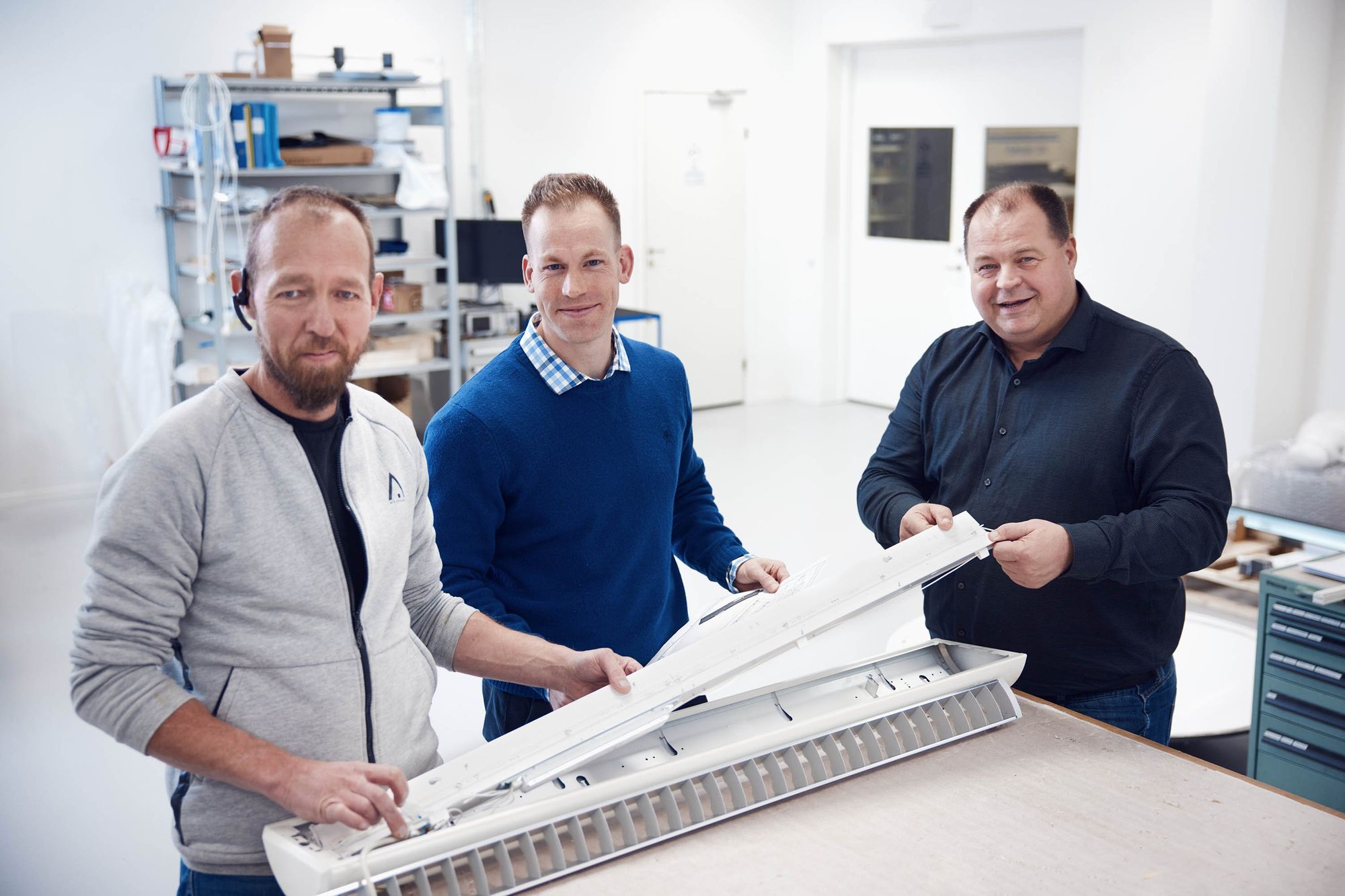
Johan Ericsson and Peter Eklund are both project managers at BLS, where unusual questions and close to impossible solutions are a part of their everyday work. Together with their colleagues, they manage inquiries from all Fagerhult’s markets, regarding special developed lighting solutions for different projects. But what kind of projects choose to refurbish, instead of investing in a new luminaire – and why?
– There are many different reasons as to why a luminaire might need to be rebuilt or refurbished instead of just replaced, Johan Ericsson explains further. There are circumstances when the luminaire is a part of the aesthetics or the design of the premises and cannot be replaced or altered. In other cases the luminaire is a part of the construction, or is built in a way where it cannot be removed, just updated. In yet other cases, and that is more frequent now than previously, there is an outspoken will to save materials and energy – and make an environmental effort by updating the luminaires instead of buying newly produced ones.
– No matter what the background is, the main focus for us is – as always – to help the client to solve the problem at hand, says Peter Eklund. In order to do so we have different solutions for different situations. But all our solutions are carefully evaluated before suggested to the client, whether it is to refurbish, rebuild or develop a new luminaire. For us, the quality of the product and its outcome, is the most important part of the process. Apart from making our client satisfied, of course.

Safty first
No matter the project, safety and quality are the red thread combining all Fagerhult’s products. And the special projects are sure to be no exceptions. But to be able to guarantee a secure and comfortable lighting solution it needs to be tested. For refurbishment projects that could seem like a tricky part, but there are solutions even for this. Peter Eklund explains:
– A crucial issue is the CE-marking and testing in cases like these. The request from our Technical Centre is that we deliver a unit that is as close to a complete luminaire as possible. If we send loose parts that are assembled on site, we cannot guarantee the quality of the end product. But if the LED package is assembled and tested in our centre, as a unit, we can ensure that it works and keep up to standards even when it is inserted in the old luminaire body.
– In these cases, we have made calculations to ease the assembling part as much as we can, Johan Ericsson develops further. We produce the new light packages so that they fit into the old screw holes, to facilitate installation as much as possible.
 "No matter what the background is, the main focus for us is – as always – to help the client to solve the problem at hand." Peter Eklund, project manager
Old and used or old and gold?
In a very environmental aware era, it is easy to get caught up in the will of doing something good, when the outcome might in fact be the very opposite. Not all old luminaires are meant to live forever, some of them are outdated and is better to be recycled instead of refurbished. Johan Ericsson explains:
– We have already pinpointed a few luminaires in our range where we know that it is more efficient to actually buy a new luminaire, than refurbish an old. This because in the process of updating it, we need to add as much new material as in a new luminaire. Then we also have the aspect of lighting comfort. Some of the old design and materials are just not as good as today’s modern techniques. And I don’t think you should forget the aesthetic aspect, since people do have these fixtures in their working environment in some cases. Even if a luminaire can be ledified, it may not be certain that it is nice and cheeky to have in your office today.
– No matter the reasons, we always calculate and balance the effort and gain by rebuilding, refurbish or updating an existing luminaire compared to buying, or developing, a new one, says Peter Eklund. Our primary goal is always that the client is equipped with the best lighting solution for the project, and we want it to be safe and secure – whether it might be a refurbished luminaire or a new one. We would never do a refurbish project if it is not the best solution for the client and the environment. Some products are suitable and others not, and we have the competence to make that decision.
Related News

Cuando el material importa: Wrapped aporta una nueva visión de la iluminación sostenible
En un mundo donde cada gramo de material y cada gramo de dióxido de carbono cuenta, Wrapped emerge no solo como una luminaria - sino como una declaración de intenciones. Es la iluminaria suspendida más sostenible de Fagerhult hasta la fecha, y no es por casualidad. Cada detalle, cada decisión, cada material fue elegido a propósito. La sostenibilidad suele empezar con una simple pregunta: ¿De qué está hecho? Para Wrapped, la respuesta es un trío de materiales, cada uno con su propia historia medioambiental. Cartón compacto: un amigo conocido En Fagerhult, conocimos el cartón compacto en 2021 con Multilume Re:Think. Pero para Wrapped, hemos ido más allá. El material consta de tres capas: un núcleo 100 % reciclado, una capa superior renovable con certificación FSC y una fina película protectora de plástico. En total, un material reciclado en un 65 % y una reducción del 89 % de las emisiones de CO₂ en comparación con el aluminio extruido virgen. Galería de imágenes: Cartón compacto Wrapped está fabricada con cartón compacto orgánico, aluminio reciclado y plástico reciclado postconsumo. Reimaginar el plástico El plástico suele ser un tema candente en las conversaciones sobre sostenibilidad. Pero no todos los plásticos son iguales. Wrapped utiliza plástico reciclado postconsumo: del tipo que ha vivido una vida antes, quizá como bote de champú o envase de comida. En cambio, el plástico preconsumo es diferente, ya que nunca ha llegado a los lineales. Cita: Josefin Carlsson Aluminio con pasado En el interior de Wrapped, dos componentes estructurales están fabricados con aluminio 100 % reciclado postconsumo. Este material también forma parte de una infraestructura circular, e incluso puede haber formado parte alguna vez de una luminaria Notor. En comparación con el aluminio virgen, esta elección reduce las emisiones en un 83 %. Diseñar con menos: construido para durar Sin embargo, la sostenibilidad no consiste solo en lo que se usa, sino en cuánto. Con solo 900 mm, Wrapped es más corto que una luminaria suspendida convencional de 1200 mm. Esa reducción de tamaño por sí sola reduce el impacto climático en un 25 %, sin renunciar al rendimiento lumínico de la luminaria. Josefin Carlsson compara el impacto climático de los productos en el Centro de Experiencias de Fagerhult en Habo. Para entender la repercusión de Wrapped, es útil mirar dónde empezamos. En 2021, Notor 65 —fabricada con aluminio virgen— tuvo un impacto climático de 34 kg de CO₂e. En 2024, con un 75 % de aluminio reciclado, esa cifra se redujo a 25 kg de CO₂e. En la actualidad, Wrapped pesa unos 12 kg de CO₂e. «Eso es un tercio de la Notor 65 original y la mitad de la versión actual, y una revolución silenciosa, medida en kilogramos de CO₂e», afirma Josefin Carlsson. Tras su larga vida útil, estimada en 100 000 horas, Wrapped está lista para un adiós igualmente sostenible. Su diseño hace que sea fácil de desmontar, con cada material reciclable y preparado para su siguiente capítulo en la economía circular.
Cerramos el ciclo: y ampliamos el ciclo de vida de las luminarias
El concepto de reconstrucción de luminarias usadas para ahorrar material y energía está en auge. A veces, lo único que necesita una luminaria obsoleta para brillar de nuevo es un poco de cariño y capacidades de ingeniería. Quedamos con Emma Hallman, Mathilda Holl y Andreas Ekslätt, el equipo de ReLight de Fagerhult, para hablar sobre los desafíos de encontrar soluciones que llevarán las luminarias usadas al futuro. En Fagerhult, una cultura de la innovación profundamente arraigada influye en todos los aspectos del trabajo. Posiblemente, surge de la mentalidad del fundador Bertil Svensson de resolver problemas con medios a veces pequeños, y curiosidad y dedicación. A diferencia de lo que pasa hoy en día, la sostenibilidad puede no haber sido una palabra de moda por aquel entonces. Sin embargo, utilizar nuestros recursos de forma consciente y esforzarse por lograr una alta calidad siempre han sido los pilares de Fagerhult. Hoy en día, un nuevo enfoque sobre la circularidad nos ha instado a cuestionar nuestra forma de pensar y nos hace conscientes de la necesidad de encontrar soluciones duraderas El departamento de soluciones de iluminación a medida (BLS, por sus siglas en inglés) de Fagerhult ha desarrollado luminarias únicas y soluciones adaptadas durante muchos años. Por lo tanto, rehabilitar y actualizar las luminarias usadas es algo que nos resulta familiar. Sin embargo, la ambición de reutilizar y reconstruir luminarias usadas para reducir el impacto climático ha aumentado con el tiempo. En este proceso, el diseño y la tecnología de ayer se ponen al día con los avances de hoy para satisfacer los requisitos del mañana. Cita Haga que sus luminarias usadas se vuelvan a encender Para el equipo de ReLight de Fagerhult, no hay preguntas peculiares ni soluciones imposibles. A diario, gestionan consultas sobre soluciones de iluminación especialmente desarrolladas para proyectos de los mercados de Fagerhult. Es un proceso complejo, pero, con el tiempo, han aprendido que algunos proyectos son ideales para reutilizar luminarias usadas en lugar de invertir en otras nuevas. «Para nosotros, las cualidades de la luminaria en cuanto a comodidad, seguridad y estética de la iluminación son el núcleo de cada proyecto ReLight. También calculamos minuciosamente cuánto podemos reducir el impacto climático total de la luminaria a lo largo de su ciclo de vida, en caso de que se pueda reducir. Si se cumplen todos estos requisitos, comenzaremos a desarrollar y diseñar un nuevo kit», afirma Emma Hallman. En ReLight, existe una voluntad abierta de ahorrar materiales y energía, y hacer un esfuerzo medioambiental actualizando las luminarias. Sin embargo, no todas las luminarias usadas pueden vivir para siempre; algunas están obsoletas y es mejor reciclarlas que reacondicionarlas. Img «Si las circunstancias no cumplen con nuestros requisitos y no funciona para reacondicionar la luminaria, no dejaremos que el proyecto avance más. Nunca pondríamos en peligro la comodidad, calidad, seguridad o la expresión de la luminaria si no resulta en una solución final de primera clase», dice Emma Hallman. En Fagerhult, la seguridad y la calidad son los hilos conductores que unen todos los productos. Y ReLight no es una excepción. A lo largo del proceso, el marcado CE y los ensayos son factores cruciales. «Para garantizar la calidad general, no se deben montar piezas sueltas in situ. Queremos que el montaje sea lo más eficaz y rápido posible, y el nuevo kit encajará perfectamente con los orificios de tornillos antiguos. La unidad está lo más cerca posible de ser una luminaria completa», comenta Andreas Ekslätt.